Fall of Saddam Hussein’s Statue

Buy on amazon

Saddam Statue 2003


Behind the camera: Various Internal Media Organizations
Where: Baghdad’s Firdus Square, directly in front of the Palestine Hotel where the world’s journalists had been quartered.
Photo Summary: Crowd of people celebrating the destruction of Saddam’s Statue
Picture Taken: April 9, 2003

The 2003 invasion of Iraq, code-named “Operation Iraqi Freedom” by the United States, officially began on March 20, 2003. The stated objective of the invasion was “to disarm Iraq of weapons of mass destruction, to end Saddam Hussein’s support for terrorism, and to free the Iraqi people”. As American forces streamed across the border most of the world thought that Saddam’s regime would quickly collapse but as the weeks past America’s invasion looked to be stalled. The Iraqi Information Minister, Muhammed Saeed al-Sahaf (M.S.S.) ran a successful propaganda program claiming that American forces were being defeated and pushed back. Even as the American forces entered Baghdad M.S.S. asserted that the Iraqis were winning, “The infidels are committing suicide by the hundreds on the gates of Baghdad … As our leader Saddam Hussein said, ‘God is grilling their stomachs in hell.'” Even though his reports were denied by American forces there was a feeling especially in the Arab world that Iraq was putting up more fight than what was expected and maybe even winning. These views were dashed when the now-famous footage of American forces entering Baghdad’s Firdus Square and then began pulling down a huge statue of Saddam without any kind of Iraqi resistance.

Staged?


The event was initially broadcast as a spontaneous show of Iraqi joy at the overthrow of the Saddam regime. It was at first reported that Iraqi civilians were trying to pull down the statue and only later were they helped by the American military. It was later revealed that rather than an Iraqi inspired event it was a stage-managed American plan from a psychological operations team. The location of the statue in Baghdad’s Firdus Square, directly in front of the Palestine Hotel where the world’s journalists had been quartered made the statue the perfect target. The army wouldn’t have to ship journalists anywhere as they were already on location. An internal military study determined that it was a fast-thinking Marine colonel who planned the operation. The square was closed off and his team used loudspeakers to get Iraqi civilians to come out a help.
The footage from that day seemed to show huge crowds and many media reports compared it to the fall of the Berlin wall. The footage was shot mostly via close up camera’s near the statue that filmed what seemed to be a large crowd of people in civilian clothing but looking at wide shots of the scene you can see that the large square was largely deserted except for a small crowd around the statue. Analysts would lament that “What you saw on television looked like there were throngs of thousands and in reality, it was just a few dozen people.” It was also unclear where the crowd came from with reports that they were bused in from anti-Saddam slums in Sadr City or anti-Saddam Iraqi National Congress military forces flown in from outside Iraq. Al Jazeera reporters in the movie Control Room seemed to back the theory of the crowd coming from outside Iraq as they remarked that people from the crowd didn’t seem to speak Arabic with Iraqi accents.

Statue

The 12-metre tall Statue was one of Iraq’s newest Sculptures erected in honor of Saddam Hussein’s 65th birthday in April of 2002. In May of 2003, a group of Iraqi artists raised a new statue where Saddam used to stand. The Iraqi artists describe, “the new sculpture is seven metres (23 feet) high and shows a symbolic Iraqi family holding aloft a crescent moon and a sun.”

The Main Players


  • Marine Corporal Edward Chin of the 3rd Battalion 4th Marines regiment, a 23 year old ethnic Chinese who moved to New York when he was one, was the soldier who scaled the statue to put the chain around the neck of the giant Saddam. He also attached the American flag, and then climbed back up to replace it with an Iraqi one. “At the moment, I was just doing what I was told to do by my commanding officer,” Corporal Chin said. “I had to get the job done just like we’ve been doing out here in Iraq.”
  • Kadhem Sharif was the huge sledgehammer wielding strongman who was filmed trying to smash the base of the statue. He had a hot and cold relationship with the Saddam Family as a world-class wrestler and weightlifter he frequently felt the wrath of Saddam’s son, Uday, and was even put in jail after the team did poorly. He designed a huge expensive weightlifting gym for Uday and saw first hand how Uday would abuse steroids. He is convinced Uday’s excessive use of steroids drove him insane. A mechanic, he had a falling out with Uday after a disagreement when he refused to fix Uday’s collection of motorbikes. He was promptly arrested and spent several years in jail on trumped-up charges. Famous around Baghdad for his collection of bikes in 2004 he was arrested for trying to sell looted motorcycles. In 2008 for an interview with Al Jazeera he stated that due to the harsh and violent years of American occupation it was a joyful day that he doesn’t want to remember now. After the huge suicide bomb that killed hundreds of people in the summer of 2016, he did an interview with BBC’s Jeremy Bowen. He told Bowen that he looked back with regret at Saddam’s overthrow:

    Saddam has gone, and we have one thousand Saddams now, … It wasn’t like this under Saddam. There was a system. There were ways. We didn’t like him, but he was better than those people. Saddam never executed people without a reason. He was as solid as a wall. There was no corruption or looting, it was safe. You could be safe.”

    When asked what would he do if he meets Tony Blair, he responded, “I would say to him you are a criminal, and I’d spit in his face.”

  • Ali Fares and Khaled Hamid were some of the men who put the initial rope around the statue’s neck.”We asked the Americans to bring us this rope with a noose. I climbed the ladder myself. To begin with, I was scared, but when I climbed the ladder, the Iraqis started clapping, even the American soldiers. I heard them saying nice things about me. I couldn’t reach Saddam’s head, but by that time there was no fear. I was sure we’d got rid of him.”
  • Marine Lieutenant Tim McLaughlin was the soldier who provided the first American flag. The flag was had been in the Pentagon on 11 September 2001 and was given to Kuhlman by a friend. He kept it carefully wrapped in a box on the bottom of his tank and tried to raise it two times before. The first time he was forced to retreat after taking shots from a sniper and the second time the flag pole broke. As they stood around the statue his company commander, Captain Bryan Lewis asked for the flag to put on the statue. McLaughlin still has the flag that he keeps wrapped up on his bookshelf.
  • Marine Lieutenant Casey Kuhlman claims that he provided the second pre-1991 Iraqi flag. When the first flag went up the crowd started to turn ugly. He remembers that people started shouting and woman correspondent for a Middle Eastern television company started begging for them to take it down. Seeing the need for action he quickly brought out the Iraqi flag and passed it through the crowd. Where strongman Kadhem Sharif claims to have taken it to the marines on the crane.
  • More famous images

    Related Posts:

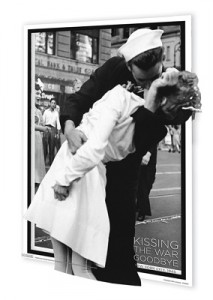
    VJday Times Square Kiss

    Buy on amazon

    Behind the camera: Alfred Eisenstaedt although Lt Victor Jorgensen took a similar image
    Where: Times Square, New York City, USA
    Photo Summary: Many claims to be the Nurse and Sailor shown in the picture. Former nurses Edith Cullen Shain and Greta Friedman are the most likely Nurses and George Mendonça and Carl Muscarello are the most likely Sailors.
    Picture Taken: August 14, 1945. Victory in Japan day is actually Aug 15, 1945, but news broke out at Times Square on August 14 because of the International date-line and time zone changes.

    America had been at war for almost 4 years, Germany had finally been knocked out of the conflict three months earlier but Japan still fought on. Finally, after nightly bombing raids and two cities wiped out by Atomic explosions, Imperial Japan surrendered. News travelled like wild fire and on August 14, 1945, America celebrated! One of the most famous pictures of World War II, Alfred Eisenstaedt captured this image in the revelry at New York’s Time Square.

    Taking the picture

    Actual photo taken by Alfred Eisenstaedt

    When news broke out of Japan’s surrender Alfred Eisenstaedt ran to Times Square taking pictures as he went. Suddenly he saw a sailor who was “‘running along the street grabbing any and every girl in sight. Whether she was a grandmother, stout, thin, old, didn’t make any difference. None of the pictures that were possible pleased me. Then, suddenly in a flash, I saw something white being grabbed. I turned around and clicked the moment the sailor kissed the nurse … Although I am 92, my brain is 30 years old.’ To prove it he recalled that to shoot that victory kiss he used 1/125 second exposure, aperture between 5.6 and 8 on Kodak Super Double X film.” Eisenstaedt snapped four shots of the kissing couple before moving on to get other pictures. A navy photographer, Lt Victor Jorgensen, was standing very close to Eisenstaedt and took a similar image. As Jorgensen was a federal employee his images are in the public domain while Eisenstaedt’s are copyrighted.

    Who is in the Picture?

    Original letter to Eisenstaedt

    On that crazy August day, Alfred Eisenstaedt got so caught up in the excitement that was going on in Times Square that he didn’t write down who the sailor and nurse were. Since that day many have stepped forward claiming to be the two in the picture.

    Edith Cullen Shain

    Edith Cullen Shain was a Nurse that was taking part in the celebration when she was kissed by a sailor. She said she wasn’t surprised as “at that time in my life everyone was kissing me.” Even though she knew it was herself in the image she didn’t step forward until the late 70s when she saw an article in the LA Times with Eisenstaedt. He was talking about the photo and after reading it she decided to come forward. In the 40s Edith ” didn’t think it was dignified [to be photographed kissing] but times have changed” so she wrote this letter to Eisenstaedt:

    Dear Mr, Eisenstaedt:
    Now that I’m 60 – it’s fun to admit that I’m the nurse in your famous shot “of the amorous sailor celebrating V.E. Day by kissing a nurse on New York’s Broadway.”
    The article in the Los Angles Times, which described your talents, stimiulated the recall of the scene on Broadway. I had left Doctors’ Hospitial and wanted to be part of the celebration but the amorous sailor and a subsequent soldier motivated [me] into the next opening of the subway.
    I wish I could have stored that jubulation and amour for use P.R.N. [“P.R.N.” is a medical term meaning “as needed”]
    Mr Eisenstaedt, is it possible for me to obtain a print of that picture? I would be most apprecitive. I regret not having meet you on your last trip to Beverly Hills.
    Perhaps next time. If not – will understand because “it’s not only hard to catch him … its hard to keep up with him”
    Have fun, Fondly,
    Edith Shain

    New York City celebrating the surrender of Japan. They threw anything and kissed anybody in Times Square.

    Lt. Victor Jorgensen’s version of the photo

    Of all the nurses claiming to be “the one” Eisenstaedt has backed Shain describing her as a “vivacious, lovely woman.”. Shain died at her home on June 20, 2010. She was 91 years old.

    Greta Friedman

    Greta Friedman claims the photo is of her but concedes that Shain was probably there, “There’s no doubt that Mrs. Shain was there and got kissed … because every female was grabbed and kissed by men in uniform.” But, says Greta of Frederick, Md., “it definitely is my shape. I used a comb in my hair. I had a purse like the one in the nurse’s hand. I remember being kissed by a sailor, right on Broadway.” Of the women, only Greta is high enough to be the Nurse to Mendonsa’s sailor. She died in 2016 at the age of 92.

    Barbara Sokol

    In the kissing frenzy in Times Square, Barbara Sokol recalls, she got “an ucky, sloppy kiss” and was wiping her mouth with a handkerchief when up walked another guy who yelled, “‘Gotcha’ I said, ‘No! No! No!’ and when he bent me back I thought, ‘My God, I’m gonna fall'” Barbara a nurse in Derby, Conn. She has always claimed that the Nurse was her and has kept a cut out of the picture framed, “my one claim to fame.”

    George Mendonsa

    Rita Mendonsa future wife of George Mendonsa behind the kissing couple

    George Mendonsa or George Mendonça, a native of Newport, Rhode Island, was named by the Naval War College in August 2005 as the Sailor in the picture due to some compelling evidence including picture analysis by the Mitsubishi Electric Research Lab (MERL) in Cambridge, MA, matching scars and tattoo spotted by photo experts and the testimony of one Richard M Benson a photo analysis expert and professor of photographic studies plus the former Dean of the School of Arts at Yale University. Mr. Benson has stated that “It is therefore my opinion, based upon a reasonable degree of certainty, that George Mendonsa is the sailor in Mr. Eisenstaedt’s famous photograph.” George, on leave from the USS THE SULLIVANS (DD-537), was watching a movie with his date, future wife Rita Mendonsa, at Radio City Music Hall when the doors opened and people started screaming the war was over. George and Rita took part in the partying on the street but when they couldn’t get into the packed bars decided to walk down the street. It then that George saw a nurse walk by and took her into his arms and kissed her, “I had quite a few drinks that day and I considered her one of the troops–she was a nurse.” In one of the four pictures that Eisenstaedt took you can actually see Rita in the background.

    Mr. Mendonsa’s daughter, Sharon Molleur, reported that her father suffered a seizure and died on Sunday, February 17, 2019, after a fall at a care home in Middletown, Rhode Island. He was 95 years old.

    Mygrapefruit aka Sanna Dullaway VJ Kiss

    Colourized by Mygrapefruit aka Sanna Dullaway

    Other Sailors

    Bill Swicegood, Clarence “Bud” Harding, Wallace C. Fowler and others have claimed to be the sailor but none have the evidence that supports Mendonsa’s claim. Even with all the evidence supporting Mendonsa as the sailor ex-NYPD officer, Carl Muscarello still insists that he is the kisser, “I am 100 percent sure. There is no doubt in my mind.” While Muscarello doesn’t have scientific proof behind the claim he does have the backing of the Edith Shain who the photographer, Alfred Eisenstaedt, backed before he passed away. Another supporter of Muscarello was his mother, “When the magazine came out, my mother called me and said I was in LIFE magazine. You couldn’t see my face, but she knew the birthmark on the back of my right hand. She said, ‘Don’t you know you shouldn’t be kissing strange women? You’ll get a disease.’ I said, ‘Mom, the lady’s a nurse.’ She said, ‘They’re the worst kind, always around sick people.’ “. Muscarello who lives down in Florida was recently in the news when he and his son tackled a golf club-wielding home invader who surprised the family while eating breakfast.

    As of 1995 LIFE magazine has never identified who was in the picture.

    Alfred Eisenstaedt

    Alfred Eisenstaedt (December 6, 1898, Dirschau, West Prussia (now Tczew, Poland) – August 24, 1995, Jackson Heights, Queens, New York) was a photographer and photojournalist, best remembered for his photograph capturing the celebration of V-J Day. Eisenstaedt immigrated to the United States in 1935, where he lived the rest of his life. Eisenstaedt worked as a photographer for Life magazine from 1936 to 1972. His photos of news events and celebrities, such as Sophia Loren and Ernest Hemingway, were featured on more than 90 Life covers.

    #MeToo

    The advent of the #MeToo movement caused society to reevaluate this iconic kiss. After the “Kisser” Mendonsa died a statue of the kiss was vandalized, with someone spraying #MeToo on the nurse’s leg. Several of nurses recall being kissed against their will that day but write it off as being caught up in the moment. BBC reported that “After Ms Zimmer’s death in 2016, her son told the New York Times his mother did not view the kiss negatively.”

    More Famous Images

    Related Posts:

    D-day soldier in the water

    Buy on amazon
    Some of the Capa 11 used by LIFE
    Behind the camera: Robert Capa
    Where: ‘Easy Red’ beach on the American Omaha beach of Normandy
    Photo Summary: Edward Regan or Huston “Hu” Riley lying in the surf while trying to make it to Normany’s ‘Easy Red’ beach
    Picture Taken: June 6, 1944 (D-Day)

    Es una cosa muy seria (This is a very serious business)
    -Robert Capa during D-day

    Robert Capa had made a name for himself as a war photographer that had covered the Spanish civil war and the Second Sino-Japanese War. To escape the Nazi’s he moved to New York where he became a photographer for the Allies. On D-Day June 6, 1944, the Allies started their much-anticipated invasion of mainland Europe. Hitting the beaches with American troops Capa, while dodging intense German fire, was able to take 106 pictures before returning to London to develop his photos. Unfortunately, an incident in the London photo development labs caused all but 11 of his 106 pictures to be destroyed. This shot of a soldier in the water is considered the best and shows the true nature of the Normandy invasion. Steven Spielberg was so inspired by this shot that for the Saving Private Ryan movie he tried to duplicate the conditions shown in the photo.

    Taking the photo

    Life magazine published the surviving 11 pictures with a caption that explained that the “immense excitement of [the] moment made photographer Capa move his camera and blur [his] picture.” Capa always resented the implication but it probably influenced the naming of his 1947 memoir, Slightly Out of Focus. In his memoir he remembers that day:

    The flat bottom of our barge hit the earth of France … The boatswain lowered the steel-covered barge front, and there, between the grotesque designs of steel obstacles sticking out of the water, was a thin line of land covered with smoke — our Europe, the ‘Easy Red’ beach.
    My beautiful France looked sordid and uninviting, and a German machine gun, spitting bullets around the barge, fully spoiled my return. The men from my barge waded in the water. Waist-deep, with rifles ready to shoot, with the invasion obstacles and the smoking beach in the background gangplank to take my first real picture of the invasion. The boatswain, who was in an understandable hurry to get the hell out of there, mistook my picture-taking attitude for explicable hesitation and helped me make up my mind with a well-aimed kick in the rear. The water was cold, and the beach still more than a hundred yards away. The bullets tore holes in the water around me, and I made for the nearest steel obstacle. A soldier got there at the same time, and for a few minutes, we shared its cover. He took the waterproofing off his rifle and began to shoot without much aiming at the smoke-hidden beach. The sound of his rifle gave him enough courage to move forward, and he left the obstacle to me. It was a foot larger now, and I felt safe enough to take pictures of the other guys hiding just like I was.
    I felt a new kind of fear shaking my body from toe to hair, and twisting my face. [seeing a landing craft] I did not think and I didn’t decide it, I just stood up and ran toward the boat. I knew that I was running away. I tried to turn but couldn’t face the beach and told myself, ‘I am just going to dry my hands on that boat.’

    Inside the landing craft, he returned to the ships further offshore and promptly fell asleep with the undeveloped 106 pictures that he had taken with his two Contax cameras. Upon arriving back in the UK he quickly sent his four rolls of film off to London and with his pictures off and his courage restored he tried to make it back to the beaches.
    [midgoogle]

    Lab disaster


    Capa The Magnificent Eleven

    Of all the photographers sent out with the Allied invasion, only Capa had taken any sort of photos that showed what looked like the invasion that was being broadcast over the radio. Other photographers were either foiled by weather from taking any decent shots or landed on beaches that faced little German opposition. When Capa’s images came in Life editors were desperate for any type of action shots and when the package finally arrived in London orders were to rush the development.
    The pressure got to the LIFE staff and John Morris remembers that a young boy, Dennis Banks, was given the task to develop the film. As LIFE staff started ringing asking where the images were Morris remembers that the young Dennis came running up the stairs and into his office, crying. “They’re ruined! Ruined! Capa’s films are all ruined!” Dennis then proceeded to choke out an explanation that he had hung the film to dry but in order to speed up the process he had closed the doors to the drying room. Without ventilation, the emulsion had melted most of the exposures. However, on further inspection, it was revealed that not all were ruined as on the end of the fourth roll 11 images were salvageable. It was these images that were the only record of fierce German resistance the Americans suffered during the Normandy invasion.

    Robert Capa


    Some of the Capa 11 used by LIFE
    Robert Capa was born on October 22, 1913. He was born with the name Endre Ernő Friedmann in Budapest, Hungary. When he was 18 he left Hungary for Germany but when the Nazis took power he emigrated again to Paris. It was from Paris that he went to Spain to cover the Spanish Civil War. After Franco defeated the Republic Capa returned to France until the Nazi invasion upon where he left for America. He went on to become a celebrated war photographer covering five different wars: the Spanish Civil War, the Second Sino-Japanese War, World War II across Europe (He was the only “enemy alien” photographer for the Allies), the 1948 Arab-Israeli War, and the First Indochina War. His two most famous pictures are the, Falling Soldier and this image of the 1944 D-Day Normandy invasion. In 1947, Capa co-founded Magnum Photos with, among others, the French photographer Henri Cartier-Bresson. Magnum Photos was the first cooperative agency for worldwide freelance photographers. In 1947 Capa travelled to the Soviet Union with his friend, John Steinbeck. When he was leaving the country Soviet officials wanted to look through his undeveloped images. Capa refused to give them access unless Yevgeny Khaldei developed them. Capa had befriended the photographer while the two covered the Potsdam Conference and the Nuremberg Trials together. Both men were hard-drinkers and recognized as playboy lady killers.
    On May 25, 1954, at 2:55 p.m. Capa was with a French regiment in Vietnam when he left his jeep to take some photos. While walking up the road he stepped on a land-mine and lost his leg. He was quickly rushed to a small field hospital but was pronounced dead on arrival due to massive trauma and loss of blood.

    Who is in the picture

    The man lying in the surf was identified as Edward Regan. Regan remembers that he, “was in the second wave and landed at H-hour plus forty minutes … there were so much chaos and mass confusion that one was reduced to a state of almost complete immobilization” Regan was in Company K of the 116th Infantry Regiment’s 3rd Battalion. However, the daughter of another soldier, Alphonse Joseph Arsenault, claims that the person in Capa’s photo is in fact her father that is lying in the surf and historian Lowell Getz claims that his research shows that the man is Huston Riley. Riley claims that Capa actually helped him out of the water, “I was surprised to see him there. I saw the press badge and I thought, ‘What the hell is he doing here?’ ” he said. “He helped me out of the water and then he took off down the beach for some more photos.”

    Copyright info


    Copyright to this photo is managed by Magnum D-Day soldier by Robert Capa

    More Famous photos

    Related Posts:

    Churchill and the Tommy Gun

    Buy on amazon
    Churchill decides to fight on
    Behind the camera:
    Where: Tour of the coastal defence positions near Hartlepool, UK
    Photo Summary: Winston Churchill with a Tommy Gun Imperial War Museum, photo no. H2646A
    Picture Taken: July 31, 1940

    With France and its other European Allies out of the war, the UK and its Empire stood by itself against a triumphant Hitler. A defiant Churchill instead of bowing down to Germany famously promised during his June 4, 1940 speech to the house of commons, “We shall fight on the beaches, we shall fight on the landing grounds, we shall fight in the fields and in the streets, we shall fight in the hills; we shall never surrender!” Trying to pass on his never-give-up attitude he sought to back up British morale with some public tours of the UK’s coastal defences. During one of these tours on July 31, 1940, he was photographed trying out an American 1928 Tommy Gun or Thompson SMG (Submachine Gun) at defence fortifications near Hartlepool in Northern England.

    Nazi Propaganda

    Nazi propaganda minister Goebbels saw the image as a god send and used it extensively domestically, with the other Axis countries, the few remaining neutral countries and even in air drops over the UK during the Battle of Britain with the text in English “WANTED,” and at the bottom, “for incitement to MURDER.” The reverse of the leaflet is all text:

    This gangster, who you see in his element in the picture, incites you by his example to participate in a form of warfare in which women, children and ordinary citizens shall take the leading parts. This absolutely criminal form of warfare which is forbidden by the Hague Convention will be punished according to military law. Save at least your own families from the horrors of war!

    Churchill propaganda Murder poster

    Nazi poster with Churchill in an alley holding the Thomson with the German text, "Sniper."


    Churchill propaganda Murder poster

    Nazi Leaflet

    Sir Winston Leonard Spencer-Churchill

    As noted in what has been called the most famous portrait in history the Canadian, Churchill Portrait, Churchill was born on 30 November 1874 into a famous English aristocratic family, the Spencer-Churchills. He spent much of his childhood at boarding schools where he had little if any contact with his parents. He went onto the Royal Military College in Sandhurst and graduated eighth out of a class of 150 in December 1894.

    Churchill and the Tommy Gun 1940

    Colourized by Jecinci


    As an officer in the British Army, he fought in a number of colonial wars where he showed courage on the front lines. In 1900 he started his political career and spent much of the rest of his life in British politics. In the run-up to the second world war, he fiercely opposed the British Prime Minister, Neville Chamberlain’s appeasement of Hitler. When Chamberlain was forced out of office Churchill, then the First Lord of the Admiralty was chosen as a successor on May 10, 1940. During the difficult war years, Churchill is credited with having to give the United Kingdom the strength to fight on against the Axis onslaught. This defiance is captured perfectly in the Tommy Gun picture.
    Although not the same gun as in the picture, in the World War II London Underground Headquarters, now a museum, there is a display of a similar Tommy Gun that Churchill planned to use if the Nazis came to London. If they had successfully invaded he is quoted as planning to:

    to light a good cigar, take a sip or two of his favorite brandy, and go out in the streets and take as many German troops with as he could, perhaps fighting alongside the Queen and the royal family when the end came.

    This determination made it possible for the UK to win the war but the country didn’t see him as a man of peace and after the war he lost the 1945 election but was returned to the Prime Minister’s office in 1951 before then retiring in ’55. When he died in 1965, his state funeral was attended by the one of the largest gatherings of world leaders in history.

    Other people in the picture


    Churchill's body guard to his left

    The men in the image have not been identified but the man wearing the grey pin-striped suit behind Churchill might be his bodyguard, Detective Inspector Walter Henry Thompson, as he is wearing the same suit in the picture to the right of Churchill firing a Sten gun in 1941.
    From between 1921 to 1945 Thompson was Churchill’s on and off again bodyguard. Churchill hadn’t needed Thompson for a long time until in 1939 when he was about to vacation in France. Churchill, even though he was not part of the government at that time, was worried about a possible Nazi assassination plot and called up Thompson for protection duty with a telegram from on August 22, 1939, simply reading “Meet me Croydon Airport 4.30pm Wednesday.” While there were no incidents that trip Thompson claims to have saved Churchill’s life countless times, often because the Prime Minister recklessly putting his life in danger.
    After the war, the bodyguard tried to publish a book about his experiences travelling the world protecting the Prime Minister’s life but was blocked by the police department. It wasn’t until 2005 that the full version was published as Churchill’s Bodyguard: The Authorised Biography of Walter H. Thompson

    More Famous Images

    Related Posts:

    We Can Do It!

    Buy on amazon
    Rosie The Riveter poster
    Behind the camera: J. Howard Miller
    Where: Miller’s Studio
    Photo Summary: A poster put out by the US government to encourage women to head out into the workforce
    Picture Taken: 1943
    This image is in the public domain because it was taken by a federal employee, J. Howard Miller

    While other girls attend their fav’rite cocktail bar
    Sippin’ dry martinis, munchin’ caviar
    There’s a girl who’s really puttin’ them to shame
    Rosie – is her name
    All the day long, whether rain or shine
    She’s a part of the Assembly Line
    She’s makin’ history, workin’ for Victory
    Rosie! The Riveter

    -Rosie The Riveter was written by Redd Evans and John Jacob Loeb

    After the bombing of Pearl Harbor by the Japanese, America entered the war. Companies who had been already producing some war material for the Allies switched to full wartime mobilization. As factories stepped up production, they faced an immediate problem, manpower shortages. Men working in the American labor force left by the millions to serve their country in the military. Companies who had just signed lucrative contracts with the government desperately needed workers and they turned to as yet untapped resource, American Women.

    Women in the Workforce

    Women in the workforce were not a new thing, especially for minorities and the poor. These working women though were mostly restricted to the traditional female professions. The attitudes of the time placed the ideal role of a woman as a homemaker raising the kids. Compounding this way of thinking was the high unemployment during the Depression. Most saw women in the workforce as taking jobs from unemployed men. The American government seeing that it would have to smash these mind-sets launched a media campaign to get women into the labor force.

    [bigquote quote=”Do the job he left behind” author=” American government slogan”]
    With slogans like, “Do the job he left behind” or “The more women at work, the sooner we will win”, the government launched a media blitz intended to get more ladies into the factories. The “US Office of War information” even put out a “Magazine war guide” for publishers. It had ideas, slogans, and information on how to recruit women workers. Publishers were told to write articles depicting work as glamorous, with high pay but most of all emphasizing patriotism, doing all you can do. Articles soon appeared talking about how because of the war it would not reflect poorly on the man that he was not the sole moneymaker, that a family with a working wife was a patriotic family. Posters and ads of the time also stressed that the female in the factories scenario was temporary, to allay the fear that women were taking Men’s jobs. While making more money was also pressed as a plus, the government warned that the more money coming in shouldn’t be overemphasized or else women might go crazy with spending and cause inflation.

    The Empowerment Posters

    Part of the campaign was a series of propaganda posters encouraging all Americans to buckle down and do their part. An example of this was a poster created by Westinghouse War Production Co-Ordinating Committee artist J. Howard Miller. It was simply entitled “We Can Do it”. He based the poster on a United Press International (UPI) picture taken of Geraldine Doyle working at a factory. At the time of the poster’s release, the woman pictured wasn’t named Rosie. The Rosie name came later when a popular patriotic song called “Rosie the Riveter” was released. The song was written by Redd Evans and John Jacob Loeb and recorded by big band leader Kay Kyser. The name Rosie still wasn’t cemented as a household name until the Norman Rockwell Cover on the Saturday Evening Post came out.

    Feminist Icon?

    Recent research has been done on the purpose behind the “We Can Do it” poster. While modern culture has assigned the poster a symbol of women’s rights the original purpose may have been much different. Analysis by Gwen Sharp and Lisa Wade have put forward the theory that the poster wasn’t created to be a feminist symbol rather it was a short run poster hoping to promote management and prevent strike action. They note that the poster has instructions in the bottom left corner telling to hang the poster from Feb 15 to Feb 28 [1943]. Also, a small company badge on her shirt collar is noticeable, so rather than being a poster for the general public Sharp and Wade claim that it was an internal poster for employees that already worked for the company not a call-up for more women from the general public.

    the message wasn’t designed to empower workers, female or otherwise; it was meant, as were the other posters in the series, to control Westinghouse’s workforce … Images of happy workers expressing support for the war effort and praising workers’ abilities served as propaganda meant to persuade workers to identify themselves, management, and Westinghouse itself as a unified team with similar interests and goals … Kimble and Olson write: “…by addressing workers as ‘we,’ the pronoun obfuscated sharp controversies within labor over communism, red-baiting, discrimination, and other heartfelt sources of divisiveness.” Indeed, the authors note that such measures were effective, since “patriotism could be invoked to circumvent strikes and characterize workers’ unrest as unAmerican.” Today, we see the poster through a lens shaped by what came later, particularly Second Wave feminism.
    –Gwen Sharp and Lisa Wade

    Rockwell’s Rossie


    The May 29, 1943, edition featured Rockwell’s take on women doing their part for the war effort. Rockwell painted a statuesque factory worker named Rosie who contemplating the greater things in life while eating lunch is crushing a copy of Mein Kempf under her feet. Rockwell based the image on Michelangelo’s depiction of the prophet Isaiah in the Sistine Chapel. Like many of his painting, he used a model from Arlington, Vermont the small town where he spent most of his time. The 19-year-old telephone operator, Mary Doyle (later Married as Mary Keefe) posed for the picture and was quite surprised when Rockwell turned her small frame into the muscled Rosie seen on the cover.

    Real life Rosies

    The popular Rockwell cover and hit song prompted the government to launch a campaign promoting the fictional character of “Rosie the Riveter”. Rosie was seen as the ideal woman worker: loyal, efficient, patriotic, and pretty. Media were encouraged to go along and soon they started to find their own real-life Roses. One such Rosie was Rose Hicker, who with her rivet partner was reported to have broken a record for driving rivets into a Grumman “Avenger” Bomber at the Eastern Aircraft Company in Tarrytown, New York. Hollywood star Walter Pidgeon discovered his own Rosie when touring the FORD Willow Run Aircraft Factory in Michigan. He found a Rose Monroe riveting plane parts together, he quickly had her moved from the factory floor to the film stage, playing herself riveting in war bond films.

    The similarities between the “We can do it!” poster and the Rockwell cover ensured that both women were labelled as Rosie. Soon every woman in the workforce was referred to as Rosie. Women who worked in the factories during World War II are still called Rosies. The Miller poster and Rockwell’s cover were seen as the ideal Rosie and each had a huge demand. Yet, Rockwell’s cover was copyrighted which slowed reproduction. Miller’s poster had no restrictions and it was soon on everything, as everybody wanted to show their support for Rosie. The Rockwell cover, while it had helped create the Rosie legend, slowly faded from view and Miller’s “We can do it” poster, rechristened Rosie the Riveter became the image everyone remembers.

    Millions of women took up the call to fill the factory the floor’s vacated by the men during World War II. It became so hard to find women to do traditional jobs that many companies had to shut down, for example, some 600 hundred laundries were forced to close due to lack of workers. While women enjoyed the independence and money their jobs brought, after the war as the men started to return home most left or were forced from their jobs. They went either back into the home or into traditional female employment roles but not all left, as after World War II women in the workforce would never dip below pre-war levels.

    Geraldine Doyle

    For decades Geraldine Doyle, born July 31, 1924, was thought of a woman who inspired Miller’s poster. She has toured the country signing Rosie the Riveter posters. She didn’t make the claim she was Rosie until the 1980s when she found the picture in a 1942 Modern Maturity Magazine. Only 17 when she took the job at a metal pressing plant near Ann Arbor, Michigan she quit after only two weeks upon finding out that another woman had badly injured her hand doing the same job. Doyle loved to play the cello and was worried that the job might cripple her. In 1992 the U.S. Postal service created a stamp with Rosie’s Image. Geraldine Doyle died on December 26, 2010, from complications of her arthritis. Her daughter Stephanie Gregg said that Doyle was quick to correct people who thought she was the original women worker. “She would say that she was the ‘We Can Do It!” girl,” Gregg said. “She never wanted to take anything away from all the Rosie the Riveters who were doing the riveting.”

    Naomi Parker Fraley, the real Rosie the Riveter


    Naomi Parker Fraley

    The image that started it all

    When Doyle died in 2010 associate professor of communication at Seton Hall University in New Jersey James Kimble began to see holes in her claim to be the woman who inspired the poster. Central to the identity of Rossie is an uncaptioned photo that is claimed to have inspired J. Howard Miller. After years of research, in 2015, he made a breakthrough when he found a series of photos with the caption that listed the woman in the photo as Naomi Parker Fraley.

    Pretty Naomi Parker looks like she might catch her nose in the turret lathe she is operating, [The women wore] safety clothes instead of feminine frills … And the girls don’t mind – they’re doing their part. Glamour is secondary these days.

    Naomi Parker Fraley was born in Tulsa, Oklahoma in August 1921 to mining engineer Joseph Parker and his wife Esther. Eventually, they had eight children and moved throughout the country following mine work. After America joined WWII 20-year-old Naomi got a job at the Naval Air Station in Alameda with her sister Ada. It was there that a photographer took her picture. She didn’t make the connection until 2011 when she saw learned that the picture was the inspiration of the poster. No one would listen to her claims until Professor Kimble tracked her down to her home in California. When they went public the Omaha World-Herald asked how it felt to finally be known as the real Rosie she shouted through the phone “Victory! Victory! Victory!”

    Mrs. Fraley’s first marriage, to Joseph Blankenship, resulted in a son Joseph Blankenship but the marriage ended in divorce. She got married again but her second husband, John Muhlig, died in 1971. Her third husband, Charles Fraley, died in 1998 after 19 years of marriage. On January 20, 2018, Naomi Parker Fraley herself died while living with her sister.

    In 2016 in an interview with People Magazine she said: “The women of this country these days need some icons, If they think I’m one, I’m happy.”

    More Famous Images

    Related Posts:

    Bloody Saturday

    battle of shanghai babyBehind the camera: H.S. ‘Newsreel’ Wong, also known as Wong Hai-Sheng or Wang Xiaoting. News footage was taken with Eyemo newsreel camera, this photograph was taken with his Leica camera.
    Where: Platform of the Shanghai South Railway Station
    Photo Summary: A crying baby sitting in the ruins of a bombed out train station
    Picture Taken: August 28, 1937
    This image is in the public domain

    During an aggressive bombing raid on Shanghai by the Imperial Japanese army in 1937 untold thousands of Chinese civilians died and the city was largely destroyed. Photographer H.S. “Newsreel” Wong took the iconic photo “Bloody Saturday” which has also been largely referred to as “The battle of Shanghai baby” photo. This photo went on to be voted one of the top ten pictures of the year by “Life” magazine in 1937 and in 2003 appeared in the Time-life book “100 photographs that changed the World”.

    The Battle of Shanghai

    In 1937 the Battle of Shanghai was the first of the twenty-two major battles to be fought between the Imperial Japanese army of the Empire of Japan and the National Revolutionary Army of the Republic of China during the Second Sino-Japanese war.
    Although air operations commenced on the 14th of August with heavy causalities on both sides, the bloodiest period of the bombing was during the “second phase” of air operations which were conducted from August 23rd to October 26th. It was during this Second phase of combat that the “Bloody Saturday” photo was taken.

    Taking the Photo

    H.S. “Newsreel” Wong was a cameraman working for the Hearst Metrotone News. On August 28th, he was gathered with many other reporters and cameramen on top of the Butterfield and Swire building to take photos of a supposed incoming bombing raid. By 3 PM no aircraft had been seen so most of the reporters left. Wong remained, however, and at 4 PM 16 Japanese aircraft emerged and then bombed a group of war refugees at Shanghai’s South Station. Wong left the building and quickly took his car to the Station. According to Wong, the level of gore and death was nearly unfathomable. Walking between the bodies Wong, “noticed that [his] shoes were soaked with blood.” He immediately began filming. Wong then claims that he saw two children on the tracks with a woman he presumed was the babies’ mother. A man came and grabbed one child, moving it to the platform, this is when Wong took the iconic shot of the long child, then the man, presumably the father, returned and took the next child, all the while Wong continued shooting as another wave of Japanese aircraft closed in on the ruined area. Wong was going to take the child with him but another survivor took the children. He was never able to determine if it was a boy or a girl and he never saw them again.

    Reaction to the Photo

    By the end of 1937, over 140 million people had seen the still black and white image of the child at the station. The photo was used to fan Anti-Japanese sentiment in the United States. It was shown to movie audiences during the new-reels and it was also in newspapers and magazines. It caused Senator George Norris to claim that the Japanese were “disgraceful, ignoble, barbarous, and cruel, even beyond the power of language to describe.”

    Controversy surrounding the Photo

    Another picture with brother being placed on the platform

    Another picture from the series that shows another child was rescued
    Immediately the Japanese called the photo a fake, and a price of 50,000 USD was placed on Wong’s head (The equivalent of US$ 760,000 in 2011). Other photos were taken by Wong at the same show another child in the frame, along with a man. Wong claims this is the man that was moving the children to safety however the Japanese insisted this was his assistant, Taguchi, arranging the children to be more pitiable and hence photogenic. Another account has it that the man in the photo is an aid worker that posed for the photo and some have even alleged that Wong somehow added smoke to the photographs to make the surrounding damage seem more extensive than it was. A secondary photo of the child exists in which the baby is on a medical stretcher being given first aid by a Chinese boy scout and although this would seem to legitimize Wong’s account it is often not included in discussions even to this day.
    Photographer

    Wong would go on to continue reporting but due to constant death threats from the Japanese, he was forced to take his family and relocate to Hong Kong. After the war, Wong retired to Taipei, Taiwan and died of diabetes at his home at the age of 81 on March 9, 1981.

    More Famous Images

    Related Posts:

    • No Related Posts

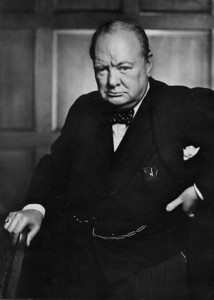
    The Churchill Portrait

    Buy on amazon

    Behind the camera: Yousuf Karsh (1908-2002) He signed his photos ‘Karsh of Ottawa’
    Where: Speaker’s chamber in the Canadian House of Commons
    Photo Summary: A glowering Winston Churchill then Prime Minister of the United Kingdom.
    Picture Taken: December 30, 1941 after a speech given to the Canadian House of Commons

    Most reproduced portrait in history
    -The Economist – July 18th 2002

    Yousuf Karsh was arguably the most famous Canadian photographer in history. He captured this photo of Winston Churchill just after he finished giving a rousing speech at the Canadian House of Commons. The scowling Churchill portrait perfectly captured the defiant 1941 Churchill and is the most reproduced portrait in history. This image symbolized Churchill and the British Empire fighting alone against the Fascist Nazi threat.

    Capturing Churchill

    1941 saw Churchill leading the UK, the only European country still resisting the Nazis. While touring the Dominion to rally for Commonwealth support, Churchill gave what many remember as a rousing speech to the Canadian House of Commons in Ottawa:

    When I warned [the French] that Britain would fight on alone, whatever they did, their Generals told their Prime Minister and his divided cabinet: ‘In three weeks, England will have her neck wrung like a chicken.
    Some chicken…Some neck!

    After the speech, Canadian Prime Minister King had arranged for a portrait session to commemorate the event and told Karsh the day before, “When Churchill finishes his speech, I will bring him directly to you.” King ushered Churchill into the room but he refused to enter demanding, “What’s going on?” Unamused and caught by surprise Churchill lit up a cigar and growled, “Why was I not told of this?” The photographer Yousuf Karsh wrote what happened next:

    He was in no mood for portraiture and two minutes were all that he would allow me … Two … minutes in which I must try to put on film a man who had already written or inspired a library of books baffled all his biographers, filled all the world with his fame, and me, on this occasion, with dread. [Churchill marched into the room] regarding my camera as he might regard the German enemy.
    … chewing vigorously on his cigar … He reluctantly followed me to where my lights and camera were set up. I offered him an ash tray for his cigar but he pointedly ignored it, his eyes boring into mine. At the camera, I made sure everything was in focus, closed the lens and stood up, my hand ready to squeeze the shutter release, when something made me hesitate. Then suddenly, with a strange boldness, almost as if it were an unconscious act, I stepped forward and said, “Forgive me, sir.” Without premeditation, I reached up and removed the cigar from his mouth.

    … At this the Churchillian scowl deepened, the head was thrust forward belligerently, and the hand placed on the hip in an attitude of anger … I clicked the shutter. Then he relaxed. “All right,” he grunted as he assumed a more benign attitude, “you may take another one.”

    After developing the image the young Armenian immigrant knew he had a winner but didn’t know how to go about publicizing it. Eventually, he was able to get in contact with Life magazine who used it in their magazine and then on May 21, 1945, cover. For the image that would make what Karsh called, “the turning point in my career” Life paid him the grand total of $100.

    Yousuf Karsh


    Yousuf Karsh - Self Portrait 1938

    Yousuf Karsh – Self Portrait 1938

    Yousuf Karsh was an ethnic Armenian born in Mardin Turkey on December 23, 1908. He grew up under intense Armenian-persecution where he wrote, “I saw relatives massacred; my sister died of starvation as we were driven from village to village.”
    To escape persecution when he was 16, his family sent him to a photographer uncle named George Nakash who lived in Canada. When he first arrived in Eastern Quebec, young Yousuf wanted to be a doctor and worked in his uncle’s studio to raise money for medical school.
    Showing promise as a photographer, Nakash sent him to study under a family friend, John Garo, a renowned photographer who lived in Boston, USA. For three years Yousuf learned the tricks of the trade often accompanying Garo to high society functions across the Eastern seaboard. During this time he became engrossed in photography and any thoughts of being a doctor were forgotten.
    He returned to Ottawa and set up a studio because, “I chose Canada because it gave me my first opportunity and I chose Ottawa because, as the capital, it was a crossroads that offered access to a wide range of subjects,” As word of his talents spread he set up studios in other cities like New York and London for the convenience of his clients but it was in Canada that he captured his famous Churchill portrait.
    The Churchill shot cemented his fame and throughout his career, he went on to shoot many famous portraits and many famous people. On July 13, 2002, Karsh died at Boston’s Brigham and Women’s Hospital after complications following surgery. He was 93 years old.

    Sir Winston Leonard Spencer-Churchill

    Churchill was born on 30 November 1874 into a famous English aristocratic family, the Spencer-Churchills. He spent much of his childhood at boarding schools where he had little if any contact with his parents. He went on to the Royal Military College in Sandhurst and graduated eighth out of a class of 150 in December 1894.
    As an officer in the British Army, he fought in a number of colonial wars where he showed courage on the front lines. In 1900 he started his political career and spent much of the rest of his life in British politics. In the run-up to the second world war, he fiercely opposed the British Prime Minister, Neville Chamberlain’s appeasement of Hitler. When Chamberlain was forced out of office Churchill, then the First Lord of the Admiralty was chosen as successor. During the difficult war years, Churchill is credited with having the strength to never surrender to the Axis onslaught. This defiance is captured perfectly in Karsh’s picture.

    We shall not flag or fail. We shall go on to the end. We shall fight in France, we shall fight on the seas and oceans, we shall fight with growing confidence and growing strength in the air. We shall defend our island, whatever the cost may be. We shall fight on the beaches, we shall fight on the landing-grounds, we shall fight in the fields and in the streets, we shall fight in the hills. We shall never surrender!

    After the war, he lost the 1945 election but was returned to the Prime Minister’s office in 1951 before then retiring in ’55. When he died in 1965, his state funeral was attended by one of the largest assemblies of world leaders in history.

    Theft


    Yousuf Karsh lived in a high end Ottawa hotel, Château Laurier for years with his first wife and he had his studio there until 1992. The hotel had come into possession of 15 of Karsh’s works, including the Churchill portrait. They hung with pride in its Reading Lounge. The bold art theft took place sometime between Christmas Day 2021 and January 6, 2022 and was only discovered in August of 2022. It was reported that the Churchill portrait had been replaced with a copy. The print might have a high value to Churchill collectors as Michel Prévost, president of La Société d’histoire de l’Outaouais, confirms that “no prints of Karsh’s work have been allowed since his negatives were given to Library and Archives Canada in the 1990s.” On November 14, 2024 the CBC reported that a 43-year-old Canadian had stolen the photo and a London auction site to a Genoa, Italian collector, both of whom were unaware that it had been stolen. On November 13, 2024, an unveiling ceremony took place to celebrate the return of the photo to the Fairmont Château Laurier hotel in Ottawa.

    More Famous Images

    Related Posts:
    Farrah Fawcett – Swimsuit Poster

    Buy on amazon

    Farrah


    Behind the camera: Bruce McBroom
    Where: Farrah Fawcett’s home in Bel Air, California
    Photo Summary: Farrah Fawcett in a red swimsuit
    Picture Taken: Summer of 1976 poster released in Sept of same year

    During World War II Betty Grable was the pin-up queen. After the war, the title was passed from various Hollywood bombshell to Hollywood bombshell but Farrah Fawcett ruled the 70’s. This poster which was released the same year as when she played Jill Munroe on the TV show Charlie’s Angels went on to sell a record 12 million copies making it one of the most famous pin-ups ever.

    Pro Arts Inc.

    Mike and Ted Trikilis dropped out of Kent State in 1967 to open an art gallery that sold posters. A shipment of anti-war posters soon became their number one breadwinner and so they sold the store and became the Pro Arts Inc. Ohio’s number one and only Distributor of Youth-Oriented Posters. They struggled for a few years but then a poster of the Fonz sold more than a quarter-million copies which bumped Pro Arts in the big leagues.
    In April of 1976, Ted was working on his farm with the neighbor’s son Pat Partridge when Pat mentioned that if he running Pro Arts he would make a poster of Farrah Fawcett. He admitted that he and his friends had been buying women’s magazines just to get pictures of her from the Wella Balsam shampoo ads. Ted had never heard of Farrah but knew that if students were using ads of her then a poster would be a big seller. He soon got in touch with Fawcett’s agent Rick Hersh and tried to get a deal. After Ted finished talking Hersh was puzzled and asked, “What type of product is Farrah to be selling on the poster?” “We want to sell Farrah on the Farrah poster,” Ted explained.
    Hersh passed the idea on to Farrah who thought it was “cute” and said she had a photographer she likes to work with.

    Taking the picture


    When the photo was taken Farrah Fawcett was still an unknown actress wanting to make it big. She hadn’t yet signed on for her hit show Charlie’s Angels but got some work doing commercials. Bruce McBroom a freelance photographer had worked with Farrah before and so Pro Arts agreed to hire him for the shoot. They wanted a bikini shot of the blond beauty.
    The shoot was at Farrah’s Bel Air, Calif., home of her and then-husband, actor Lee Majors. She did her own hair and they took the photos behind the home by their pool. She modelled several different swimsuits but McBroom didn’t get excited about any of the pictures he shot. When she came down in the now famous red one-piece swimsuit to cover a childhood scar on her stomach McBroom knew he had something. For the backdrop McBroom grabbed the old Indian Blanket covering his car seat and hung it up, “I should have told people I styled this,” McBroom says, “but the truth is it came off the front seat of my ’37 Chevy.”
    He took a number of shots, using his Nikon, including a sultry Farrah eating a cookie but Farrah chose the final frame that would make her one of the most famous people of the ’70s. In the early summer of ’76 McBroom sent a package of 25 shots of Farrah indicating which one Farrah wanted to use.

    I’ve since heard that when the guy in Cleveland got the pictures, he went, “First of all, where’s the bikini?” He told me he wasn’t ever gonna pay me, because he hated the pictures. But I guess he showed them around to people in his business and they changed his mind. It was Farrah’s pose, Farrah’s suit, Farrah’s idea. She picked that shot. She made a lot of money for him and for herself, and made me semifamous.
    –McBroom

    McBroom was paid $1000 for the assignment but is happy to be associated with such a cultural icon. In 2006 on the 30th anniversary of the image, Fawcett said: “I was a little self-conscious [of the image], probably because my smile is so big, but it always more ‘me’ than any other photograph out there.”
    Ice Used?

    It was all Farrah
    – McBroom

    Legend has grown around Farrah’s prominent features and that she used ice but the photographer, McBroom has always dispelled the rumour saying, “It was all Farrah,”.

    Farrah Fawcett

    Farrah Fawcett (born Ferrah Leni Fawcett on February 2, 1947) in Corpus Christi, Texas to James William Fawcett and Pauline Alice Evans. She is the second of 2 daughters. Her older sister, Diane, passed away from lung cancer in 1998. As a child, Farrah displayed a natural athletic ability which her father encouraged. She was raised Roman Catholic. She attended the University of Texas at Austin and was a member of the Delta Delta Delta sorority.

    In 1976, Fawcett played the character of Jill Munroe for one year in the successful TV series Charlie’s Angels. She was paid $5,000 an episode but with the popularity of the poster earned $400,000 in royalties. She broke her contract and left the show after one season. As settlement to a lawsuit stemming from her early departure, Fawcett appeared six more times as a guest star in seasons three and four.

    Fawcett went on to receive achieve critical praise and her first of three Emmy Award nominations as a serious actress for her role as a battered wife in the 1984 television movie The Burning Bed. She also won acclaim in the stage and movie version of Extremities, in which she played a rape victim who turns the tables on her attacker. She then played a predatory role in another miniseries, Small Sacrifices, receiving a second Emmy nomination. Her third Emmy nomination came in 2004 for her work in The Guardian. Fawcett has been nominated for several other awards as well including the Golden Globe Award and ACE awards.

    Fawcett posed in the December 1995 issue of Playboy, which became the best-selling issue of the 1990s, with over 4 million copies sold worldwide. She later posed for the July 1997 issue, which also became a top seller.
    Farrah Fawcett was diagnosed with cancer in 2006. At approximately 9:28 a.m., PDT on June 25, 2009, in the intensive care unit of Saint John’s Health Center in Santa Monica, California Farrah Fawcett lost her battle with cancer.

    More Famous Images

    Related Posts:

    Vietnam Airlift

    Buy on amazon
    Vietnam Airlift 1975
    Behind the camera: Huber Van Es
    Where: 22 Gia Long Street (now Ly Tu Trong Street), downtown Saigon where senior Central Intelligence Agency employees were housed.
    Photo Summary: South Vietnamese refugees fleeing communist forces
    Picture Taken: Tuesday, April 29, 1975

    1975 saw the crumbling of the country of South Vietnam under the final North Vietnamese push to unite the two countries under Communist rule. Under the January 1973 Paris peace accords, America agreed to a near-total withdrawal of US forces in early 1973. The only Americans left in Saigon in 1975 were some private contractors and government officials there to back up the South Vietnamese government. However, a number of spectacular defeats of the South Vietnamese forces in central Vietnam led to a total rout of the South Vietnamese army. As Northern forces closed in on Saigon thousands rushed to escape the communists. Since the airport was vulnerable to communist forces the Americans initiated Operation Frequent Wind a helicopter evacuation of Saigon. This picture, on top of the CIA building, is a shot of one of those evacuations.

    Taking the Picture

    Vietamese Airlift Es series 1975

    More from the series

    Huber Van Es a dutch press agent was working at the UPI office which was in the penthouse of Saigon’s Peninsula Hotel. He was processing pictures from earlier in the day, shots of the evacuation of Foreign personal from Saigon. The “secret” code that was to signal the start of the evacuation was a quote on Armed Forces Radio: the comment that the temperature is rising, followed by eight bars of White Christmas. (Japanese journalists were concerned that they would not recognize the tune and had to get someone to sing it to them). The code was compromised and Van Es had a number of chaotic shots of Marines trying to keep crowds of Vietnamese at bay while only allowing foreigners on the evacuation buses.
    Around 2:30 in the afternoon one of the journalists started shouting that there was a helicopter on the roof of another building. Van Es quickly ran to the penthouse balcony and observed that around four blocks away there was indeed a helicopter on a place called the ‘Pittman Apartments’. It was well known that the CIA and its officers lived there and it was revealed that several weeks earlier the roof had been reinforced with steel plates so that it could take the weight of a helicopter. Van Es recalls what happened next:

    ..I grabbed my camera and the longest lens left in the office — it was only 300 millimetres, but it would have to do — and dashed to the balcony. Looking at the Pittman Apartments, I could see 20 or 30 people on the roof, climbing the ladder to an Air America Huey helicopter. At the top of the ladder stood an American in civilian clothes, pulling people up and shoving them inside.
    Of course, there was no possibility that all the people on the roof could get into the helicopter, and it took off with 12 or 14 onboard. (The recommended maximum for that model was eight.) Those left on the roof waited for hours, hoping for more helicopters to arrive, to no avail.
    After shooting about 10 frames, I went back to the darkroom to process the film and get a print ready for the regular 5 p.m. transmission to Tokyo from Saigon’s telegraph office. In those days, pictures were transmitted via radio signals, which at the receiving end were translated back into an image. A 5-inch-by-7-inch black-and-white print with a short caption took 12 minutes to send.

    Hubert didn’t want to evacuate with the other foreigners instead choosing to see the war play out. He remembers that, “As a Dutch citizen, I was probably taking less of a risk than the others.”. He stayed in Saigon until he was invited by the new regime to leave on June 1, 1975. He has since returned a number of times to Vietnam but is based out of Hong Kong where he died on May 15, 2009. His wife said that he had suffered a brain hemorrhage a week earlier and never regained consciousness. He was 67 years old.

    Operation Frequent Wind


    Saigon Airlift 1975

    Another color picture


    North Vietnamese artillery shells and rockets had been pounding the Tan Son Nhut airport forcing it to shut down for a time on April 28. The next day a U.S. C-130 transport was hit by a rocket on the runway and burst into flames as the crew escaped. When the airport at Tan Son Nhut was deemed unsafe by the man in charge of American personal, Graham Martin the U.S. ambassador in Saigon, advised President Ford to start Operation Frequent Wind. At 10:45 p.m. April 29, the President ordered Operation Frequent Wind to commence. During the operation, some 6,236 passengers were removed to the safety of American ships offshore, despite severe harassing fire. To some, however, it seemed that the DAO area and the evacuation process itself were deliberately spared by the North Vietnamese.
    On April 29 and 30, 662 US military airlift flights took place between Saigon and ships 80 miles away. Ten Air Force HH/CH-53s flew 82 missions, while 61 Marine Corps CH-46s and CH-53s flew 556 sorties. There were 325 support aircraft sorties by Marine, Navy, and USAF aircraft. Air America, the CIA private “mercenary” airline, joined in, even though having flown 1,000 sorties in the previous month.
    Rooftop, 22 Gia Long Street, Saigon.jpg

    The Rooftop of 22 Gia Long Street, Saigon in 2002


    On April 30, 4:58 a.m. a CH-46 helicopter, call sign “Lady Ace 09,” flown by Capt. Jerry Berry transported ambassador Martin from the embassy roof to the waiting US fleet. All that was left in the embassy was a group of Marines left to provide security for Martin’s take-off. Due to a miscommunication, it was assumed that the marines left on this flight. It wasn’t until the Ambassador had landed on the USS Okinawa that the mistake was discovered. Almost three hours after ambassador Martin’s helicopter lifted off, at 7:53 a.m., the last flight of Operation Frequent Wind took the Marine personnel who had been defending the embassy to the waiting USS Okinawa. They abandoned around 300 South Vietnamese in the embassy and hundreds more outside the embassy who had been promised a way out.

    More Famous Pictures

    Related Posts:

    Burst of Joy

    Burst of joyBehind the camera: Slava ‘Sal’ Veder
    Where: Travis Air Force Base, in California
    Photo Summary: The Stirm family running to their father, Lt. Col. Robert L. Stirm. In the lead is 15 year old Lorrie followed by Robert Jr., Cindy, Roger and wife Loretta.
    Picture Taken: March 17, 1973

    With the signing of the Paris Peace Accords on January 27, 1973 American involvement in the Vietnam was over. Through a series of diplomatic negotiations a deal was reached with the North Vietnamese government that allowed the return of 591 American POWs held by the communists. In Operation Homecoming from February 12 to April 4 there were 54 flights out of Hanoi, North Vietnam to bring the POWs home. One of these runs was the plane with Lt. Col. Robert L. Stirm. After giving a short speech Stirm’s family ran across the tarmac to greet their father who they hadn’t seen in six years. Slava “Sal” Veder who was working for the Associated Press caught this image. It went on to win the 1974 Pulitzer Prize for photography.

    Taking the photo

    The March 17th flight bringing 20 POWs home from Vietnam had a lot of press come out with a large crowd of around 400 family members and supporters. 46 year old Associated Press photographer Slava “Sal” Veder on assignment saw that after Lt. Col. Robert L. Stirm finished his speech his family had appeared on the runway. “You could feel the energy and the raw emotion in the air,” he said. He snapped off a couple of shots and then rushed to the makeshift AP darkroom that had been set up in the Air Base ladies’ bathroom (United Press International were in the men’s). He and another AP photographer, Walt Zeboski, picked six to develop. Sal picked his favorite, titled it Burst of Joy and sent it out over the wire. It was published across the country and because Lt. Col. Stirm’s had his back turned towards the camera the anonymous image came to represent all the Vietnam homecomings.

    Lt. Col. Robert L. Stirm

    Robert Stirm was born in San Francisco, California, in 1933. In 1953 he joined the Aviation Cadet Program and graduated as a 2nd Lieutenant in the U.S. Air Force on November 3, 1954. He served as a fighter pilot in Holland before getting training in the F-105 Thunderchief and going to Vietnam in August 1967. On October 27, 1967 Stirm was leading a flight of F-105Ds over Canal Des Rapides Bridge, Hanoi when he was shot down and captured that night. Before October 27th he had flown 33 combat missions. Throughout his six years as a POW he was held in several camps including the infamous Hanoi Hilton. He endured starvation, torture and a total of 281 days in solitary confinement. For part of his imprisonment he shared a cell with future politician John McCain. Robert Stirm remained in military service after his return retiring as a colonel in 1977. He lives in Foster City, California.

    The Stirm family

    LT. COL. Robert L. Stirm, a recently released prisoner of war, greets his family upon his arrival at Travis Air Force Base

    Lt. Col. Robert L. Stirm, a recently released prisoner of war, greets his family upon his arrival at Travis Air Force Base.

    While in the Air Force Robert Stirm married his wife Loretta on February 6, 1955. They had four children Lorrie Alynne, Robert L. Jr., Roger David and Cynthia “Cindy” Leigh. Lorrie was only 9 when her father was shot down. After 6 long years he finally came home. While her Dad gave a speech on behalf of the 20 POWs on their flight the family was stuck in the Stirm’s station wagon on the tarmac at Travis Air Force Base. Minutes passed that seemed like hours but finally with the formalities over, the children jumped out of the car and ran to their father. Lorrie remembers that she “just wanted to get to Dad as fast as I could, We didn’t know if he would ever come home … That moment was all our prayers answered, all our wishes come true.”
    The happiness of the reunion didn’t last long. Three days before Stirm returned to America a chaplain had handed a Dear John letter from his wife. When he returned they tried to keep the marriage alive. Lorrie remembers “So much had happened—there was so much that my dad missed out on—and it took a while to let him back into our lives and accept his authority.” Robert and Loretta Stirm divorced within a year. His wife remarried in 1974 moving to Texas with her husband. Robert Stirm also remarried but this marriage too ended in divorce.
    The oldest Robert became a dentist and the younger Robert, like his father, joined the Air Force rising to the rank of Major. Lorrie the oldest is an executive administrator and the youngest daughter Cindy is a waitress. Except for pilot Robert, who lives in Seattle, they all live in California. All four keep the picture mounted in their houses. “We have this very nice picture of a very happy moment,” Lorrie says, “but every time I look at it, I remember the families that weren’t reunited, and the ones that aren’t being reunited today—many, many families—and I think, I’m one of the lucky ones.”

    The photographer

    Slava J. Veder was born on August 30, 1926 in Berkeley, California. An alumni of Modesto Junior College, Pacific College and Sacramento State. After working in several jobs such as fireman, sportswriter for the Richmond Independent and staff on the Oakland Hockey Club in 1949 he joined the Almeda Times-Star before moving to the Tulsa World were he got work as an editor. In 1956 he left the Tulsa World and worked for a number of papers around America working as an editor. In 1961 he returned to California to work for the AP in Sacramento before transferring to the AP San Francisco office. It was in San Fran that he took Burst of Joy and a year later won the Pulitzer.

    Copyright info


    AP Images owns the rights to this image, Vietnam Released POW

    Other famous photos

    Related Posts: