Behind the camera: Lyle Owerko Where: Close to the WTC complex, New York City, America Photo Summary: Seconds after United Airlines Flight 175 smashed into the South WTC Tower (2 WTC) at 9:03 AM. Picture Taken: Minutes after 9:00 AM September 11, 2001
On September 11, 2001, Lyle Owerko was resting after a gruelling trip back from Africa. He was just unpacking his gear when he heard a huge explosion. Rushing from his apartment he looked up to see the North Tower of the WTC on fire. Minutes later another plane screamed overhead and crashed into the South WTC Tower. Owerko remembers that “when that second plane hit, I knew that the world changed. You could just feel it. I just knew that the camera I was holding in my hand contained lightning in a bottle.”
Taking the picture
After hearing the explosion he ran out of his Tribeca neighbourhood apartment chasing what he remembers as “the worst sound I’ve ever heard in my life.” Since he still hadn’t unpacked much, from his assignment in Africa, he had the cameras and lenses he was using from his trip. It was this 400-millimetre telephoto lens that he didn’t normally carry with him that allowed him to capture such powerful pictures. He spent some time in NYC after the attacks taking pictures which he then published together in a limited run book, of 2000 copies, called: And no birds sang
Lyle Owerko
In 2012 Wired.com did a series of photos of photographers and their iconic pictures
Born in and raised in Calgary, Canada, Owerko studied at the Pratt Institute and graduated from the Communication Arts program. Since then he has taken on many eclectic jobs from directing Robert Redford in a series of Sundance Channel commercials, to working for MTV and of course taking the TIME cover of the second plane hitting the WTC. That critically acclaimed image was later nominated as one of the 40 most important magazine covers in the last 40 years.
Since taking the now iconic image Owerko has spent years in Africa documenting Kenya’s Samburu warriors. In an interview, he contrasted his work by saying:
9/11 shattered my innocence and still does to this day. I have a hard time with those images, as my main goal as a creative has always been to dignify the human condition. On the other hand, Africa offers a way for me to console and reconcile my proximity to the cycle of life and death by using the camera to engage suffering and to raise the voices of the tiny and overlooked.
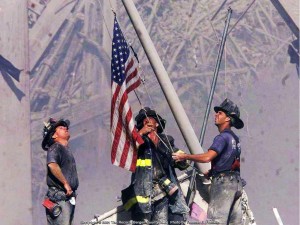
Behind the camera: Thomas E. Franklin of The Bergen Record Where: Thomas E. Franklin said he was standing under a pedestrian walkway across the West Side Highway that connected the center to the World Financial Center, located at the northwest corner of the World Trade Center site. Franklin said the firefighters were about 150 yards (137 meters) away from him and the debris was 100 yards (91 meters) beyond that. They were about 20 feet (6 meters) off the ground on top of WTC wreckage. Photo Summary: The firefighters pictured were Brooklyn-based firefighters George Johnson (36) of Rockaway Beach and Dan McWilliams of Long Island (both from Ladder 157), and Billy Eisengrein of Staten Island (Rescue 2). Picture Taken: Around 5:00 PM Sept 11, 2001
This picture of three Firefighter raising the American flag at the site of the WTC attacks is one of the most famous images from 911. Shot by Thomas E. Franklin, of The Bergen Record, the photo first appeared on Sept 12, 2001, under the title, Ground Zero Spirit. The paper also put it on the Associated Press wire and it appeared on the covers of several newspapers around the world. Due to its subject, raising the flag during important American historical events, this photo has often been compared to the famous Flag on Iwo Jima photograph taken by Joe Rosenthal during World War II. The photo which was distributed worldwide was a finalist in 2002 for the Pulitzer Prize in breaking news photography.
Getting to Ground Zero
Thomas E. Franklin started his day like any other arriving at The Bergen Record, at 8 a.m. to start his day. When news that a plane had hit the WTC spread through the office, Franklin headed down to the riverfront across from New York. When he arrived he started taking pictures of ferries carrying the wounded from the city and a triage area being set up on the shore. It wasn’t just another story for Franklin as his brother worked close to the WTC and while taking pictures he, “scanning the faces in Jersey City, hoping that I would see my brother.” It wasn’t until later in the day that he was able to contact his brother and make sure he was OK.
Around noon, the police started to restrict access to the city, but Franklin was able to tag along with another photographer, John Wheeler, who had convinced police to them take a tugboat to New York. While wandering around taking pictures of the carnage, he met up with James Nachtwey, a Pulitzer-prize winning photojournalist. Around 5 p.m. the two decided to take a break and while eating Franklin noticed three firefighters with a flag. Thomas Franklin recalls what happened next,
I would I say was 150 yards away when I saw the firefighters raising the flag. They were standing on a structure about 20 feet above the ground. This was a long lens picture: there was about 100 yards between the foreground and background, and the long lens would capture the enormity of the rubble behind them … I made the picture standing underneath what may have been one of the elevated walkways, possibly the one that had connected the World Trade Plaza and the World Financial Center. As soon as I shot it, I realized the similarity to the famous image of the Marines raising the flag at Iwo Jima.
The photograph captured the Brooklyn-based firefighters George Johnson of Rockaway Beach and Dan McWilliams of Long Island (both from Ladder 157), and Billy Eisengrein of Staten Island (Rescue 2) running up the flag on an existing flag pole located on West St. The firefighters had been digging through the rubble around WTC 7 when they where pulled out as the building was about to collapse. While evacuating McWilliams saw a yacht in the harbor, Star of America, running an American flag and an empty flag pole sticking out of the wreckage on West St. He grabbed the flag from the yacht and together with Johnson walked toward the flagpole. The third firefighter, Eisengrein, saw what they were doing and offered to lend a hand. As they scrambled up the debris Franklin aimed his long lens in their direction, catching what would soon be an Iconic Image.
911 still hovers over us – Thomas Franklin
Where are they now
All of the firemen in the picture refused to do TV spots or interview requests and still work at their respective ladders. The photographer, Thomas Franklin, still works at his Jersey newspaper and told USA Today, “A lot of people involved with 9/11 really haven’t moved on,” Franklin says. “I would have thought we would have. But it still hovers over us.”
As one of the most important roles in the first responder department, firefighters without hesitation march into danger to help us. They contribute to the life battlefield, which is a battlefield full of danger and unknown. Firefighters in firefighting suits and helmets march against the wind to protect us. They are heroes of this era.
We can honor the firefighter heroes in our own way, especially on holidays like International Firefighters’ Day. In addition to donating to related organizations to support them, we can gift them with custom Firefighter Challenge Coins. Challenge coins are a traditional symbol of honor. You can make custom Firefighter Challenge Coins with the firefighters’ photos, names, or your blessings. And express our gratitude and appreciation with these customized challenge firefighter coins. Which is a unique way of showing respect to the firefighter heroes. See more at gs-jj.com.
The Flag
The flag came from the 130-ft. (40 m) the yacht named Star of America, owned by Shirley Dreifus of the Majestic Star, which was docked in the yacht basin in the Hudson River at the World Financial Center. Researchers were able to determine that the flag was originally manufactured by Eder Flag Manufacturing located in Oakcreek, Wisconsin. After the flag was raised by the firemen, it flew on the pole for about 10 days before the Fire Department took it down on the request at the request of the Navy. They wanted it to fly on the American aircraft carrier, USS Theodore Roosevelt (CVN-71), which was on its way to Afghanistan to support the upcoming fight against the Taliban. Before it left to join the Navy it appeared at a service on Sept. 23, at Yankee Stadium, where it was signed by Gov. George Pataki, Mayor Rudy Giuliani and the fire and police commissioners. Sometime before this signing, the flag was switched with a bigger flag. The yacht’s flag measured four feet by six feet, the impostor flag measured five feet by eight feet. The difference was first noticed by one of the firefighters when during a raising ceremony, in April 2002, after its return from the Navy he and the others confirmed that the flag was too big. The original owner, Shirley Dreifus, also noticed that the flag had been replaced and actually sued the city in hopes that it would be forced to return the flag. An investigation was launched which failed to find the flag and the lawsuit was dropped. Mayor Michael Bloomberg, when asked about the disappearance, stated that the city didn’t have it, “I don’t know where Osama bin Laden is, either.” As of Dec 2006 the flag has yet to be found Shirley Dreifus has even started a Web site (www.findthe911flag.com) to get the flag back.
Stamp
The “Heroes 2001” stamp, USA Scott #B2, was unveiled on March 11, 2002, by President George W. Bush, in a ceremony attended by Franklin, Johnson, Eisengrein, and McWilliams. These stamps were semipostals: they had a purchase price (45¢) higher than their postage value (34¢), with the balance given to the Federal Emergency Management Agency’s relief efforts. A special exception was thus made to the normal requirement by the United States Postal Service that subjects of stamps be deceased.
Statue
The photograph taken of the same scene, but different angle, by Ricky Flores
In December 2001 The New York Fire Department unveiled plans for a statue based on the photograph to be placed at the Brooklyn headquarters. Instead of the original three firefighters, the statue was to include African American, White American, and Hispanic firefighters. However, it was cancelled in an outcry about rewriting history.
From a different Angle
Franklin wasn’t the only photographer to snap the shot of the three firemen. Ricky Flores also took a picture that ran on the front page of his employer, The Journal News (Journal News serves the Lower Hudson Valley i.e. New York’s Westchester, Rockland and Putnam counties). His picture is often confused with Franklin’s even though they are taken from two totally different angles. Ricky somehow was able to get into the second story of a building on Canal St. where he snapped his shot through a window that had its glass shattered out.
Behind the camera: Kurt Strumpf Where: Israeli apartment in the Munich Olympic village Photo Summary: The terrorist was never identified and could have been any of 8 hostage takers: Luttif Afif (Issa), the leader, his deputy Yusuf Nazzal (Tony), and junior members Afif Ahmed Hamid (Paolo), Khalid Jawad (Salah), Ahmed Chic Thaa (Abu Halla), Mohammed Safady (Badran), Adnan Al-Gashey (Denawi), and his cousin Jamal Al-Gashey (Samir). Picture Taken: September 5, 1972
The Munich Olympics looked to be one of the greatest Olympics in games history. Nicknamed the “Happy Olympics” the events that took place in the second of week of events would change all that and forever link the Munich Olympics with the slaughter of 11 team embers of the Israeli team. Of all the pictures taken by media covering the event one taken by Kurt Strumpf of one of the masked terrorists overlooking the balcony of the Israeli team, quarters has stood the test of time. The picture is now synonymous with what is now known as the Munich Massacre.
Black September
The Black September Organization (BSO) was a Palestinian militant group, founded in 1970. The group took their name from the conflict known as Black September when King Hussein of Jordan attacked Palestinian militant groups, killing thousands, after they attempted to take over Jordan. The group was originally formed to take revenge against the King and Jordan’s government but expanded into anti-Israeli attacks. Its members came from various countries with Palestinian refugee camps, and they carried out a number of terrorist activities, including their most infamous attack the, Munich Massacre.
Munich Massacre
The 1972 Olympics, officially known as the Games of the XX Olympiad, were held in Munich, West Germany, from 26 August to 11 September 1972. It was the second time Germany had held the Olympics–the first being during the Hitler’s reign in 1936–and the Germans hoped to erase their Nazi past with a happy and free Olympics. The West German Olympic Organizing Committee tried to do this by creating an open and friendly atmosphere. Security was deliberately lax, and athletes and support staff came and went with only cursory checks.
The Black September Organization (BSO) had planned the attack extensively and even had members working in the village. Taking advantage of the lax security, the eight terrorists jumped a fence dressed as athletes and, despite a struggle while entering the Israeli compound, where two Israeli athletes were killed, managed to hold nine Israeli athletes hostage in their Olympic village apartment. After a series of failed negotiations, the terrorists and their hostages were taken to the military airport of Faurstenfeldbruck. There the West German government attempted to rescue them, but they bungled the poorly planned raid, and all the hostages were killed, along with five of the terrorists. The three survivors were arrested but later released in exchange for a German Lufthansa passenger jet that was hijacked in October of that year.
The massacre led Germany to realize the inadequacy of its approach to combat terror and to create the elite counter-terrorist unit GSG 9 to address future incidents. It also led Israel to launch an aggressive counter-terrorism campaign known as Operation Wrath of God, which Steven Spielberg based his movie, Munich
.
Taking the picture
It is often reported that Kurt Strumpf took the picture while covering the event from the Puerto Rican team quarters inside the apartment but Strumpf took the picture from outside the village. It was AP writers Karol Stonger and Bill Ritz who were able to get into the Puerto Rican team apartment.
Behind the camera: Max Desfor Where: A bridge on the Taedong River that runs through the city of Pyongyang, North Korea Photo Summary: Labelled Flight of Refugees Across Wrecked Bridge in Korea the image shows refugees fleeing the North Koreans over a bridge on the Taedong River Picture Taken: December 4, 1950
Late 1950 in the Korean War saw the direct entry of China into the Korean War. North Korean forces along with huge numbers of Chinese reinforcements not only broke the United Nations advance but sent them reeling. American forces, who made up the most of the United Nations forces, started the longest retreat in U.S. military history. As UN forces retreated so to did Korean civilians, with thousands fleeing from the advancing communist forces. Near the North Korean capital of Pyongyang AP photographer Max Desfor took this picture on a freezing December day as Korean refugees struggled across the ruined bridge. The image went on to win the 1951 Pulitzer Prize for photography.
Covering Korea
When he heard war had broken out in Korea 36-year-old Max Desfor volunteered at his work in the AP news service to cover the war. His supervisor initially tried to dissuade him from going as he didn’t think the war last two weeks. Desfor persisted and joined United Nations forces as they retreated from the North Koreans in the initial stages of the War. He was free to roam the various army groups and remembers that “embedding was not a term we used in Korea. We were not directed as to whom to go with. We were completely on our own.
He took part in a number of operations and after the hugely successful Inchon landing that forced the North Koreans into retreat, he took part in a parachute jump with the 187th Regimental combat team. “It was just about mid-way from Seoul to Pyongyang when I heard of a parachute jump that was going to take place… it was incredible – what an experience it is to make a parachute jump,” said the photographer. Even though the United Nations had by late 1950 occupied most of North Korea the direct involvement of China into the war changed everything. A string of battles broke the UN advance and they forced to retreat before the combined forces of the Chinese and North Koreans.
Taking the photo
Retreating with United Nations forces Desfor remembers stumbling upon an incredible scene in the freezing weather of December of 1950. In a the book Remembering the Forgotten War Desfor recalls:
I liberated a jeep from someone and joined the retreat. With me were [Tom Lambert (AP) and Homer Bigart(NY Times)] and an army signal corpsman. We crossed the Taedong River on a pontoon bridge that had just been hastily erected by the army engineers … On the south side of the river … [civilians] were walking across where the ice was solid and clogged the river. A little farther upstream, where the water was still open, they were crossing in small boats. As we jeeped farther southward … I saw what had been a sturdy span across the river, obviously recently destroyed by aerial bombs … with Koreans fleeing from the north bank of the Taedong River, crawling through and into and above and onto the broken-down bridge, it was like ants crawling through the girders. They carried what little possessions they had on their heads or strapped to their shoulders, and on the north side I saw thousands more lined up waiting to do the same thing, waiting to crawl and join the rest of them.
Desfor actually had trouble working his camera due to the plummeting temperatures. Falling off the bridge into the freezing river was likely a death sentence yet the thousands of refugees kept streaming across the bridge. Years after the war Desfor was struck by the “deathly silence” of the scene. The reporters continued on their way to what was left of the airport and put his film on the last Air Force Plane. He could have been evacuated with his film but decided to keep reporting the retreat. He did, however, get word to Bill Achatz the photo editor in AP Tokyo to look out for the film. Achatz got the film and transmitted it to the States on December 5, 1950.
Max Desfor
Desfor was born in 1914 and was an Associated Press photographer. He covered the Pacific Theater during World War II and was one of the photographers that photographed the Enola Gay crew when it returned from the Hiroshima Atomic Bombing. He was also able to record the Japanese surrender in 1945. After World War II he covered the Indonesian National Revolution in 1946 and the Indian Pakistan Kashmir War in 1947. In 1950 he returned to America after being stationed with his family in Rome, Italy. When war broke out he volunteered to cover the war taking a number of photos but it was this image that won him a Pulitzer Prize. In 1936 he married Clara Mehl until 1994 when she was taken from him in a horrible car accident. He lived another two decades after his wife’s death, dying himself at his Silver Spring, Maryland home on February 19, 2018, at the age of 104.
Behind the camera: Robert Capa Where: It was for decades thought that the shot was taken at Cerro Muriano on the Cordoba Front. However new research has determined that the photo was taken 30 miles (50 km) away, near Espejo, a Cordoban town Photo Summary: A Spanish Republican (Loyalist) soldier supposedly the moment he is struck by a bullet. The soldier was identified as Federico Borrell García based on the assumption the photo was taken at Cerro Muriano. Picture Taken: September 5, 1936 around 5:00PM
Robert Capa, a photo journalist, arrived in Spain in August 1936 to cover the Spanish Civil War, which had broken out a few weeks before. During his coverage as a war photographer, he took the famous Falling Soldier image. The image came to symbolize the Civil War between the Spanish government and General Francisco Franco’s fascist rebels. In World War II Capa would later take another famous image on the D-day Normandy beaches.
Taking the photo
The subject of the photo taken before his "death shot". He is standing on the far left
The original title was Loyalist Militiaman at the Moment of Death, Cerro Muriano, September 5, 1936. The Falling Soldier was first published in the September 23, 1936, issue of the French magazine Vu. The Vu article read, “With lively step, breasting the wind, clenching their rifles, they ran down the slope covered with thick stubble. Suddenly their soaring was interrupted, a bullet whistled — a fratricidal bullet — and their blood was drunk by their native soil.” There was no mention in the article on where the picture was taken. Then on July 12, 1937, Life magazine published an article with the Capa image and the caption, “Robert Capa’s camera catches a Spanish soldier the instant he is dropped by a bullet through the head in front of Córdoba.”
Robert Capa
Robert Capa was born on October 22, 1913. He was born with the name Endre Ernő Friedmann in Budapest, Hungary. When he was 18 he left Hungary for Germany but when the Nazis took power he emigrated again to Paris. It from Paris that he went to Spain to cover the Spanish Civil War. After Franco defeated the Republic Capa returned to France until the Nazi invasion upon where he left for America. He went on to become a celebrated war photographer covering five different wars: the Spanish Civil War, the Second Sino-Japanese War, World War II across Europe (He was the only “enemy alien” photographer for the Allies), the 1948 Arab-Israeli War, and the First Indochina War. His two most famous pictures are the Fallen Solider and his image of the 1944 D-day Normandy invasion. In 1947, Capa co-founded Magnum Photos with, among others, the French photographer Henri Cartier-Bresson. Magnum Photos was the first cooperative agency for worldwide freelance photographers. In 1947 Capa travelled to the Soviet Union with his friend, John Steinbeck. When he was leaving the country Soviet officials wanted to look through his undeveloped images. Capa refused to give them access unless Yevgeny Khaldei developed them. Capa had befriended the photographer while the two covered the Potsdam Conference and the Nuremberg Trials together. Both men were hard-drinkers and recognized as playboy lady killers.
On May 25, 1954, at 2:55 p.m. Capa was with a French regiment in Vietnam when he left his jeep to take some photos. While walking up the road he stepped on a land-mine and lost his leg. He was quickly rushed to a small field hospital but was pronounced dead on arrival due to massive trauma and loss of blood.
[midgoogle]
Faked?
The hand of the solider supposedly showing his hand in a death grip.
Starting in the 70s historians began to question the authenticity of, Fallen Solider’s image. Much of the confusion revolves around Capa’s inexperience as a photographer. The Spanish Civil war was his first and he often didn’t caption or take notes about where and when he took his photos. His editors many times had to guess where his pictures were taken. Further complicating things is that there is no negative of “Falling Soldier” known to exist.
The first accusations came from O.D. Gallagher, a South African-born journalist who was also covering the war. In an interview he gave for the book, The First Casualty: From the Crimea to Vietnam; The War Correspondent as Hero, Propagandist, and Myth Maker (1975) Gallagher claims that “at one stage of the war he and Capa were sharing a hotel room. … there had been little action for several days, and Capa and others complained to the Republican officers that he could not get any pictures. Finally … a Republican officer told them he would detail some troops to go with Capa to some trenches nearby, and they would stage some manoeuvres for them to photograph.” However, Gallagher’s account was discounted when in a later interview for another book the 1978 Jorge Lewinski work, The Camera at War, Gallagher claimed that Franco’s troops, not Republican ones, had staged the photo. Controversy has continued to surround the image. The most recent accusations have been levelled by research carried out by José Manuel Susperregui for his book “Shadows of Photography”.
Susperregui by studying the background images of the surrounding hillsides was able to determine that the image took place near a village called Espejo. There was some intense combat near Espejo in late September but no fighting occurred around the 5th of that month when Capa was in the region. This lead Susperregui to conclude that the photo was staged because there were no battles when the picture was taken. Capa’s supporters have replied that the image might be of a sniper hit behind enemy lines but Susperregui disregards these criticisms because there was no documented use of snipers on that battlefront.
When the Gallagher debate emerged the issue was resolved when in August 1996, Rita Grosvenor, a British journalist reported that Spanish historians were able to determine that on September 5, 1936, the only soldier that was killed in battle at Cerro Muriano was one Federico Borrell García. Borrell’s younger brother, Everisto, confirmed the identification. However, Susperregui in his research noted that the Cerro Muriano battleground was in “a wooded area, with century-old trees,” not at all like the open hillside shown in Capa’s photograph. He backs this up with an obscure anarchist magazine article first published in 1937 that states Borrell was hit while positioned “behind a tree”. The article quotes fellow soldiers saying they remember that “I can still see him stretched out behind the tree that served as his barricade, with his unruly hair falling over his face and a trickle of blood dripping from his mouth.”
Magnum Photos the company that Mr. Capa was a co-founder of has used the 1996 revelation of the identity Federico Borrell García as the final proof that the photo was authentic. Although they have not responded to Susperregui’s accusation there has been some recent forensic evidence that supports the photo is indeed one of a man dying.
When asked to view the images, Captain Robert L. Franks, the chief homicide detective of the Memphis Police Department, made an interesting observation. Zooming in on the left hand you can observe that the fingers form a claw with fingers curled towards the palm. This indicates that there is some sort of muscle spasm. It is almost impossible for any person to resist the impulse of while falling to splay your fingers and stick out your wrist to break your fall. To claim that Capa trained the man to fake that reflex seems unlikely.
Behind the camera: This picture was part of a series that Special Forces troops took as souvenir pictures of them ‘posing’ with John Walker Lindh Where: In a shipping crate at American military base, Camp Rhino (70 miles south of Kandahar) Photo Summary: John Walker Lindh strapped to a stretcher Picture Taken: Dec 7, 2001 This image is in the public domain because it was taken by a federal employee
John Walker Lindh or the American Taliban was made a media sensation after his discovery during the US military action in Afghanistan in response to the 911 attacks. Lindh in 2001 was serving in Afghanistan’s Taliban forces who were part of Afghan civil war against the Northern Alliance. After 911 the American government demanded the give up Osma Bin Laden when the Taliban refused US forces entered the ongoing civil war on the side of the Northern Alliance. Lindh was part of a group of Taliban soldiers in Konduz region that surrendered to Northern Alliance forces on November 25, 2001. These same soldiers staged a violent uprising in their prison near Mazar-e Sharif. Lindh, while wounded by a bullet in the thigh, was one of a few survivors of the failed prison uprising and was taken into US custody on, December 2, 2001. While in US custody American Special Forces took hundreds of souvenir pictures with Lindh strapped down to a stretcher. This was one of those pictures.
Prision Uprising at Qali-i-Jangi fortress near Mazar-e Sharif
This is against Islam. It is a major sin to break a contract
-Lindh
About 300 Taliban entered Qali-i-Jangi, a 19th-century fortress on Nov 24, 2001. Many of them where Non-Afghan fighters who felt they had been betrayed as they had been promised to be deported if they surrendered, not taken to the Qali-i-Jangi prison. An uprising was sparked on the 25th and over the course of the next 8 days, the prisoners were bombed into submission until 86 holdouts, including Lindh, agreed to surrender after Northern Alliance forces flooded the basement they were holed up. When Lindh’s Taliban Unit surrendered to Northern Alliance forces part of the agreement was that they would give up all weapons. In an interview taken shortly after being captured while he was partially drugged on morphine, Walker said that some of the Taliban had hidden grenades, “This is against what we had agreed upon [with the Northern Alliance], and this is against Islam. It is a major sin to break a contract, especially in military situations,”. It was these grenades that set the stage for the uprising that would wound Lindh and kill CIA operative, Mike Spann. Spann’s death went on to become major news as he was the first American to die in combat in Afghanistan.
Souvenir Shots
American Special forces took hundreds of souvenir pictures and home videos of Lindh while he was strapped down to a stretcher. Even though the Geneva Convention prohibits activities that might humiliate prisoners. The rest of the photos were not made public and most were destroyed when their existence was discovered by superior military personnel. While the government denies destroying evidence Lindh’s lawyers had to get a federal judge to order a “preservation order” for all evidence, including videos and photographs.
Lindh Treatment
He appeared to be suffering from hypothermia, and exposure, and acted delirious
-Special Forces Agents on Lindh’s condition
During the federal government prosecution of Lindh’s case, serious questions were raised about his treatment after his capture on Dec 1, 2001. It emerged that during the uprising which lasted from Nov 25 to Dec 1, 2001, Lindh had been wounded and had very little to eat and almost no time to sleep. From the fortress prison, he was bundled into a truck with the other prisoners and taken to the nearby town of Sheberghan where he arranged with CNN correspondent Robert Pelton to get medical care in exchange for an interview. According to Special Forces personnel who were present at the time Lindh, “was malnourished and in extremely overall poor condition … he appeared to be suffering from hypothermia, and exposure, and acted delirious”. The bullet in his thigh was not removed at this time. He spent the night in town and the next day was taken to the Turkish School House in Mazar-e Sharif where he was questioned by special forces over a week while receiving very little food or sleep. On Dec 7 he had still not received medical attention for his leg but on that day was transferred to official US military control and taken to an American military base, Camp Rhino (located 70 miles south of Kandahar). It was here while strapped to a stretcher that his clothes where cut off, placed in a metal shipping container and photographed. For two days he was held naked in the shipping crate, still without medical attention, before on Dec 9 he was handed over to the FBI for more questioning. After the questioning, he received some clothing and food but was placed back into the shipping crate. On Dec 14 he was flown to the USS PELELIU. The next day on Dec 15 almost two weeks after his capture at the prison Lindh had an operation to treat his wounds.
[midgoogle]
Walker Growing Up
Walker was born in Washington, D.C.(born February 9, 1981), to parents Marilyn Walker and Frank Lindh. He was baptized Catholic and grew up in Silver Spring, Maryland, until he was ten years old and his family moved to San Anselmo, California, in Marin County. Walker was sickly as a boy due to an intestinal disorder, after briefly attending several middle schools his family opted to home school him starting in 1993 when he was 12. He tried to go back to school but never fit in opting for self-study and earning a GED at age 16.
During this time Walker was a shut-in, rarely leaving home but increasingly participating in IRC internet chat rooms, often using fake names. He became a devoted fan of Hip-hop music, and engaged in extensive discussions on BBS groups about the music, sometimes pretending to be African American. During this time, Walker saw the Spike Lee film Malcolm X which made a deep impression on him and began his interest in Islam.
In 1997 he officially converted to Islam and began regularly attending mosques in Mill Valley and later San Francisco. In 1998, he travelled to Yemen for about ten months, to learn Arabic so that he would be able to read the Qur’an in its original language. He returned to the United States in 1999, living with his family for about eight months before returning to Yemen in February 2000, whence he left for Pakistan to study at an austere madrassa (Islamic school). It was in Pakistan that he attended a militant training camp and where he chose to go to Afghanistan in the spring of 2001. He was trained by a militant group funded by Osma Bin Laden and sent to front lines to fight the Northern Alliance just before the Sept 11 attacks.
Trial
I provided my services as a soldier to the Taliban
-Lindh pleading guilty
The federal government initially charged Walker with the following charges:
Conspiracy to murder U.S. citizens or U.S. nationals
Two counts of conspiracy to provide material support and resources to designated foreign terrorist organizations
Two counts of providing material support and resources to terrorist organizations
One count of supplying services to the Taliban.
Conspiracy to contribute services to Al Qaeda
Contributing services to Al Qaeda
Conspiracy to supply services to the Taliban
Using and carrying firearms and destructive devices during crimes of violence
If convicted of these charges, Walker Lindh would have received multiple life sentences, six additional 10-year sentences, plus 30 years. However, the government faced the problem that a key piece of evidence—Walker’s confession—might be excluded from evidence as having been forced under duress and torture.
To forestall this possibility, Michael Chertoff, the head of the criminal division of the Justice Department, directed the prosecutors to offer Walker a plea bargain: He would plead guilty to two charges — serving in the Taliban army and carrying weapons. He would also have to consent to a gag order that would prevent him from making any public statements on the matter for the duration of his twenty-year sentence, and he would have to drop claims that he had been mistreated or tortured by U.S. military personnel in Afghanistan and aboard two military ships during December 2001 and January 2002. Any profits Walker might make from telling his story will be taken by the government. In return, all the other charges would be dropped.
Walker accepted this offer. On July 15, 2002, he entered his plea of guilty to the two remaining charges. The judge asked Walker to say, in his own words, what he was admitting to. “I plead guilty,” he said. “I provided my services as a soldier to the Taliban last year from about August to December. In the course of doing so, I carried a rifle and two grenades. I did so knowingly and willingly knowing that it was illegal.” On October 4, 2002, Judge T.S. Ellis, III formally imposed the sentence: 20 years without parole.:
Walker is now imprisoned in a medium-security prison in Victorville, northeast of Los Angeles. His attorney, James Brosnahan, said Walker would be eligible for release in 17 years, with good behavior.
Common Misconceptions About the American Taliban
In 2001 Washington is the biggest donor of aid to the Taliban regime
-US Gov
Around the time Lindh was deciding to go to Afghanistan, in early 2001, Secretary of State Colin Powell announced a grant of $43 million to the Taliban government for opium eradication
While he did attend an Osma Bin Laden funded camp and John actually met Osama bin Laden, he came away from those encounters very skeptical about bin Laden because John recognized instantly that bin Laden was not an authentic Islamic scholar based on what John himself knows.
John never fought against American troops.
When he was arrested by special forces after the prison uprising he was not armed but badly wounded.
He was tied up and could not have prevented the death of CIA agent Mike Spann.
In the few days he was actually sent to the front lines against the Northern Alliance he never fired his weapons.
Release
On May 23, 2019, Walker Lindh was released from prison after serving 17 years of a 20-year sentence. His release stirred up controversy as the National Counterterrorism Center and the federal Bureau of Prisons published reports saying that, as of 2016, Lindh “continued to advocate for global jihad and to write and translate violent extremist texts … told a television news producer that he would continue to spread violent extremist Islam upon his release.” For the three years of his probation, he will be supervised by Judge T.S. Ellis, in Virginia. He faces a number of restrictions some of which include:
Not being allowed to possess any “internet capable device” and any approved device would be “monitored continuously”
No online communications in any language other than English
No communication with a known extremist
He cannot possess or view “material that reflects extremist or terroristic views”
Behind the camera: Steve McCurry Where: Nasir Bagh refugee camp just outside Afghanistan on the Pakistan border Photo Summary: Sharbat Gula looking at the camera Picture Taken: Steve states that he meet her two years before the 1985 cover but then in 2003 says that he took the picture in 1984
Sharbat Gula (Pashto: شربت گلا “sweetwater flower girl”) (Sharbat is pronounced as Sherbet in English) has only been photographed twice in her life. Once by Steve McCurry when he took her picture and again when he tracked her down almost 20 years later. Sharbat’s haunting eyes which got her on the June 1985 cover of National Geographic Magazine were not touched up in any way, there was no strobes or extra lighting used to take the shot. The cover became one of National Geographic most popular covers and came to represent the plight of Afghan refugees at the time.
Covering Afghanistan
Debra Denker and photographer Steve McCurry were covering the war in Afghanistan in the ’80s as Afghan Mujaheddin (“holy warriors”) fought the USSR’s Soviet army. After sneaking into Afghanistan to witness the ongoing war, they also visited the sprawling refugee camps along the Afghan-Pakistan border. In this conservative Muslim environment, Steve found it extremely difficult to talk to women who are not relatives, let alone get permission to photograph them. However, he was very determined to get a picture to have a visual representation of the Afghan refugee crisis from a female point of view.
I was kind of walking through the refugee camp one morning and I happened across a tent. Which was being used as an elementary school and there were about 15 to 20 students in a Pakistani structure.
So I went and asked the teacher if I could, umm you know photograph some of the students, if I could stay there for a while and she agreed and I noticed this one student, one young Afghan girl about 12 who had this very kind of haunted look in her eye and I asked the teacher about her and she told me her story, that she had to walk for about 2 weeks through the mountains of Afghanistan because her village had been ahh helicoptered, you know attacked by helicopter gunships and that umm that many of her family members had been killed and so they had this perilous trip through the mountains to get to this refugee camp and she was real traumatized and kind of freaked out as you can imagine. A 12 year old first she is in a village and then suddenly in another country…
So I think this particular portrait kind of summed up for me the trauma and the plight and the whole situation of suddenly you know having to flee your home and ending up in a refugee camp, you know hundreds of miles away.
National Geographic’s picture editor didn’t want to use the picture as it was too disturbing but finally relented and put the Afghan girl on the cover. The cover was and is a huge success. Steve recalls that “Right away, we got thousands of letters from people wanting to help her, send her money, adopt her, marry her,”. All these years later he still gets emails everyday wanting more information on the girl with the eyes.
[midgoogle]
Tracking Sharbat
Sharbat Gula 17 years after her first picture.
Steve McCurry had tried several times to find the girl in his picture but was hampered by the remoteness of Afghanistan and the ongoing civil war. Finally in January 2002, along with a team from National Geographic he travelled to Afghanistan to locate the subject of the now-famous photograph. McCurry, upon learning that the Nasir Bagh refugee camp was soon to close, inquired of its remaining residents, one of whom knew Gula’s brother and was able to send word to her hometown. However, there were a number of women who came forward and identified themselves as erroneously as the famous Afghan Girl. In addition, after being shown the 1984 photo, a handful of young men falsely claimed Gula as their wife.
The team finally located Gula, then roughly age 30, in a remote region of Afghanistan. To confirm that Sharbat Gula was the same girl as the famous image the National Geographic EXPLORER team used the same iris-scanning technology and face-recognition techniques used by the U.S. Federal Bureau of Investigation. Modern pictures of her were featured as part of a cover story on her life in the April 2002 issue of National Geographic and was the subject of a television documentary, entitled Search for the Afghan Girl, which aired in March 2002. In recognition of her, National Geographic set up the Afghan Girls Fund, a charitable organization with the goal of educating Afghan women.
Sharbat Gula
In 2012 Wired.com did a series of photos of photographers and their iconic pictures
When Sharbat was finally tracked down by the Explorer team she told of her life in war-torn Afghanistan. An ethnic Pashtun she was born around 1972 in a small village in Afghanistan. Her earliest memories include sounds of war, planes overhead and bombs falling. She remembers it as a time of hunger where she would rise for prayer at dawn and go to bed hungry. Sometime in the early 80’s, her village was attacked by Soviet helicopter gunships that killed her parents. Her, her siblings and grandmother hiked over the mountains to the Nasir Bagh refugee camp in Pakistan.
She married Rahmat Gul in the late 1980s and returned to Afghanistan in 1992, eventually settling in the Taliban stronghold of Tora Bora. Gula had three daughters: Robina, Zahida, and Alia. A fourth daughter died in infancy. Sharbat has expressed the hope that her girls will receive the education she was never able to complete. McCurry has since set up a fund to see to her daughter’s education and any medical help they need.
Sharbat remembered Steve McCurry and getting her picture taken as it was the first time anybody had even taken her picture. Looking at the picture she recalled the holes in the red scarf she had worn, were from earlier in the day when she burned herself at the campfire. She recalls the time under the Taliban as peaceful and she regards the burka as a thing of beauty and a Muslim women’s duty to wear. While doing the interview she would not allow him to see her face, only lifting the veil when his face was behind his camera.
She had no idea that her face had become so famous and she had never seen her famous portrait before it was shown to her by the Explorer team in January 2002. At first, she was upset that her image was so widely seen, “but when I found out that I have been the cause of support/help for many people/refugees, then I became happy.” After meeting McCurry she stated that she wishes to live out of the limelight and, “will not give another media interview and she wishes not to be contacted”.
Sometime after McCurry found her she moved back to Pakistan. In 2012 her husband died from hepatitis C. While in Pakistan Sharbat purchased a fake ID so that she could purchase a home and educate her children. As tensions between Pakistan and Afghanistan heightened the Pakistani government undertook an effort to force the millions of Afghani refugees to return to their war-torn country. Thousands of refugees were arrested for having fake IDs. One of the those caught up in this police action was Sharbat Gul. In the fall of 2016, she was arrested and spent 15 days in jail for possession of false papers. When the international media discovered her plight it caused headlines all over the world. Embarrassed the Pakistan government offered to allow her to stay but she refused and moved back to Kabul, Afghanistan in the spring of 2017. She told the BBC:
I told them that I am going to my country. I said: ‘You allowed me here for 35 years, but at the end treated me like this.’ It is enough. If I wanted to go back [to Pakistan], it will be just to offer prayer at the graves of my husband and daughter who are buried in front of the house we lived in.
As of 2017, she lives in Kabul under the protection of the Afghan government.
Steve McCurry
Steve McCurry born in Philadelphia, Pennsylvania 1950 is an American photojournalist best known for his color photography. Throughout his career, he has covered many areas of international and civil conflict, including the Iran-Iraq war, Beirut, Cambodia, the Philippines, the Gulf War, and continuing coverage of Afghanistan. McCurry’s work has been featured in every major magazine in the world and frequently appears in National Geographic magazine. It was the Afghan war that launched his career when he snuck into Afghanistan during the Soviet invasion and occupation of Afghanistan. His pictures were some of the first to show the battle between the Afghan Mujaheddin and Soviet forces.
Consent Controversy
An investigation into how the picture was taken without Sharbat Gula’s consent and how she was furious that it was published.
Behind the camera: US Military Where: Military Photographer Photo Summary: DoD portrait Picture Taken: Undated This image is in the public domain because it was taken by a federal employee
Jessica Lynch became one of the main news stories of the 2003 American invasion of Iraq. Media jumped on the story of a cute little blond soldier who was plucked from behind enemy lines by US Special Forces. The American military filmed the rescue attempt and footage from the official military cut and stills from the footage became one of the most viewed pictures of the war. When talking about Jessica the media would also cut to a DoD portrait of her probably the most famous soldier of the war.
Jessica Dawn Lynch was born on April 26, 1983, in Palestine, West Virginia. She joined the army hoping to see the world after being turned down for a job at Walmart. She was assigned to the 507th Maintenance Company (based in Fort Bliss, Texas) as a Quartermaster Corps Private First Class (PFC).
Wrong Turn
The 507th Maintenance Company is based out of Fort Bliss, Texas. Made up of cooks, clerks, mechanics and other support staff provided they keep the 5th Battalion, 52nd Air Defense Artillery (ADA) running.
A trailing vehicle convoy of this unit got lost during the rapid advance towards Baghdad during Operation Iraqi Freedom on March 23, 2003. The 507th was last in a marching column of over 600 vehicles from the 3rd Infantry Division. This element which included the heavier, slower vehicles of the 507th, made a wrong turn into Nasiriyah, a major crossing point over the Euphrates River northwest of Basra. After the war, a U.S. Army investigation concluded that this wrong turn was the result of a navigational error compounded by a lack of rest, limited communications and human error.
Nasiriyah was still under Iraqi control and as the 507th drove around its crowded streets desperately trying to find their way out of the city they drove into an ambush where most in the unit were gunned down. Five members were able to get away but six either too wounded to run or totally surrounded by enemy forces surrendered after their weapons jammed from the Iraqi sand. Those taken prisoners were:
Spc. Edgar Hernandez, 21, of Mission, Texas, was hit in the biceps of his right arm.
Spc. Joseph Hudson, 23, of Alamogordo, New Mexico, was shot three times, twice in the ribs and once in the upper left buttocks.
Spc. Shoshana Johnson, 32, a naturalized American from Panama, was shot with a single bullet that sliced through both ankles. She was the first black women ever taken prisoner in American military history.
Private First Class Patrick Miller, 23, of Wichita, Kansas
Sgt. James Riley – 31-year-old bachelor from Pennsauken, New Jersey. As the senior soldier present, it was he who ordered the surrender.
Jessica Lynch born April 26, 1983, in Palestine, West Virginia suffered a head laceration, an injury to her spine, and fractures to her right arm, both legs, and her right foot and ankle. She was knocked unconscious after her Humvee crashed. In the book, I Am a Soldier, Too: The Jessica Lynch Story by Rick Bragg, the author alleges that Lynch was sodomized during her captivity. This was based on the medical records and her pattern of injuries. She would become a media sensation after her April 1, 2003 rescue and one of the main events of the Iraqi invasion.
When they surrendered, they feared the worse. Private First Class Patrick Miller held out little hope for mercy. “I thought they were going to kill me,” he said. “That was the first thing I asked when they captured me: ‘Are you going to kill me?’ They said no. . . . I still didn’t believe them.”
Best Friend, Lori Ann Piestewa
Are you going to kill me?
-Private First Class Patrick Miller
While the other members of her unit were taken into Iraqi custody two heavily injured American POWs, Jessica Lynch and her best friend in the army, Lori Ann Piestewa was taken first to a Military Field Hospital, a few hundred meters from the ambush site at 8 am, about an hour after the attack. A few hours later, she was brought to the al-Nasiriyah general hospital. Footage later emerged of the two receiving medical aid. When the footage was shot, Lori Ann Piestewa was still alive and when the Iraqi TV adjusted her body for the camera’s she appeared to grimace in pain although the footage didn’t seem to show was aware of what was going on. The footage was never aired in Iraq and only surfaced months later when an employee of the state-run Iraqi TV handed over a copy to American forces. While doctors were able to save Jessica Lynch, Lori Ann Piestewa died from severe head injuries.
Al-Nasiriyah General Hospital
no bullet … no stab wound, no other thing, merely … road traffic accident
-Jessica’s Doctor
When the American military rescued Lynch they reported that she had received several bullets and stab wounds from “valiantly” fighting the Iraqis until she ran out of ammunition. She herself claims that she never fired a shot as her gun jammed when the first bullet was fired, “I did not shoot – not a round, nothing. I went down praying to my knees – that’s the last thing I remember.” Also, Dr Harith Al-Houssona, 24, the doctor who first treated her at the hospital remembers her injuries, “I examine her, I see she has a broken arm… and broken thigh, with a dislocated ankle. Then we do another examination. There is no shooting, no bullet inside her body… no stab wound, no other thing, merely RTA. Only road traffic accident … She was very frightened when she woke up,… She kept saying: ‘Please don’t hurt me, don’t touch me.’ I told her that she was safe, she was in a hospital and that I was a doctor, and I never hurt a patient.” After gaining her trust Jessica had a number of conversations with the doctor discussing her boyfriend back home and fighting with her family. Dr Harith even went outside the hospital to get her some orange juice as she wouldn’t eat anything, “I told her she needed to eat to recover, and I brought her crackers, but her stomach was upset. She said as a joke: ‘I want to be slim.’ ”
In the time between her capture and being taken to the hospital, reports from American doctors who examined her after her rescue claimed that she had been raped. Mahdi Khafazji, an orthopedic surgeon at the Nasiriyah hospital disputed these claims. He was the doctor who performed surgery on Lynch to repair a fractured femur. He claims he found no sign of rape and protected Jessica when she arrived at the hospital, “She was injured at about 7 in the morning,” he said. “What kind of animal would do it to a person suffering from multiple injuries?”
As her condition stabilized Jessica’s military captors ordered staff to transfer her to another hospital but on March 30, 2003, Dr. Harith instead told the ambulance driver to take her to the advancing American forces but when the ambulance driver approached American forces they were fired upon forcing him to return Jessica to the hospital. Dr. Harith was then able to hide her in the hospital and when retreating Iraqi forces abandoned their positions and fell back to Baghdad without taking her thinking that she wasn’t at the hospital. By this time Iraqi informants had told American forces that an American POW was being held at the hospital.
[midgoogle]
Mohammed Odeh al Rehaief
The US military has claimed that several Iraqi informants were able to get in touch with American forces but the one that got the most media attention was Mohammed Odeh al Rehaief. According to Mohammed, he was visiting his wife who was a nurse in the hospital in an effort to get her to leave with him to a safer area while the fighting was going on:
I went to see my wife [and] What caught my attention was that there were some bodyguards at a door, and there was a rumor going around Nasariya that one of the Baath party leaders was in the hospital. But when passed nearby [Lynch’s room,] I heard the door slam hard. And the guards in front of the door were talking very loudly. That is not a common thing to do when there is a big leader in the room—doors close nicely, you talk quietly. There were no flowers, no gifts, and it didn’t like anybody was paying attention to that room. When there is a VIP, lots of doctors and nurses are around. I went in, I saw Jessica and three people—one was a fedayeen
[militia] officer, one a translator and a third one was writing. I saw the fedayeen officer slapping her face. She was answering to the translator instead of to him, that’s when he hit her … Because there was a young lady facing death. It was my duty to humanity to help her. The Americans came there to help us, and I looked at her like she was a savior for us. We were living under a very cruel dictatorship for 35 years. — Mohammed Odeh al Rehaief
Mohammed went on to say that he returned twice to American forces to give them information on the layout of the hospital and Jessica’s location. It was during one of these crossings between fighting Iraqi and American forces that his car was hit by shrapnel and Mohammed was hit in the face losing vision in his left eye.
After the successful rescue of Jessica on April 10 Mohammed his wife and then five-year-old daughter were taken to America from a refugee camp in Iraq. They were granted, “humanitarian parole, a status typically awarded for urgent humanitarian cases, such as foreigners needing urgent medical care.” Mohammed and his family were given this type of special treatment because the American’s could not guarantee his safety in Iraq.
After the end of combat operations, many other accounts of what happened began to cast doubt on Mohammed’s story with even his wife describing him as overly influenced by John Wayne movies. He still lives in the Washington D.C. area of the United States and as of 2006 works for The Livingston Group, a Washington, D.C., lobbying firm run by former U.S. Rep. Bob Livingston.
Rescue
US Special forces tasked with her rescue carrying Lynch out of the Saddam Hospital or Al-Nasiriyah general Hospital in Nasiriyah, Iraq on the night of April 01, 2003
On April 1, 2003, with information from Mohammed and other informants the military made their move to rescue Jessica. Earlier in the day Marines staged a diversionary attack against Iraqi forces in an effort to draw soldiers away from the hospital. While the Marines forces attacked a joint assault unit of Navy Seal’s and Army Rangers landed with BlackHawk helicopters and secured the hospital and took Jessica out. The military created a video and the footage shows a terrified Jessica in the hospital with what appears to be patients herded into one room.
It was the first time in decades that a military operation to rescue POWs behind enemy lines had been pulled off and Special Forces officials justified videotaping the operation for the historical value, and also for future educational purposes. When reports emerged that blanks were used during the raid Special forces personal bristled and went on to say that, “no shots — blanks or otherwise — were fired by the Navy SEAL-led team inside Saddam Hospital in Nasiriyah, south of Baghdad.” In fact, officials said there was no resistance by any of the Iraqi’s present in the hospital but that treating those present as potential threats is part of their operating procedure.
Another part of the operation that is not often reported was that while Jessica was being brought down from hospital a team of soldiers was digging up the nine members of Jessica’s unit that had been killed, some of which had been killed with a shot to the forehead.
Jessica Returns
They used me as a way to symbolize all this stuff. It’s wrong
-Jessica Lynch
Jessica returned to America with a hero’s welcome in her hometown, Palestine, West Virginia and her family and fiancé, Sgt. Ruben Contreras, who was also in the army. By the time she came back to America, Jessica Lynch was a media star. Offers for book deals poured in and eventually she signed a one for over a million dollars which went on to become a best seller and later became a movie, Saving Jessica Lynch.
On August 27, 2003, Lynch was given a medical honorable discharge and after months of physical therapy, Lynch began to feel confident about her ordeal and the Pentagon’s spin of the events surrounding her capture. While doing an interview with Diane Sawyer she again denied that she went down fighting and while expressing gratitude for her rescue said the way the Pentagon portrayed the rescue bothered her, “Yes, it does. They used me as a way to symbolize all this stuff. It’s wrong.”
After returning home her relationship cooled with finance Sgt. Contreras. First, there was a postponement in 2004 and by 2006 the two were just good friends. In August 2005 Lynch started attending West Virginia University in Morgantown, West Virginia. In 2006 she announced that she and boyfriend Wes Robinson are expecting a girl which was born in January. The 7 pounds, 10 ounces was given a name inspired by her best friend in the army Lori Piestewa who died when they were attacked, Dakota Ann Robinson. Ann was Lori Piestewa’s middle name and Dakota means friendship or ally.
Behind the camera: US Military Where: Adwar, Iraq about 15 kilometers (nine miles) from Tikrit, Saddam’s ancestral home Photo Summary: Saddam Hussein getting a medical checkup from an unknown US military doctor. He would later be treated by Dr. Sudip Bose Picture Taken: December 13, 2003
Saddam was last seen April 9, 2003, just before American forces overran Baghdad. As the months passed American forces were under intense pressure to capture the former President of Iraq. The Iraqi uprising was escalating and the American government hoped that the capture of Saddam would take the wind out of the sails of the insurgency. Defense Secretary Donald Rumsfeld even visited the task force charged with finding Saddam. He told the commander in charge of the operation, “I’m dumbfounded when I think about it … The chances of us using that kind of money to find somebody — to figure out how to invest some time and develop a network and produce the information that would do it — I mean, that ought to be doable.” Finally, on December 13, 2003, Paul Bremer the U.S. civil administrator in Iraq held a press conference where he formally announced the capture of Saddam Hussein by saying what would become his famous phrase, “Ladies and gentlemen, we got him.” The footage shown at that news conference of a heavily bearded Saddam calmly getting a medical checkup from US military personnel would be shown around the world and become one of his most famous images.
Operation Red Dawn
Saddam had been on the run since April evading American forces by disguise and his network of loyal Iraqi civilians. Slowly though Americans were able to breakdown his security network by arresting security officials and former bodyguards. Finally, a breakthrough when on December 12 Mohamed Ibrahim Omar al-Musslit was unexpectedly captured in Baghdad. Mohamed had been a key figure in the President’s special security organization. His arrest leads to other arrests and interrogation of one of these detainees lead to information on Saddam’s whereabouts.
The informer told American forces that Saddam was located in the village of Ad-Dawr on the outskirts of Tikrit in one of two groups of buildings on a farm codenamed Wolverine 1 and Wolverine 2.
Within hours Colonel James Hickey (1st Brigade, 4th Infantry Division) together with US Special Operations Forces launched Operation Red Dawn and under cover of darkness made for the target areas. At first, the units didn’t find anything, but under closer inspection, Special Forces found what they called a “spider hole” with Saddam inside. As soldiers removed the cover for of the spider hole they saw Saddam Hussein who seeing he had no option but surrender said, “I am the President of Iraq…” — to which an American soldier replied: “The President of The United States sends his regards.” In his almost tomb-like hole Saddam had two AK-47s, a pistol, $750,000 in $100 bills.
Death to Saddam! Down with Saddam!
-Iraqi journalists
News Breaks
On December 13, 2003, the Islamic Republic News Agency (IRNA) of Iran first reported that Saddam Hussein had been arrested, citing Kurdish leader Jalal Talabani. These reports were soon confirmed by other members of the Iraq Interim Governing Council, by U.S. military sources, and by British Prime Minister Tony Blair. In a press conference in Baghdad, shortly afterwards, the U.S. civil administrator in Iraq, Paul Bremer, formally announced the capture of Saddam Hussein by saying, “Ladies and gentlemen, we got him.” Bremer reported that Saddam had been captured at approximately 8:30 p.m. Iraqi time on December 13.
At the news conference, Bremer presented video footage of Saddam in custody. Saddam Hussein was shown with a full beard and hair longer and curlier than his familiar appearance, which a barber later restored. His identity was later reportedly confirmed by DNA testing. He was described as being in good health and as “talkative and co-operative”. At the news conference Iraqi journalists rose to their feet and started shouting, “Death to Saddam!” and “Down with Saddam!”
Behind the camera: Ken Jarecke Where: A lone truck on a highway heading south to Kuwait from Southern Iraq Photo Summary: (the corpse) … had been burned alive … I don’t know who he was or what he did. I don’t know if he was a good man, a family man or a bad guy or a terrible soldier or anything like that. But I do know that he fought for his life and thought it was worth fighting for.– Ken Jarecke Picture Taken: Hours before the 1991 Gulf war ceasefire on 28 February 1991
Hours before the 1991 Gulf war ceasefire that would mark the end of the conflict, photographer Ken Jarecke was inside Iraq covering the War. Devastated from a month of heavy American air strikes, the Iraqi army was in total chaos and retreat. American forces had free reign over southern Iraq. Travelling with a US army public affairs officer, Jarecke was heading south to Kuwait when he came across a single truck burnt out in the middle of a double lane highway. When the Public Affairs escort asked why he would take such a gruesome picture Ken Jarecke said the first thing that came to mind, “If I don’t make pictures like this, people like my mother will think what they see in war is what they see in movies.”
Gulf War
I think people should see this
-Ken Jarecke
Saddam Hussein had invaded Kuwait in August 1990 setting in motion the American-led action to drive him out. Cash-starved after his almost 8-year long war with Iran, Saddam thought he could wipe out a large part of his huge wartime debt by simply invading one of his biggest debtors, Kuwait. President Bush Sr. was quickly able to put together a Coalition of some 30 countries in an effort to force Saddam out of Kuwait. When Bush Sr. felt all efforts at diplomacy had failed, on Jan 16, 1991, he started a devastating air campaign. Flying some 1000 sorties a day, Coalition air forces neutralized most of Iraq’s air force and air defenses. After they ruled the skies the Coalition forces turned to Iraq’s army and the countries infrastructure. Nothing was safe as Jets, bombers, and helicopters roamed Iraqi skies searching for targets. When the land invasion was launched on Feb 24, the almost month-long air bombardment proved it’s worth as those Iraqi units who didn’t flee, surrendered in mass, anxious to get away from Coalition Air Strikes. By the end of the war, almost 100 hours after it had begun, Coalition Forces had captured thousands of demoralized Iraqi troops.
Clean War
The Gulf War had a great deal of TV coverage, as the technology to transmit live images around the world was used extensively. While there was a lot of TV footage of the war, the coverage, and media freedom was heavily restricted. The Pentagon was wary of the media after Vietnam where the press was given basically unrestricted access to the war, something many in the Pentagon felt lost them the war. To avoid a repeat during the Gulf War, tightly controlled press pools of government-approved reporters and military escorts for any field reporting were the norms. Supposedly this was to protect from sensitive information leaking out to Iraqi generals tuned to CNN but in reality, it allowed the military to restrict information given to journalists and thus to the general public. It was under these tight conditions that Ken Jarecke found himself reporting. When he found the burnt Iraqi man on Iraqi Highway 08 he was with a military escort but as he would recall for the BBC:
He didn’t try to stop me, he let me go and I just went over [to the wreckage]. … [the burn victim] might have been the driver of the truck, he might have been the passenger, but he had been burned alive and it appears as though he’s trying to lift himself up and out of the truck.
I don’t know who he was or what he did. I don’t know if he was a good man, a family man or a bad guy or a terrible soldier or anything like that.
But I do know that he fought for his life and thought it was worth fighting for. And he’s frozen, he’s burned in place just kind of frozen in time in this last-ditch effort to save his life…. I thought there might have been better pictures. I literally shot two frames and moved on to other things and I didn’t really think a whole lot about it….
Too Graphic
The U.S. Military Joint Information Bureau (JIB) is the only department allowed to interface between the military and the media. When Jarecke’s film was developed the Military JIB had objections about the picture going over the wire as it was too graphic. A compromise was met and the picture was allowed to pass after a warning about its graphic nature was placed preceding the picture. Yet the military didn’t need to worry about the picture getting public because when it reached the AP office in New York it was pulled off the wire. Even though AP office workers made copies for their own personal use, they deemed it too sensitive for anyone else. It was too gory for editors of other newspapers part of the press pool to see, too graphic for them to make their own decision on whether or not to run the image. This is why many in the US market didn’t see the picture until much later.
No such decision was made in England and the London Observer ran the picture along with The Guardian. The picture naturally caused a debate in the UK over how graphic pictures should be. Jarecke would later firmly support the republishing of his picture in every country stating:
“I think people should see this, … If we’re big enough to fight a war, we should be big enough to look at it.”
He also thought the controversy was healthy as it encouraged debate, about England’s involvement in the war, “Is this something we want to be involved in?” Jarecke said. U.S. news media would later defend their actions pointing out that when editors didn’t self-censor themselves, the public was outraged. As shown when outlets that published the footage of Somalis dragging the body of an American Solider through the streets were flooded with letters and calls of complaints. The Gulf War is now remembered as a “clean war” of precision-guided bombs and limited “collateral damage”. Yet it wasn’t clean because of the estimates of Iraqi soldiers killed ranged from 60,000 to 200,000 dead; 30,000 in the 100 hours of the ground offensive alone. The death count for the civilians of Iraq is also hard to pinpoint, but estimates of those who died as a direct result of the war 3,500 with around 100,000 dying that year from “war-induced adverse health effects,” such as the lack of clean water.




 Behind the camera: Kurt Strumpf


 Behind the camera: Max Desfor
 Behind the camera: Robert Capa


 This image is in the public domain because it was taken by a federal employee
 Behind the camera: Steve McCurry


 Behind the camera: US Military
 by Rick Bragg, the author alleges that Lynch was sodomized during her captivity. This was based on the medical records and her pattern of injuries. She would become a media sensation after her April 1, 2003 rescue and one of the main events of the Iraqi invasion.

 Behind the camera: US Military
 Behind the camera: Ken Jarecke