Muhammad Ali vs Sonny Liston

Buy on amazon
Behind the camera: Neil Leifer
Where: Central Maine Youth Center in Lewiston, Maine, the state’s second largest city
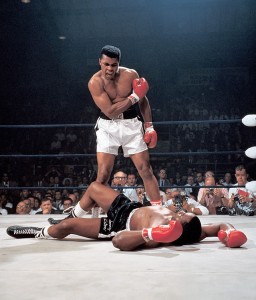
Photo Summary: Muhammad Ali screaming for Sonny Liston to get up off the ring
Picture Taken: Liston was knocked down 1 minute and 42 seconds into the first round on May 25, 1965

Muhammad Ali vs Sonny Liston title match is still one of the most controversial boxing matches in the world. The second match only lasted 1 and 42 seconds before Muhammad Ali knocked done Liston with what would become known as the “phantom punch”. While Liston laid on the ground Ali stood over him screaming to get up while photographers snapped this now-famous photo of the scene.

Taking the photo


Ali vs. Liston - May 25, 1965 - Lewiston, Maine. - Neil Leifer  5-22-07

In 2012 Wired.com did a series of photos of photographers and their iconic pictures


Photographer Neil Leifer recounting taking the picture:

Well, I was lucky. I don’t want to sound like I’m just being modest … The photographer you see between Ali’s legs is Herbie Scharfman, the other Sports Illustrated photographer. It didn’t make a difference how good he was that night. He was obviously in the wrong seat. What the good sports photographer does is when it happens and you’re in the right place, you don’t miss. Whether that’s instinctual or whether it’s just luck, I don’t know.

To capture the color, Leifer had rigged special flash units over the ring, but this led to a bigger challenge: Leifer had one shot. The other photographers brandished the equivalent of semi-automatics whilst he held a sniper rifle. Leifer’s strobes needed time to recharge, which meant he couldn’t click and click. Whenever a fighter fell, the other photographers could quick-twitch their shutters, but Leifer had to pick one moment, artistically aping the sniper’s motto: one shot, one kill.

Nonetheless, Leifer managed the risks and got the great shot—got it, knew it—but couldn’t get it to stick. Not in the minds of his editors, at least. Eventually, many months after that issue of Sports Illustrated had been consigned to the stacks, an editor espied the image again and thought it worth consideration. He submitted it to the prestigious “Pictures of the Year” contest—the Oscars for photographers. But there, too, the photo failed. What would later be voted as the best sports photo of the century couldn’t conjure an honorable mention. — Iowa Review:How Things Break

Cassius Marcellus Clay

Muhammad Ali (Cassius Marcellus Clay, Jr. on January 17, 1942) was born in Louisville, Kentucky. He was named after his father, Cassius Marcellus Clay, Sr and would grow to stand 6’3″ (1.91 m) tall. It wasn’t until March 6, 1964, Malcolm X when Elijah Muhammad the leader of the Nation of Islam stated that Cassius Clay was to be renamed Muhammad (the prophet of Islam) Ali (fourth rightly guided caliph). As an amateur Clay won boxing gold at the 1960 Rome Olympics. Turning pro he won his first fight against Tunney Hunsaker in Louisville, October 29, 1960. Over the next three years, he defeated a string of boxers including, Tony Esperti, Jim Robinson, Donnie Fleeman, Alonzo Johnson, George Logan, Willi Besmanoff, Lamar Clark (who had won his previous 40 bouts by knockout), Doug Jones, and Henry Cooper. By 1963 Clay was ready to take a stab at the World Heavyweight Boxing championship title held by the much-feared Sonny Liston.
Sonny Liston

Charles L. “Sonny” Liston (May 8?, 1932 – December 30?, 1970), was born into incredible poverty of a shareholder farmer family in Johnson Township, St. Francis County, Arkansas. As a young man, he was arrested and sent to jail which he found he actually enjoyed. The food in prison was better than any he had on the outside and while in he was discovered by a prison Chaplin who encouraged and taught him to box. Outside the prison, he soon gained a fearsome reputation as a professional boxer taking the championship title from Floyd Patterson on 25 September 1962. He and everyone in the boxing world expected Liston to crush the fast-talking Clay.

The First Match


The bout was held on February 25, 1964, in Miami, Florida. Clay launched a physiological campaign against Liston, dubbing him “the big ugly bear” and showing up and taunting him while Liston trained. When the fight opened Liston almost ran across the ring to shut up with his fists the fast-talking Clay. When talking to the press about his strategy for fighting Liston Clay and fellow street-poet Drew Bundini Brown coined the now famous quotes about he would, “float like a butterfly and sting like a bee,” and “Your hands can’t hit what your eyes can’t see.” Which is exactly what Clay did as he slowly tired down Liston while landing a few blows himself. By the third round Clay was in control but in the forth a mysterious substance found its way into Clay’s eyes blinding him. While half blind he was able to avoid Liston’s punishing blows until the burning substance was washed away from Clay’s sweat and tears. Eyes cleared by the fifth round Clay landed a number of combinations and by the sixth Liston seemed pushed to the limit. Then Liston shocked the world when he threw in the towel in 7th claiming to have an injured shoulder and giving Clay the World Heavyweight Boxing championship.

Cassius Clay becomes Muhammad Ali

The day after the fight Cassius Clay held a press conference where he announced that he was a Muslim and member of the Nation of Islam or Black Muslims. The American public was shocked at this news as the Nation of Islam was viewed with suspicion if not outright hostility. Soon Cassuis Clay announced that like Malcolm X he would be giving up his last name, his slave name and would like to be called Cassius X. Then on March 6, 1954, the leader of the Nation of Islam, Elijah Muhammad, announced that Cassius X’s new name would be Muhammad Ali.

Second Fight

Muhammad Ali (Vs. Sonny Liston) Sports Poster Print
Due to the highly irregular fight where the now Muhammad Ali had won the title the boxing commission scheduled a new fight for 16th of November 1964. Three days before the fight Ali suffered a hernia that required an operation and recovery time so the fight was delayed for six months. During those months was a fire at Ali’s apartment, Malcolm X was assassinated and the Nation of Islam’s offices in New York was bombed. The fight was to be held in Boston either due to fears of an attack on Ali or Liston’s mob connections one Garrett Byrne, on May 5, 1965, filed an injunction to block the fight. When word broke out that Boston was out Sam Michael the director of economic development in the small town of Lewiston, Maine sent word that his town could host it. Lewiston was well off the beaten path of boxing and Sam had to basically build up the fight from scratch. He had to find an arena, print tickets, get the necessary permits, find a ring but he was able to do it even calling the governor to help. By May 7 Sam Michael had everything in order and announced that the title ship match would be held in a small town about 150 miles north of Boston, Lewiston.

With the assassination of Malcolm X and Liston’s mob connections rumors abound that either boxer could be killed that night. The TV broadcasters of the fight, Sports Vision, Inc, put out a $1,000,000 insurance policy in case Ali was murdered and the fight called off. Ali’s camp knew the dangers and security were tight a New York bomb squad was brought in to sweep the building and some 200 extra police brought into search people coming into the arena. Prices soared for tickets and due to the location, security fears, and the hysteria surrounding the fight only 2,434 fans attended the fight.
Ali had changed in many ways since the last fight and so had Liston but where Ali pushed forward Liston seemed to crumble. Black activist Dick Gregory remembered visiting Liston expecting a man of steel eager to retain his title but found a defeated man slumped in front of the TV. He would tell his friends, “his mind is blown. He’s gonna lose fast.”

Ali Liston fight AP Photo by John Rooney

AP Photo by John Rooney


Gregory couldn’t have been more right as 1min and 40 seconds into the fight Ali threw what would become the “phantom punch” knocking Liston down. The ref, Jersey Joe Walcott, a former world Heavyweight champion himself couldn’t keep Ali in the corner. Ali perhaps confused himself on why Liston was on the ground screamed for Liston to get up. It was at that second that ringside photographers snapped one of the most famous pictures of Ali. It was also in that confusion that the ref forgot to count out Liston. After what was determined to be around 14sec Walcott actually allowed Liston to get up and continue the fight. Ali quickly resumed his beating before a publisher, Nat Fleischer of Ring Magazine started yelling at Walcott that Liston was down on the mat longer than 10sec. So one of the important fights of the time was called not by a ref, ringside judge or boxing official but a journalist who just happened to be there. Walcott quickly separated the boxers and declared Ali the defender and still world heavyweight champion.

What’s my Name?

Pictures of this famous pose are often confused with another fight of Ali’s February 6, 1967, Muhammad Ali vs Ernie Terrell. Terrell had infuriated Ali by calling him by his former name, Clay. Muhammad Ali pummeled Terrell throughout the fight screaming, “What’s my name, Uncle Tom … What’s my name.” He would beat Terrell unmercifully but hold back from actually knocking him out. Many sports writers at the time said that the fight only went the full 15 rounds because Ali wanted it to. After the fight Sports Illustrated writer, Tex Maule wrote, “It was a wonderful demonstration of boxing skill and a barbarous display of cruelty.”

Copyright info

APimages handles the copyright procedures for the John Rooney B&W photo

More Famous images

Related Posts:

Uncle Sam Wants You

Buy on amazon
Uncle Sam Wants You
Behind the camera: James Montgomery Flagg
Where: Flagg’s Studio
Photo Summary: Uncle Sam pointing at the viewer in such a way that the finger seems to follow the viewer around the room.
Picture Taken: Originally published as the cover for the July 6, 1916, issue of Leslie’s Weekly with the title ‘What Are You Doing for Preparedness?’. Released as a poster in 1917.
This image is in the public domain because it was taken by a federal employee, James Montgomery Flagg

This World War I recruitment poster image of Uncle Sam is one of the most recognized posters in the world. The poster cemented the image of bearded Uncle Sam and over 4 million posters were created. It became so popular that it was recreated for World War II and since then used as inspiration for countless other posters.

Painting Uncle Sam

July 6, 1916, issue of Leslie’s Weekly

James Montgomery Flagg originally created the image for the July 6, 1916, issue of Leslie’s Weekly with the title “What Are You Doing for Preparedness?”. When America entered World War I the federal government set up a propaganda division called, Committee on Public Information, headed by one George Creel. Creel, in turn, created a Committee of Pictorial Publicity (COPP) which was to specialize in creating pro-war posters. Flagg joined COPP in 1917 and redesigned his earlier Leslie magazine cover into the present famous poster.


James Montgomery Flagg

James Montgomery Flagg

The image is actually based on a very popular British recruitment poster, Kitchener Wants You! (Shown Below), published in 1914 and designed by artist Alfred Leete. Looking for a more stern face for Uncle Sam Flagg used his own features for the face and, “an inescapable, slacker-accusing finger, demanding: I WANT YOU.” During World War II when presenting a copy to President Franklin Delano Roosevelt, Flagg remarked that he had used his own face. Roosevelt replied: “I congratulate you on your resourcefulness in saving model hire. Your method suggests Yankee forebears.”

Uncle Sam

Uncle Sam’s origins remain rather murky but seem to have come from the war effort surrounding the War of 1812 when America tried to conquer its northern neighbour, Canada. Legend has it that the meat that the soldiers received had the initials E.A.– the U.S. stamped on all the army-bound food. E.A. stood for government subcontractor Elbert Anderson and the U.S. stood for the United States of America. Some of the soldiers didn’t make the connection and when asked what the initials stood for army suppliers told them, “Elbert Anderson and Uncle Sam” Uncle Sam being another contractor who supplied meat, a much loved Sam Wilson. History.com claims that on Sept 7, 1813, the “United States gets its nickname, Uncle Sam.”
Cecil Adams of the Straight Dope remarks that the story is, “Very neat, but is it true? On the surface, it might seem so. Researchers have established that Elbert Anderson and Sam Wilson did exist and did supply meat to the government during the War of 1812. What’s more, the earliest known reference to Uncle Sam in the sense of the U.S. government appeared in 1813 in the Troy Post.”


Uncle Sam points from the cover of Leslie's Magazine Feb 15 1917

Uncle Sam points from his 2nd Front Cover of Leslie’s Magazine on Feb 15 1917

However, the first connection with Uncle Sam equaling Sam Wilson doesn’t appear in print until almost 30 years later. Even when Sam Wilson died in 1854 his home papers didn’t mention the Sam Wilson, Uncle Sam connection. The post in 1816 did print a story claiming that Uncle Sam originated from the United States Light Dragoons (USLD) a regiment formed in 1807. This story claims that when asked what was said on their hats the USLD soldiers would say, “Uncle Sam’s Lazy Dogs.” In any event, Uncle Sam’s origins will remain shrouded in history.

Similar Posters

Have You Volunteered For The Red Army? Print

Have You Volunteered For The Red Army?

Lord Kitchener Your Country Needs You Art Poster

Lord Kitchener Your Country Needs You Art

SaoPaulo Constitutionalist Revolution 1932

SaoPaulo Constitutionalist Revolution 1932

Other Famous pictures

Related Posts:

  • No Related Posts

The Train Leaves the Station

Buy on amazonAccident Montparnasse Train
Behind the camera: Roger Viollet (left) and Lévy et fils (right)
Where: Gare Montparnasse, Train Station, Paris, France
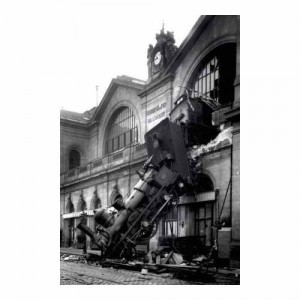
Photo Summary: Granville-Paris Express rail engine 120-721 after it crashed through the station wall and onto the street
Picture Taken: October 22, 1895
This image is in the public domain because of its age

As the Granville-to-Paris Express approached Montparnasse Station conductor Guillaume-Marie Pellerin looked at his watch. Knowing that he was going to be a few minutes late for the train’s 15:55 arrival time Pellerin kept the train running at high speed as he completed the approach to the station. Pellerin knew he could maintain the high speed and when he was close to the station he would apply the Westinghouse air brake to safely bring the train to a stop. However, on this October 22 in 1895 the Westinghouse brake system failed and at full speed, the train crashed through 100 ft (30m) of the station concourse, smashed through a two feet (0.6m) wall and sailed two stories to the ground below. The image now long since out of copyright is often used by poster companies to show images where something failed or went wrong.

The accident


Accident Montparnasse etching

Le Journal Illustré used the image as a basis for their front page etching


Montparnasse Station is one of the oldest stations in Paris have been in operation since 1840. In 1852 the station as to how it looks in the photo was completed based on the design of architect Victor Lenoir. The trains would arrive on the first floor but in front of the station, a sunken road called the Place de Rennes carried a tramway between the station and Place de l’Etoile.

Locomotive No. 721 a 2-4-0 (or type 120 using the French system) was used for the Granville-to-Paris Express which left Granville every day at 08:45. Nothing was different on the day of the accident with the train conductor Guillaume-Marie Pellerin, a 19-year railroad man, leaving at 08:45. During his run, the train began to fall behind and after the last stop before Montparnasse had 131 passengers aboard. To make up for lost time Pellerin made the infamous decision to enter the station area at cruising speed. But he wasn’t the only one to blame. Two other train staff could have stopped the train with the hand brakes but one of them Albert Mariette was preoccupied with filling out paperwork as they entered the station and he failed to notice in time that train was going faster than it should be. Just as he applied the brake the train smashed through the buffer stop.

Incredibly no one on the train was killed and there were only five injuries, three of those were the crew. Tragically though, Marie-Augustine Aguilard, the wife of a news vendor on the street below was killed when she was struck by falling masonry. She had been watching the newsstand while her husband went to get the evening papers. The train company paid for her funeral and provided a pension for her children.
Guillaume-Marie Pellerin and Albert Mariette were both prosecuted for negligence and found guilty for driving the train too fast and Mariette for not applying the brake in time. There were fined 50 and 25 francs respectively.

Roger Viollet and Lévy et fils both took pictures of the crash though Viollet took a number of photos from different angles. The image now long since out of copyright is often used by poster companies to show images where something failed or went wrong.

roger viollet la gare montparnasse Gare Montparnasse, Train Station, Paris, France Gare Montparnasse, Train Station, Paris, France The Color of TimeMontparnasse derailment that occurred on the 22nd October 1895 in Paris

See also

February 14, 1900 VS 2021. Train crash at the Harcourt Station Dublin

Other Popular Culture pictures

Related Posts:

  • No Related Posts

James Dean in Times Square

Buy on amazon

Behind the camera: Dennis Stock
Where: Walking the streets of Times Square, New York
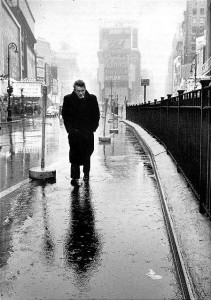
Photo Summary: James Dean walking in the rain in Times Square New York
Picture Taken: February 1955

James Dean’s fate as an iconic movie star would be guaranteed after this photo was published in a 1955 LIFE magazine issue. Only a few months later the star would die in a car crash out west. His image as a rebellious angst-ridden star would be forever sealed by his death.

Taking the picture


The photographer, Dennis Stock, had met James Dean in New York where the two talked and agreed to work together. Stock was at first hesitant about the shoot. But after Jimmy, Dennis always insisted on calling him James Dean Jimmy, invited him to a sneak premiere to Dean’s film, East of Eden, Stock was sold on the collaboration. In an interview to PBS remembers,

“As was customary in my business, I would solicit an assignment guarantee to cover expenses. The obvious magazine to approach was Life. If I was assigned to the Life editors, we could set up a schedule for visiting Indiana and New York. We further agreed that I would have the first exclusive rights to the picture story on Jimmy.”

Stock also recalled that Dean, perhaps pushing his star power too far, made some conditions on the photoshoot. He wanted a cover guarantee and an agreement that his friend to do the accompanying write-up. Stock recalls,

It was an unusual and highly egocentric gesture. I said I’d pass the request on to the editors. It was a foolhardy demand, which I never conveyed to the magazine, gambling on our growing friendship to keep the assignment afloat. I told Jimmy the editor’s answer was no. For days he acted like a spoiled kid, and then finally came around, making it possible for us to leave for Fairmount the first week in February, 1955.

They went to Fairmount to cover his small town Midwest childhood then went to New York to capture his budding movie stardom. In Fairmount they shot a number of interesting shots including one with a large hog. While Dean was agreeable in his hometown but in New York Dennis found the movie star to be grumpy and difficult to work with. Apparently, the night before the Times Square shot Dean’s insomnia had hit and the idea to take pictures in the cold wet and miserable weather took some convincing by the photographer. The photo essay titled, Moody new star, was published in the March 7, 1955, issue of LIFE magazine. On pg 128 this image was published with the caption:

Walking in Rain, Dean wanders anonymously down the middle of New York’s Times Square. His top-floor garret on Manhattan’s West Side is no more home to him, he says, than the farm in Indiana. But he feels that his continuing attempt to find out just where he belongs is the source of his strength as an actor.

James Dean


James Dean died at the young age of 24 on September 30, 1955, in a horrible car crash at the junction of highways 46 and 41 in California. His image of a rebel was created in one his most celebrated film, Rebel Without a Cause. His other two movie roles, loner Cal Trask in East of Eden, and as the surly farmer Jett Rink in Giant only supported this rebel image. Cited as an actor with great talent his death guaranteed that we would only see this side of talent. In death, he was the first actor to receive a posthumous Academy Award nomination for Best Actor and remains the only person to have two posthumous acting nominations.

Dennis Stock

The New York native Stock joined the navy at the young age of 16 to fight in World War II. After the war, he studied photography and in 1951 won the first prize in the Life young photographers competition. Catching the eye of famed photographer Robert Capa he was invited to become an associate member of Magnum, Stock had early assignments in Paris before he began shooting the Hollywood scene. Over the years he published a number of collections about the American jazz scene. He died on Jan. 11, 2010 from colon cancer in Sarasota, Florida. He was 81.

Copyright info


Copyright to this photo is managed by Magnum: James Dean in Times Square by Dennis Stock

More Famous photos

Related Posts:

Albert Einstein

Buy on amazon

Behind the camera: Arthur Sasse
Where: Princeton University
Photo Summary: Einstein leaving his 72nd birthday. Annoyed with the media he stuck out his tongue at the cameramen
Picture Taken: March 14, 1951

Einstein, the man who brought us E=mc2, nuclear power, and changed how we look at the universe. His name, Einstein, has become synonymous with brilliance or genius. Yet he wasn’t the serious, stodgy scientist stereotype, which is perhaps why he is still such a popular figure. His giant intellect, crazy hair, humour and indifferent wardrobe made him probably one of the most famous scientists if not public figures in history. The picture of Einstein with his tongue sticking out seems to sum up these down to earth characteristics that people like so much about him. Frederic Golden of TIME nailed it when he said, Einstein was “a Cartoonist’s dream come true.”

Taking the picture

Mrs. Aydelotte, Albert Einstein, Dr. Frank Aydelotte on Einstein's 72nd birthday

From left to right Mrs. Aydelotte, Albert Einstein, Dr. Frank Aydelotte on Einstein’s 72nd birthday

Caveo Sileo, assignment editor … Liked it, but the chief editor didn’t
-Art Sasse

The shot was taken on Einstein’s 72nd birthday right after an event in his honour was finished at Princeton on March 14, 1951. While walking with Dr. Frank Aydelotte, the former head of the Institute for Advanced Study, and Mrs. Aydelotte back to their car, reporters followed trying to get shots of Einstein. Art Sasse of the INP let the crowd of reporters take their pictures and when the crowd had dispersed walked up close to the car and said, “Ya, Professor, shmile [sic] for your birthday picture, Ya?” Einstein probably thinking the photographer wouldn’t be fast enough stuck his tongue out and quickly turned his head away. The picture ran as a shot of all three people in the car. The editors debated on whether or not to use the picture and Sasse remembers that “Caveo Sileo, assignment editor … Liked it, but the chief editor didn’t. So they had a conference with the ‘big chiefs upstairs.’ The picture got okayed, and we used it…” Einstein liked the image and cut up the picture so that it was just his head. He used it for greeting cards that he sent to his friends. This famous image has probably been reproduced on everything from posters to coffee cups.

Albert Einstein

Albert Einstein was born in Ulm in Württemberg on March 14, 1879, in what was then known as the German Empire. He was born in a secular Jewish family of Hermann and Pauline Einstein. His father ran an electrochemical business. Einstein had a normal education and didn’t suffer from autism, dyslexia, and/or attention deficit disorder. In 1894 Albert’s father’s electrochemical business went belly up and the family moved to Pavia, Italy. Albert stayed behind to finish his high school but even though he passed all his courses decided to leave early before graduation and didn’t get his diploma so he could be with his family.

He eventually moved to Switzerland to finish his high school and he continued on at the Eidgenössische Technische Hochschule (ETH Zurich) University, finishing a teaching diploma in the year 1900. He wasn’t able to find any work as a professor and a friend got him a job at the Swiss Patent Office in 1902. On January 6, 1903, he married Mileva Marić a fellow student at ETH and longtime girlfriend. The two had three children, the earliest a girl, Lieserl, was born out of wedlock and after her birth disappeared. In 1919 Einstein divorced Mileva and wed his cousin Elsa Löwenthal (born Einstein, Löwenthal was her first husband’s name) a few months later.

Throughout 1905 he published a number of papers later called the Annus Mirabilis Papers. Included in these papers was one titled, Does the Inertia of a Body Depend Upon Its Energy Content? Which contained the famous E=mc2 equation. He left the Patent office and taught at a number of Universities in Europe eventually settling down in Berlin in 1914. He stayed in Berlin, until 1933, where he was the director of the Kaiser Wilhelm Institute for Physics.

In 1915 he started a series of lectures where he described his theory of gravity, known as general relativity. The theories he introduced were proven in 1919 by Arthur Eddington. Eddington using observations obtained from Brazil and Africa recorded the bending of light during a solar eclipse, reinforcing Einstein’s theory of relativity. Some scientists resisted these new concepts and when Einstein won the Nobel Prize in 1921 it was granted for his earlier work on the photoelectric effect rather than his Relativity Theory. The Nobel committee picked the less-contested theory in hopes that the prize would be more acceptable to the scientific community.

Einstein flees the Nazis

Einstein becomes a US citizen

In 1933 Hitler came to power and passed the “The Law of the Restoration of the Civil Service” which forced Jewish government employees from their jobs. Einstein who had been teaching in America part-time decided to stay in America and in 1940 became a US citizen. In 1939 Einstein wrote a letter to President Roosevelt urging America to start a nuclear program out of fear the Nazi’s would develop atomic weapons first. In his later years, he would hold a number of teaching positions while trying to prove his theories.

President of Israel

Throughout his life, he was a big supporter of Israel and worked with a number of Israeli Universities and Israeli causes. In 1952 the Israeli government offered the post of president of Israeli to Einstein an offer he declined. In letter to the Israeli government he wrote:

I am deeply moved by the offer from our State of Israel [to be President], and at once saddened and ashamed that I cannot accept it. All my life I have dealt with objective matters, hence I lack both the natural aptitude and the experience to deal properly with people and to exercise official functions. Therefore I would also be an inappropriate candidate for this high task … I wish from the bottom of my heart that a man is found who will be able to take over the hard and responsible office due to his work and his personality.

Passes away at 76

Aged 76 at 1:15 AM, April 18, 1955, he died in a Princeton hospital in New Jersey from internal bleeding caused by a ruptured aortic aneurysm. His brain was removed and preserved before the body was cremated. Many groups studied the brain without any significant discoveries until it eventually ended up being studied by Canadian scientists in 1996. They discovered that the part of the brain, the inferior parietal lobe, which is responsible for mathematical thought and the ability to understand space and movement was 15% wider than average brains. Also, Einstein’s brain lacked a groove that normally runs through that region of the brain. These attributes of Einstein’s brain may have given him his genius.
Upon death Einstein left his name and image to the Hebrew University of Jerusalem, a University he supported while alive. The royalties from the licensing of his name and any products in his likeness now go to the University. The agency that runs manages the Einstein brand is very strict and insists that when using the name, ‘Albert Einstein™’, that the trademark ™ symbol must always be present. Albert Einstein™ is a lucrative trademark that makes millions for the University. Apple computer, Disneyland, and many other corporations use his name or likeness to sell products.

Ever seen a picture of young Einstein?

Albert Einstein with friends Habicht and Solovine,ca. 1903

Einstein on the right in 1903

Almost all of the products licensed to use Einstein’s image exploit the crazy-haired mad genius look of old Einstein. Pictures of young Einstein are usually ignored even though it was this time that the man Einstein changed the world. In contrast to his later years young Einstein was by all accounts and pictures, where he is clad in the latest styles, was a snappy dresser. His admirers overlook young Einstein, perhaps because his earlier images are of him following the herd rather than the popular later old Einstein, black sheep image. Images of the old Einstein have reached iconic status. Purists and admirers of young Einstein will have been left to moan about how “the most persistent myth about Einstein is that he was born at the age of 50.”

Other Famous Images

Related Posts:

Face on Mars

Behind the camera: Viking I space probe
Where: 40.8° N, 9.6° W Mars
Photo Summary: A mountain formation on Mars that looks like a face
Picture Taken: July 25, 1976 as the Viking 1 space probe orbited Mars
This image is in the public domain because it was taken by NASA

Together with Bat Boy, and Elvis the “Face on Mars” has haunted supermarket checkout Tabloids for years. NASA scientists call it merely an interesting rock formation that happens to look like a face. The faithful call it an artificial monument created by Martians as a sign, perhaps a warning, to us or other Aliens.

Where on Mars

The Face is a large mountain or mesa in the Cydonia region of Mars. It is located at around the 40.8° N, 9.6° W, that’s 40.8°N of the Martian equator. Approximately 3 km long and 1.5 km wide the face was first photographed on July 25, 1976, when the Viking 1 space probe was in orbit taking pictures. The Viking 1 was snapping photos of possible landing sites for its companion ship, Viking 2 when it shot what appeared to be a giant head.
The Viking spacecraft beamed the potential landing sites back to earth where NASA planners pored over the images to find a landing spot. When NASA scientists first saw the head the facial features were thought of as a neat coincidence. The decision was made to release the image in the hopes of spurring the public’s interest in Mars and space exploration in general.

Caption of JPL Viking Press Release P-17384 NATIONAL AERONAUTICS AND SPACE ADMINISTRATION VIKING NEWS CENTER PASADENA, CALIFORNIA (213) 354-6000 Viking 1-61
P-17384 (35A72)
PHOTO CAPTION
July 31, 1976


This picture is one of many taken in the northern latitudes of Mars by the Viking 1 Orbiter in search of a landing site for Viking 2. It shows eroded mesa-like landforms. The huge rock formation in the center, which resembles a human head, is formed by shadows giving the illusion of eyes, nose, and mouth. The feature is 1.5 kilometres (one mile) across, with the sun angle at approximately 20 degrees. The speckled appearance of the image is due to bit errors, emphasized by enlargement of the photo. The picture was taken on July 25 from a range of 1873 kilometres (1162 miles). Viking 2 will arrive in Mars orbit next Saturday (August 7) with a landing scheduled for early September.

Cydonia

Cydonia, the area of Mars where the face is located is covered with mesas that rise high in the air, the surrounding areas having been eroded by the thin Martian air, and possibly water, over billions of years. NASA Scientists saw the image as simply a large mountain similar to mesa’s found in Arizona deserts. The low image resolution of the Viking camera made the “face’s” features appear smoother than what they would be in real life. Plus the shadows give the perception of facial features. After all the brain is trained to find patterns, especially faces, in the things we see around us which is why we see things in clouds or the man on the moon. This brain’s function even has a name: pareidolia (payr.eye.DOH.lee.uh) n. The erroneous or fanciful perception of a pattern or meaning in something that is actually ambiguous or random. Finally, as talked about in the NASA caption, a bit error or a part of the image was lost in transmission appeared right where a nostril would be on a humanoid head. It is these lost “dots” or “bit errors” that give the original image a spotty appearance.

Face becomes famous

When the image was released it captured some attention but it wasn’t until the face was re-discovered three years later that it really captured the public’s imagination. Computer engineers Vincent DiPietro and Gregory Molenaar, under contract at NASA’s Goddard Space Flight Center, had been intrigued by the face and another nearby structure shaped like a pyramid, now called the D&M pyramid after its two discoverers. Poring over NASA picture archives they found 10 images taken of the face and surrounding area but only 2 where high-resolution of the face. Using a new software they had developed called SPIT (Starburst Pixel Interleave Technique) they were able to digitally enhance the images. The results of enhanced images appeared to reveal more detail of the face including, “mouth, teeth, eye sockets, eyeball and pupil, and hairline or headress, and the FACE appears to be bysymmetrical.”

The Monuments of Mars


Some of the "Monuments of Mars" see the so-called pyramid in the bottom right hand corner.


By this time public interest in the face and the potential of a lost civilization on Mars exploded. A cottage industry of books, conventions, science fiction plots about the Face on Mars quickly sprung up seemingly lead by Richard Hoagland. In his book The Monuments of Mars: A City on the Edge of Forever he talks about the face and other surrounding formations that he and others have deemed evidence of a lost civilization. Included in these other “structures” are a pyramid, fortress, ruins of a city, and much more. Fringe groups who have thought that the pyramids of Egypt and South America were either inspired by or actually built by Aliens quickly pounced on the pyramid civilization on Mars theory as proof that Aliens have visited both planets.
Aerial images of the pyramid do look similar to the shots of the supposed pyramid on Mars. However, if the Face on Mars was an artificial structure why does it look straight up? The face itself is huge if you were to stand on the ground surrounding the structure you would have trouble making out the features so why would a civilization spend vast amounts of energy building something that they couldn’t even enjoy? Past civilizations on Earth have always built great monuments like this in a standing or upright sitting position i.e. Sphinx so that they could be viewed by worshippers/subjects on the ground.
While Hoagland and his fellow band of believers were working themselves into a fevered pitch pointing out new artificial landmarks on the Martian landscape NASA was preparing for the next Mars visitor. The Mars Global Surveyor (MGS) began orbiting Mars on September 12, 1997, and much to the shock of the proponents of artificial life on Mars NASA did not first go to Cydonia to re-map the Face of Mars. NASA scientists refused to acknowledge that the Face of Mars is a priority and stated something to the effect of, we’ll get around to it eventually. The public outcry was so great to revisit the Cydonia region that NASA was forced to change its timetable and agreed to re-photograph the Face of Mars and surrounding formations as soon as possible.

Race revealed


Image taken during the 2001 flyover


On the 5th of April,1998, MGS flew over the Cydonia region for the first time. The MGS was able to take pictures 10 times sharper than the original Viking photos. As it passed over the Face thousands of earth bond enthusiasts held their breath but … there was no face. Pictures beamed back to earth showed that the Face of Mars was in fact just another mountain and on closer inspection looks nothing like a face.
Of course, this did not faze the hard-core believers who pointed out that the Face on Mars is located at 41 degrees north Martian latitude. At that degree, it was winter in April 1998, winter on Mars is a cloudy time of year. True believers clung to the belief that the MGS camera images were distorted by winter clouds! If only NASA could get shots on a clear Martian day. Then surely the face would be there for all to see.

On the 8th of April, 2000, such a day happened to come along. A cloudless summer day in Cydonia, MGS (MGS even now continues to orbit and photograph Mars having mapped almost 5% of Red Planet’s surface) took its most recent pictures: “We had to roll the spacecraft 25 degrees to centre the Face in the field of view,” said Jim Garvin, chief scientist for NASA Mars Exploration Program. “It’s not easy to target Cydonia,” said Dr. Garvin. “In fact, it’s hard work.” MGS is a mapping satellite that looks straight down and scans like a fax machine in 2.5 km-wide strips. “We just don’t pass over the Face very often.”
Again the photos confirmed that the Face on Mars is natural not a face with no eyes, no nose, and no mouth. This time the MGS was able to use laser altimetry data to confirm even more that Face is natural.
Of course, not even this has convinced the die-hard believers. Google “Face of Mars” and you will get hundreds of sites claiming that even with the recent MGS Passovers there is enough evidence to prove that the face is artificial and that NASA is trying to cover up life on the Red Planet by providing distorting images and refusing to do certain photographic tests to prove that the Face of Mars isn’t natural. If you yourself are on the fence thousands of pictures taken by MGS have been placed online and you can scan Mar’s many volcanoes, canyons, ice fields, weather systems and even the latest images of Cydonia and the “Face.”

More Famous Pictures

Related Posts:

Loch Ness

Buy on amazon
Behind the camera: Officially Colonel Robert Wilson but later revealed to be Ian Wetherell
Where: Northern shoreline of Loch Ness in Scotland, UK
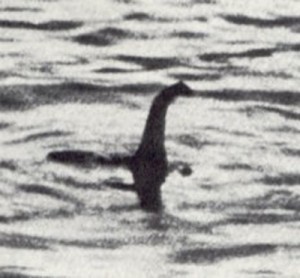
Photo Summary: The supposed Loch Ness Monster
Picture Taken: April 19, 1934

The story goes that on April 19, 1934, Colonel Robert Wilson, a respectable surgeon, was driving along Loch Ness when something in the water caught his eye. He quickly whipped out his trusty camera and took some pictures. Rumours and sightings of the Loch Ness Monster had created a media sensation in the early 1930s. When Wilson’s picture was published, believers seized it as the irrefutable proof that some kind of large beast lived in the lake. Wilson refused to be drawn into the speculation, never publishing the picture himself and refused to have his name associated with it. Therefore the picture became know as the “The Surgeon’s Photo”

Loch Ness

Loch Ness (Loch means Lake) is 37km (23 miles) long and more or less shaped like a big rectangle with an average width of 1.5km (about a mile). With a surface area of 56 km2, (22 miles2) Loch Ness is the second largest in Scotland terms of surface area. When you take into account how deep the lake is though, deepest part 226 m (740 feet), it is the largest by volume. It’s said that Loch Ness has as much fresh water as all of England and Wales. The city of Inverness is only a few kilometers north of the Loch. The area surrounding the Loch has a high peat content that drains into and makes the lake dark and murky. Even though the lake is cloudy it supports a variety of wildlife including salmon, eels, pike, sticklebacks, sturgeon, trout, seals, otters and supposedly Nessie.

Ancient Monster

Thou shalt go no further, nor touch the man
-St. Columba

The Scottish tribes who lived in the area, the Picts, named after their Painted bodies, have many legends about a monster that lived in Loch Ness. Some of their art recovered from archaeological finds show the carving of a strange water beast. Ancient historians recorded almost 1500 years ago that St. Columba, who converted much of Scotland to Christianity, had an encounter with a monster. While attending a funeral for a man who had been killed while swimming in the lake St. Columba saw that a monster was approaching another man. The ancient historian, Adamnan reports that St Columba said, “ ’Thou shalt go no further, nor touch the man; go back with all speed.’ Then at the voice of the saint, the monster was terrified, and fled more quickly than if it had been pulled back with ropes.”

It wasn’t till the 30’s that the Loch Ness legend spread outside rural Scotland. In the May 2, 1933, edition of the Inverness Courier it was reported that a Mr. and Mrs. John Mackay saw what they described as a huge animal splashing about before diving into the lake. This report sparked huge media interest throughout the country. All the major papers sent reporters to the Scottish backwater in hopes of catching a glimpse of the beast that would become to known by the nickname, “Nessie”. It was this media attention that solidified the belief some sort of monster lived in the depths of Loch Ness.

Sightings soon became commonplace and were helped by the fact that in the ’30s a new highway was built along the northern shoreline, allowing people to drive the length of the lake. One newspaper, The Daily Mail, hoping to catch the scoop hired a famous self-described big-game hunter named Marmaduke Wetherell to investigate. He wasn’t able to bag the beast but he did find some huge tracks leading into the lake that he proudly displayed to the press. When the Natural History Museum tried to confirm the find they quickly discovered that the footprints had been a hoax made by a dried Hippo’s foot. Something that at the time was commonly used for umbrella stands. Wetherell was humiliated by being taken in by the prank and bitterly faded from the limelight but his link with Nessie didn’t stop there. It wasn’t until 1994 that Wetherell’s role in the creation of the Nessie legend became public.

Wetherell’s Revenge


Model of the Nessie Submarine


Alastair Boyd, a self-described true believer, who himself witnessed a huge beast in Loch Ness has spent years researching Nessie. In the early 90’s David Martin, a friend of Alastair came across an old 1975 article detailing a claim that Ian Wetherell, the son of Marmaduke Wetherell, claimed that the surgeon photo was a fake. They decided to investigate further and found the location of Marmaduke Wetherell surviving stepson Christian Spurling, as Ian Wetherell had already died. Christian Spurling when confronted with the story, aged 90 himself and on his deathbed, confessed that yes the surgeon picture was a hoax, and the mastermind behind it was, Marmaduke Wetherell.

Instead of continuing the search after the hippo foot incident, Wetherell decided to get even. Christian Spurling his stepson remembers him saying, “we’ll give them their monster”. Spurling, a professional model-maker, was asked by his stepfather to sculpt something that would fool the public. Starting with a toy submarine Spurling added a long neck and small head. He recounted that the mock-up, “was modelled on the idea of a sea serpent.” The finished product was about 45 cm long, and about 30 cm high with a lead keel for stability on the water. On a quiet day Marmaduke Wetherell his son Ian and stepson Christian Spurling went down to the lake where Ian took some pictures of the “monster”. As a finishing touch, Marmaduke Wetherell convinced Dr. Wilson to develop the photo and sell it to the Daily Mail to add respectability to the hoax. Wetherell knew Wilson through a mutual friend, Maurice Chambers, the same man Dr. Wilson claimed he was visiting when he talked about taking the Surgeon Photo to reporters in 1934.

Still has faith


I would actually stake my life on their existence
-Alastair Boyd

Even though Alastair Boyd uncovered the hoax, he still has faith. That one of the biggest pieces of evidence supporting the existence of Nessie was a lie hasn’t fazed him, “I am so convinced of the reality of these creatures that I would actually stake my life on their existence,” recalling how he himself has seen something in the lake, “I trust my eyesight … I used to make my living teaching people how to observe, and I know that the thing I saw was not a log or an otter or a wave, or anything like that. It was a large animal.”

After the “surgeon photo” emerged in the ’30s, the general consensus was that Nessie was a leftover from the dinosaurs, maybe an ancestor of the plesiosaurs, a huge dinosaur that used fin-like appendages to move through the water. The leftover dinosaur theory is discounted though because the plesiosaurs existed millions of years ago and the loch itself is only about 12,000 years old, created by glacier excavation during the last ice age. So what is Nessie? Before the “surgeon photo” early sighting reported a large gray animal with legs and a long neck. Intrigued by this pre-“surgeon photo” sighting another researcher, Dr. Clark, spent two years investigating the legend.

Nessie an elephant?

After finishing his research, Dr. Clark suggests that Nessie was created in the mind of one Bertram Mills, a circus promoter. Clark thinks that Nessie was a “magnificent piece of marketing” created when Mills saw his circus elephants washing. Circus fairs visiting the city of Inverness would stop on the shore of Loch Ness too, “allow their animals to rest. When their elephants were allowed to swim in the loch, only the trunk and two humps could be seen: the first hump being the top of the head and the second being the back of the animal.” When the Loch Ness Monster story broke Bertram Mills offered a £20,000 reward, £1 million in today’s money, to anyone who could catch the monster. That’s a lot of money to risk but not if you know that the monster is really a couple of elephants already in your circus. Then his £20,000 reward doesn’t become a reward it becomes an advertising tool for the circus, as newspapers around the world report about Bertram Mill circus’s offer.

BBC Investigation

top to bottom … and we saw no signs of any large living animal in the loch
-Ian Florence

In 2003 the BBC tried to answer the question once and for all. Using 600 individual sonar beams and satellite technology the BBC team surveyed the murky depths of Loch Ness. “We went from shoreline to shoreline, top to bottom on this one, we have covered everything in this loch and we saw no signs of any large living animal in the loch,” said Ian Florence, one of the experts brought onto the team. Another specialist, Hugh MacKay noted, “We got some good clear data of the loch, steep sided, flat bottomed – nothing unusual I’m afraid. There was an anticipation that we would come up with a large sonar anomaly that could have been a monster – but it wasn’t to be.”

Having failed to find a large sonar target the BBC team sought to explain the Loch Ness Monster in a different light, that Nessie was a self-perpetuating myth. People wanted to see the monster after hearing about it and they saw what they wanted to see. To prove this theory the BBC team created an experiment where a fence post was submerged underwater and then raised in front of a busload of tourists. When later asked to sketch what they had seen most drew a square fence shaped object but a few drew monster-head shapes.

Using the BBC data and other previous sonar expeditions, researchers were able to conclude that not enough prey stock would exist in Loch Ness to support any large animal. The Loch’s murky waters can’t support enough fish and other wildlife to support a number of large predators needed for a self-sustaining breeding population. Another nail into the legend of Nessie’s coffin is a report by the Italian geologist, Luigi Piccardi. Piccardi came to the conclusion that seismic activity below the lake causes underwater waves, groans, and gaseous explosions that have kept the myth of the Loch Ness Monster alive for years. His report is backed up by studies that show when there is seismic activity in the area Nessie sightings seem to spike. The people who flock to Loch Ness every year don’t seem to care about all the evidence against Nessie, with many Nessie sightings still reported every year. Indeed no matter what the truth behind the Loch Ness legend one thing is for certain, the Loch Ness monster is very good for the Scottish tourist industry.

More Famous Pictures

Related Posts:

  • No Related Posts

American Girl in Italy

Buy on amazonAmerican girl in Italy
Behind the camera: Ruth Orkin
Where: Streets of Florence, Italy
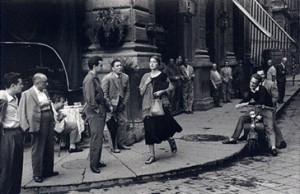
Photo Summary: Ninalee Craig walking down a street surrounded by Italian men. She is wearing an orange shawl
Picture Taken: 1951
In 1951 Ruth Orkin was backpacking around Italy when she ran into another American, Ninalee Craig, doing the same thing at a cheap hotel in Florence, Italy. Talking the two decided to do a photo shoot on the streets of Florence. This, now iconic, shot is just one of many of Ninalee walking around the city while Orkin followed her and took shots Paparazzi style.

Taking the picture

After the two girls decided on doing the photo shoot they walked around the city taking pictures of Ninalee (then going by the name Jinx) doing various things. Craig remembers the two hours the shoot took as “we were literally horsing around.” While walking down a street Orkin noticed that the 6ft tall Craig was getting a lot of looks from the men hanging out there. She had Craig walk up and down the street and then captured this image. The daughter of Orkin who maintains the photographer’s collection after her death also confirms that the photo isn’t staged saying “She told the man on [the] motorcycle to tell the other men not to look at the camera,… But the composition, it just happened. And my mother got it. That’s what she was good at. … She didn’t take loads and loads of photos. She waited for shots.”

When asked if the men were harassing her or threatening her Craig said:

Very few of those men had jobs, Italy was recovering from the war and had really been devastated by it … I can tell you that it wasn’t the intent of any man there to harass me.
That young man [touching himself] is not whistling, by the way; he’s making a happy, yelping sound, And where you see him touching the family jewels, or indicating them, with his hand — well, for a long time that was considered an image people should not look at. That part was airbrushed out for years … But none of those men crossed the line at all.

Ninalee Craig


In 1951 a 23-year-old Ninalee Craig gave up her New York job and booked passage on a third-class ship going to Europe. Taking the name Jinx Allen for six months she toured through France, Spain, and Italy by herself. After about six months and spending less than a thousand American dollars Craig returned to her life in New York. She spent some time teaching before meeting an Italian widower and moving to Italy. The marriage didn’t last and so she returned to America where she met a Canadian and married again moving to Toronto in the 70s. “My life has been wonderful, I’m ready for more” says Craig.

Ruth Orkin

Ruth Orkin was born in 1921, Boston, Massachusetts, the daughter of the silent film actress, Mary Ruby. At the age of 10 she took up photography and enjoyed a bit of fame after cycling from LA to New York, taking pictures along the way. She went on to become an American photographer, filmmaker and a late member of the Photo League. She married photographer and filmmaker Morris Engel. Together the made the critically acclaimed movie The Little Fugitive. She produced two photobooks, A A World Through My Window and More Pictures From My Window before dying from Cancer in New York on 16 January 1985.

American Girl in Italy

Colourized by DOUG

More Famous Posters

Related Posts:

Microsoft – Bliss

Behind the camera: Charles O’Rear
Where: Sonoma County, California
Photo Summary: A hillside next to the shoulder of Highway 121
Picture Taken: 1996

In 1996 photographer Charles O’Rear was driving on Highway 121 through the Napa and Sonoma counties to the city of Marin. Looking over at the beautiful green hill and perfect sky O’Rear made the decision to pull over and snap the scene. Much later Microsoft Windows XP was looking for a picture and selected this one, renaming it Bliss. They choose the picture to be the centerpiece for the Windows XP $200 million advertising campaign Yes you can.

Taking the photo


Charles O’Rear was driving to the city of Marin and was struck by the scene he saw laid out before his eyes along Highway 121. To get the perfect shot he got out of his car and poked his medium format camera through the wire fence. He chose the ISO and f-stop settings and pushed the shutter. He would later remark in an interview:

Photographers like to become famous for pictures they created, I didn’t ‘create’ this. I just happened to be there at the right moment and documented it. If you are Ansel Adams and you take a particular picture of Half Dome and want the light a certain way, you manipulate the light. He was famous for going into the dark room and burning and dodging. Well, this is none of that.
I sure would have liked to have sold them another photo, But I think this is one that will be recognized by more people on the planet than any other photograph. People may still remember it when I’m dead and gone. It will probably be mentioned in my obituary.

To have full ownership of the photo Microsoft paid a huge sum, “one of the largest amounts ever paid to a living, working photographer.”

Photographer


Same location taken in 2006 shows there are now vineyards on the hill


Charles O’Rear is a professional photographer who has travelled the world taking pictures for National Geographic. He got his first camera when he was 10 and in his hometown of Butler, he worked as a sports reporter for the Daily Democrat. Moving to the big city he shot pictures for the Kansas City Star before he moved and worked for the Los Angeles Times shooting celebrities. After seeing his pictures National Geographic decided to give him a job and sent him to Alaska. For the next few decades, he worked NG taking pictures all around the world. While travelling through Indonesia on a year-long assignment he used over 500 rolls of film or thousands of pictures. Of all those only 25 for use for the issue of the magazine. He is now based out of Napa Valley, California and has published nine books of wine photography, including his best-selling Napa Valley: The Land, The Wine, The People and his wife co-wrote the Wine Across America: A Photographic Road Trip in 2007

More Art Posters

Related Posts:

Kissing Couple

Buy on amazon
Behind the camera: Robert Doisneau
Where: Streets of Paris outside the Hotel de Ville
Photo Summary: Françoise Bornet and then boyfriend Jacques Carteaud posing for a kiss
Picture Taken: 1950

Titled “Le Baiser de l’Hotel de Ville,” or “Kiss at City Hall.” Robert Doisneau’s (pronounced ro-bear dwa-no.) picture has itself come to symbolize spontaneous acts of love and cement that Paris is the city of romance. In late 2000 Paris Match magazine called on young couples to recreate the kiss in celebration of the 50th anniversary of the picture. Doisneau took the snapshot of lust, in 1950, as part of a series on young love in Paris, for LIFE magazine. Over the years millions of copies of the image were sold as posters. One of the women who showed up for the reenactment said she has never really understood why Paris is seen as more romantic than other European cities. “But we must continue to perpetuate the image”

Rebirth

He didn’t want to shatter their dream
Why Robert Doisneau didn’t admit using models

After the picture appeared in the LIFE magazine series it lay forgotten for 31 years until a publisher called Doisneau asking to make a poster of the “Kiss at City Hall” shot. The poster was a huge hit, and soon posters and postcards were sold all over the world. The image brought Doisneau fame but it also brought a lot of headaches too. Since the success of the poster, many couples have come forward claiming to be the couple in the picture. Doisneau was not threatened by the claims, as he knew he had used models to pose for the kiss. In a 1992 interview, Doisneau said: “I would have never dared to photograph people like that. Lovers kissing in the street, those couples are rarely legitimate.”

Still, he greeted the claims with gentleness. His daughter Annette Doisneau, who worked as an assistant for Robert, remembers meeting one of the couples with her father. Even though he knew that their claim was false, “He said nothing,” she said. “I asked him why he hadn’t told them the truth. He said he didn’t want to shatter their dream.” Not denying the claims would cost Robert dearly. In 1993 Denise and Jean-Louis Lavergne took him to court claiming that they were the couple in the picture and demanding compensation for taking the picture without their knowledge.

Models come forward

The photo was posed. But the kiss was real
Ms Bornet the women in the shot

The lawsuit forced Robert to admit that the shot wasn’t spontaneous, he had indeed used models for the picture. With this admission, the lawsuit was dismissed. However his legal trouble didn’t end as the model that he used, Françoise Bornet then came forward and sued for a portion of the poster sales. This case too was thrown out when Robert provided evidence that she had been paid for posing in 1950. Françoise Bornet and then-boyfriend Jacques Carteaud posed for the picture after Robert had seen them kissing earlier in a café. Mrs. Bornet a former actress, now in her 70’s has revealed that her and Jacques’ relationship only lasted around 9 months. Even though they are forever linked in the picture as one of the most romantic couples they didn’t stay in touch. “I now think of it as a picture that should never really have existed,” Ms. Bornet said. She added maybe with regret: “The photo was posed. But the kiss was real.”

In 2005 she sold the original print, which bears the photographer’s authentic signature and stamp, that Robert Doisneau had sent her a few days after taking the shot. At the Artcurial Briest-Poulain-Le Fur auction, an unidentified Swiss collector paid 155,000 euros, more than 10 times what it was expected to fetch. A surprised Mrs. Bornet told the French media that she would use the proceeds to set up a film production company with her husband.

Robert Doisneau


Robert Doisneau became one of Frances’s most prolific and popular photographers. He is known for his everyday shots of life in France’s cafés and streets. He once said that “The marvels of daily life are exciting; no movie director can arrange the unexpected that you find in the street.” This is ironic considering that his most famous picture was staged. Critic’s have tried to marginalize his artistic reputation as a “cheerful chappie” who marched around happily taking pictures of whoever passed him by. However, this image has always annoyed those close to him. His daughter, Francine Doisneau, “Nothing could be further from the truth, … If you look closely at his work, you’ll see that the lightness, the carefree touch he strives for, aims to mask his own melancholy.” Doisneau’s own life was indeed anything but cheerful. Born in Gentilly in the Val-de-Marne, France 1912. He watched his father march off to World War I and then his mother died when he was seven. Raised by an aunt and then stepmother who never showed him the love that his mother did, he eventually trained as an engraver at the Ecole Estienne in Chantilly. However, when he graduated he found that his training was out of date and useless. While working at a pharmaceutical firm he learned photography in the advertising department. He first started taking pictures as a hobbyist but soon he turned pro selling his first photo story to the Excelsior newspaper in 1932 at the age of 20.

When World War II came around, he was first a member of the French Army and then the Resistance using his skills as an engraver to forge passports and identification papers. After the war, he did some freelance work for a number of international magazines including Life, and Vogue. Through Vogue, he became well known in the high-society fashion circles but Robert Doisneau didn’t go down in the books for his fashion photography but his “street photography”. Some of his favorite pictures were of street urchins and those whom he called “Urban Gallantry” (prostitutes). He used to wander the streets at night trying to capture those on the edge of French society. One of his favorite pictures, taken in 1935, is a near self-portrait of Doisneau as a street kid. A short film about his version of Paris, Le Paris de Robert Doisneau, was made in 1973. Doisneau won the Prix Kodak in 1947, the Prix Niepce in 1956 and was a consultant to Expo ’67, Canada. He died on April Fools’ Day 1994.

More Famous Images

Related Posts: