Marilyn Monroe

Buy on amazon

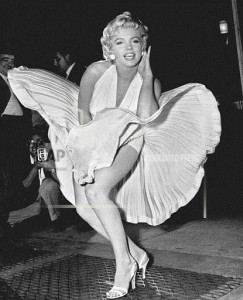
Behind the camera: The many press photographers and bystanders that took pictures of the movie shoot for, The Seven Year Itch
Where: The pictures were shot at Manhattan’s Lexington Avenue at 52nd Street close to the Trans-Lux theatre.
Photo Summary: Marilyn Monroe
Picture Taken: Late Sept 8, early morning of Sept 9, 1954

Before her death, Marilyn Monroe was an iconic Movie star who’s movies thrilled millions. This famous scene was shot for the movie, The Seven Year Itch . The picture has been turned into posters, t-shirts, mugs and is probably her most famous image. Filmed on location on Lexington Ave, New York, the New Yorkers who turned up to watch the filming got so out of control that the director couldn’t use any of the footage taken because of the crowd noise. The scene had to be recreated in Studio but then was cut by the censors for being too steamy. In the actual movie, her skirt never rises above her knees.

Marilyn Monroe

Marilyn Monroe (June 1, 1926 – August 4, 1962) was an American actress, singer, and model. After acting in small roles for several years, she gradually became known for her comedic skills, sex appeal, and screen presence, going on to become one of the most popular movie stars of the 1950s. She was and is idolized throughout the world as a sex goddess. Later in her career, she worked towards serious roles with a measure of success but was always restrained by several prescription drug addictions. On August 4, 1962, Marilyn Monroe died between 8:30 p.m. and 10:30 p.m. at her home at 12305 Fifth Helena Drive in Brentwood, Los Angeles, California. She was 36 years old. The cause of death based on the toxicology report was acute barbiturate poisoning.

Marilyn and Joe Dimaggio

We haven’t lost a star; we’ve gained a center fielder
-Fox execs on the Dimaggio marriage

Marilyn was married three times in her short life. Her third and last was to Arthur Miller the famous playwright on June 29, 1956. Author of the play Death of a Salesman and a movie Marilyn stared in, The Misfits; their marriage lasted four years and seven months with the two divorcing in 1961. Her first marriage was when she was just 16 to James Dougherty on June 19, 1942. She filed for divorce in Las Vegas, Nevada and it was finalized on September 13, 1946.

Her second was in 1951 she eloped with, famous baseball player, Joe DiMaggio on January 14, 1954. Fox loved the idea of marriage with executives boasting that “we haven’t lost a star; we’ve gained a center fielder”. The marriage was rocky from the start with Joe pressuring Marilyn to become a quiet wife while Marilyn tried to keep her star rising. Even on their honeymoon, Marilyn left to do a tour for the troops in Korea. A busy schedule of movies saw Marilyn go directly from the movie set of Show Business to the set of The Seven Year Itch. This was a move that made Dimaggio furious as he wanted to spend some time with his new wife. An abusive man, friends, and makeup people would often see bruises on her arms and backs from her fights with Joe. When Marilyn visited Marlon Brando on the set of Desirée he noticed that her arm was black and blue. Yet the stoic Marilyn, while their marriage was crumbling she, had to shoot, The Seven Year Itch.

The scene from The Seven Year Itch

The Seven Year Itch was a play turned into a movie about a man who sent his family away upstate to escape the hot and humid New York summer. While alone he meets his new neighbor, the blonde and beautiful Marilyn Monroe, known in the movie as “the girl”. The two get to know each other and he is torn between his lust for the girl and being faithful to his wife.

The scene in which the skirt was to blow up was a part of the movie were Marilyn’s character, known as the girl, was on a date with the main character, Richard Sherman played by Tom Ewell. They are walking out of the Trans-Lux theatre where they just watched Creature from the Black Lagoon. As they walk down the street Marilyn sees the breeze wafting up from the sidewalk grates as a subway car passes underneath. Even though it is night, New York is still hot and humid and she runs over to catch the breeze. As subways run back and forth and her skirt is lifted up, she says her lines from which we get some famous quotes such as, “Don’t you feel the breeze from the subway? Isn’t it delicious?” and “Ooohhh! This feels just elegant!”

This particular scene is where Richard Sherman is overtaken by the moment and kisses Marilyn. However, while the play had Sherman eventually sleeping with Marilyn’s character the movie ends with Sherman being faithful and running to upstate New York to join his wife and son.

Behind the Scenes


Crowd around Marilyn while filming the famous scene picture by Sam Shaw

Crowd around Marilyn while filming the famous scene, picture by Sam Shaw


Directed by Billy Wilder the film required the subway skirt scene to be shot at a location on Lexington Avenue at 52nd Street in New York. Fox Studio publicity men put the word out on the street that Marilyn would be on location wearing an outfit that would, “stop traffic”. Marilyn who by this time was taking multiple pills for various ailments both real and imagined struggled with her lines. While Marilyn did a take after take a crowd began to develop around the many photographers who showed up to get pictures. Rather than being quiet and constrained, the mob of New Yorkers yelled and whooped whenever the skirt was blown up over her waist which the bright movie lights, despite wearing two sets of underwear, revealed “all” of Marilyn.

The Split

Joe Dimaggio hated publicity and Hollywood, he usually stayed away from the set but since Marilyn was filming in New York he hovered nearby drinking at a bar. He ran into a friend, Walter Winchell who convinced him to go to the set and watch Marilyn.

The scene when he arrived was of thousands of fans screaming every time they could see her underwear. Conservative Joe Dimaggio while listening to the roar of the mob in time with the skirt lifting over her waist became infuriated and stormed off the set. At the hotel, that night crewmen heard screaming from their room and the next day Marilyn’s hairdresser, Gladys Whitten had to cover up bruises on her shoulders with make-up.

After filming, the couple flew back to California were friends saw more fights and neighbors saw Marilyn wandering the streets crying. 274 days after getting married the two staged an elaborate press conference where they announced that they were getting a divorce due to, “conflict of careers” and, “the usual mental cruelty”.
The skirt scene that helped kill the marriage was thrown out by the director as the crowd noise made it unusable. The whole street was recreated in a studio so that Marilyn could do it again in privacy. Even then most of the skirt shots were cut from the picture when the Hollywood censorship board, the Hays Code or Production code, killed any shot where the skirt went over the knee.

The Dress

Over the years actress, Debbie Reynolds amassed a huge collection of Hollywood memorabilia including the infamous dress used in this image. In 2011 her collection was put on the auction block and a lucky and very rich bidder bought the dress for $4.6 million ( $5.52 million after taxes and fees were included ) This smashed the record for the most-payed-for dress which was held by Audrey Hepburn’s iconic black dress from the 1961 film Breakfast at Tiffany‘s, which sold for $923,187.

Copyright images

AP Images handles the listening for some of the September 8, 1954, Seven Year Itch photos.

More Famous Images

Related Posts:

Tennis Girl

Behind the camera: Martin Elliot
Where: Birmingham University’s tennis courts in Edgbaston, United Kingdom
Photo Summary: Then 18-year-old Fiona Butler (Married and now Fiona Walker)
Picture Taken: September of 1976

In September of 1976 aspiring photographer, Martin Elliot convinced, his then-girlfriend, Fiona Butler to pose for a series of cheeky pictures in hopes of creating the next big pinup poster. He took a couple of shots and sold this image to publishing giant Athena. The poster went on to sell 2 million copies. In response to famous British film and television critic George Melly calling the poster a “schoolboy joke” Martin Elliot replied, “that’s just what it was.”

Taking the photo

In 2011 Fiona Butler finally agreed to show her face


In 1976 Martin Elliot was dating 18-year-old Fiona Butler. Anxious to help out her photographer boyfriend she agreed to pose for some photos at the Birmingham University’s tennis courts in Edgbaston, central England. Fiona didn’t actually play tennis and had to borrow the tennis racket and Eliot had their tailor friend, Carol Knotts, design and create a sexy tennis dress. In a 2007 interview, Fiona recalled that she:

can remember the day quite clearly … When the picture got so popular I was quite amused that something taken that afternoon could get so big. It became one of those pictures that everyone knows and everyone’s seen. It gave me quite a buzz because I could secretly smile and say ‘no you’re wrong’, every time someone guessed.

I remember going to a party with my husband and people were saying ‘is that the girl in the photograph?’. They looked me up and down and said ‘I don’t think so’ I’ve got no objections to it whatsoever. My children have never been upset about it. It’s really nothing that anyone could be offended by. It’s just a bit of fun. I think it was banned in a couple of countries but really I don’t think there was anything to get upset about.

The poster has become such a cultural icon that when Fiona went on to marry, millionaire Ian Walker, and have kids her son’s headmaster confided in her that he had the poster on his wall while in University.

The poster

Publishing giant Athena bought the rights for the poster and released the first print in a calendar for the Queen’s Silver Jubilee in 1977. The calendar was released the same year Virginia Wade won the Wimbledon singles title. Due to the popularity of the calendar, Athena published a poster and these combined factors pushed the poster into mass production and it eventually went on to sell over 2 million copies.

To mark the 30th anniversary of the photo the tennis outfit and racket were sold on Internet auction site eBay on June 16, 2006. Some of the proceeds of the sale went to the Dan Maskell Tennis Trust, a disabled children charity. The remaining went to the dress designer Carol Knotts’ attempt to take part in the Global Challenge round-the-world yacht race in 2008.

Imitators

For British male comedians, it’s almost like a right of passage to imitate this image with celebs like Alan Carr, Frank Skinner, and Ricky Gervais exposing their backsides. I’ll spare you their pictures but I’ll include this one of singer, and all-around superstar, Kylie Minogue.

The Photographer

Originally from Oldbury, Martin Elliot was in the Birmingham School of Photography program and after graduating had a successful career with a studio in Birmingham’s Jewelry Quarter; living in Stourbridge and Portishead. In later life when doing interviews he would remember that he took the shot during “an afternoon in September at the end of the long hot summer. It was over very quickly. I only took one roll of film, which is pretty feeble for a photographer and I just hoped I’d got the shot.”

In 1999 he retired and lived in Cornwall before losing a 10-year battle to cancer in April 2010.

More Famous Images

Related Posts:

Betty Grable

Buy on amazon

Betty


Behind the camera: Frank Powolny
Where: Studio
Photo Summary: Betty Grable in a promotional shot for the movie Sweet Rosie O’Grady
Picture Taken:1943

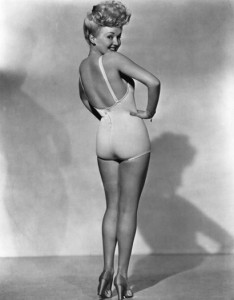
While American soldiers were overseas fighting World War II, they longed for something that reminded them of home. They chose this picture of Betty Grable. Some liked her sexy figure; others thought she reminded them of that ideal “girl back home.” Whatever the reason, she was by far the number-one pin-up girl during that time.

Taking the picture

Grable had just finished the movie Sweet Rosie O’Grady, and the studio needed some bathing suit shots. Grable herself remembers that “the session wasn’t going too well; Frank was trying to achieve something different. After about a dozen shots, he told me to turn my back to the camera and he would catch my face in profile. I obliged, turned my face toward the camera, and asked, ‘How about this?'” which was when Powolny snapped his photo. Powolny remembers that:

I asked Betty if she’d like to have a back shot, just to be different, She said, ‘Yes,’ and began to clown around. ‘You want it like this?’ she asked, posing. And I said, ‘Yeah.’ I made only two shots of that pose. It was the second shot that became famous.

There are some who claim that Grable was pregnant at the time when this shoot happened but both her kids Victoria and Jessica’s birth dates wouldn’t match up. Victoria was born on March 4, 1944, and Jessica was born on May 20, 1947. It was doubtful that the pregnancy would have been showing in early 1943 if she conceived as late as June 1943. Also, Powolny took other photos of her facing the camera and it doesn’t appear to show a baby bump. When the studio released the photo it became the most requested picture in movie history.
FOX studios saw its potential and persuaded the US military to allow it to distribute 5 million postcards of this picture to American GIs fighting in the war. Soldiers soon had painted the picture on planes, bomber jackets, and barrack walls making it the most popular pin-up during the war.
[midgoogle]

Betty Grable

She was born Elizabeth Ruth Grable in St. Louis, Missouri, on December 18, 1916. The third child of John Conn Grable (June 28, 1883-January 25, 1954) and Lillian Rose Hofmann (May 29, 1889-December 24, 1964). Her sister was Marjorie L. Grable (April 17, 1909-November 25, 1980) and her brother was John Carl Grable (who died in infancy). She was propelled into acting by her mother, who insisted that one of her daughters become a star. For her first role, as a chorus girl in the movie Happy Days (1929), Grable was only 13 years old (legally underage for acting), but, because the chorus line performed in blackface, it was impossible to tell how old she was.

She got a number of small-time roles in various movies before obtaining a contract with 20th Century Fox, becoming their top star throughout the 40s. It was during her reign as box-office champ (in 1943) that Grable posed for her iconic pin-up photo, which (along with her movies) soon became escapist fare among GIs fighting overseas in World War II. Despite solid competition from Rita Hayworth, Dorothy Lamour, Veronica Lake, and Lana Turner, Grable was indisputably the number-one pin-up girl for American soldiers. She was wildly popular at home as well, placing in the top ten box-office draws each year for ten years. By the end of the 1940s, Grable was the highest-paid female star in Hollywood.

Also, in 1943, she married jazz trumpeter and big band leader Harry James, by whom she had two children; they divorced in 1965. Grable’s later career was marked by feuds with studio heads, who worked her to exhaustion. At one point, in the middle of a fight with Darryl F. Zanuck, she tore up her contract with him and stormed out of his office. Gradually leaving movies entirely, she made the transition to television and starred in Las Vegas.

I little tragic irony involved a nuclear weapon named after Betty. On May 25, 1953, the largest atomic weapon fired by artillery was exploded over the Las Vegas desert in the test series named Operation Upshot-Knothole. The cannon was named Atomic Annie while the shell and the blast were named Grable. Thousands of military personnel were present at the Grable blast to test exposure to radiation. Operation Upshot-Knothole was responsible for the release of a large portion of the radioactive iodine produced as a result of continental nuclear tests. This fallout resulted in thousands of cases of cancer. Grable herself died of lung cancer at age 56 in Santa Monica, California. Her funeral was held July 5, 1973, 30 years to the day after her marriage to Harry James. She is interred at Inglewood Park Cemetery, Inglewood, California.

Frank Powolny

Frank Powolny was an immigrant moving to the United States when he was 13, growing up in Clarkson, Nebraska. As the chief portrait and still photographer at 20th Century Fox from 1923 to 1966 he captured thousands of stars including taking the last known photographs of Marilyn Monroe. On January 5th, 1986 he died of a heart attack in Valencia.

Picture copyright


The Wikipedia Commons website claims this image is in the public domain.

More Famous Images

Related Posts:

Matrix Ping Pong


When March 31, 2003
Where: Kinchan and Katori Shingo’s National Costume Competition
Who:NTV
Summary: Team captiain: Hideki Kajiwara (梶原比出樹)”


Matrix Ping Pong is a famous video clip that makes the rounds as an Internet meme on the web. It is a recording from the popular annual Japanese show Kinchan and Katori Shingo’s National Costume Competition (欽ちゃん&香取慎吾の新!仮装大賞). The video shows a group of people attempting to mix moves in the style of The Matrix movie while parodying another, Japanese movie named Ping Pong, using kurokos (stagehands dressed all in black that are used in Japanese theatre) to hold the actors and the props up. This performance won the competition on March 31, 2003.

Video Breakdown

The video opens with what appears to be two competitors about to start a ping pong match. On closer inspection, you can see the kurokos in the background that move the various parts of the stage. Each “competitor” is made up of two people one controls the visible top half and the other the legs, the visible lower half. All told there are 7 people involved in the skit:

4 people to control the Red and Orange players
1 person to control the ping pong ball
2 people to move the actual ping pong table

On the screen appear the Skit Title and 29. The title is in Katakana letters that translate into PingPong and the contestants are number 29.

Celebration


In each episode, there are 30 or so skits that individuals or groups of people act out. There is a panel of 10 judges, each with two buttons to vote with. At the end of each skit, they vote on how much they liked it, with 15 being a passing score and 20 being the max score. So if they didn’t like the skit then they give no points, kind of liked it then they get 1 point, really like it 2 points. If a skit gets below 15 then don’t move onto the next round but if they get above 15, they get a medal and get a chance to win money. This is why and the end of the skit you see them cheering and hugging each other because they got above 15 points.

Kasou Taishou

Kasou Taishou or the (欽ちゃん&香取慎吾の新!仮装大賞; Kinchan and Katori Shingo’s National Costume Competition) is a semi-annual show on NTV in which various amateur groups (or solo artists) perform short skits, which are rated by a panel of judges. It originally was just a show to showcase costumes but as people started performing to showcase their costume the show, especially in recent years, has evolved into skits that revolve around clever methods of “faking” cinematic special effects on a live stage, like “Matrix Ping Pong”. You can view the winners of each episode on the official website press the sixth link down on the left menu bar.

Other Viral Videos

Related Posts:

Man Sucked Into Jet Engine

Behind the camera: Deck Camera
Where: Flight deck of the USS Theodore Roosevelt
Photo Summary: John Bridget is shown getting sucked into an A-6E’s engine
Picture Taken: 03:41:11 Feb 20, 1991
This image is in the public domain because it was taken by Navy personnel

Not to be confused with the video of a helmet getting sucked into a Jet, this video is actual footage of a one John Bridget (21 years old at the time) getting sucked into an A-6E Intruder’s jet engine. It’s been a segment on numerous TV shows like World’s Wildest Videos and has since been taped, digitized and uploaded to the net. Once online it became quite famous, as its small size made for easy sharing. The footage got a second life when it was revealed that not only did the man get sucked into an engine but that he survived.

Getting sucked into a Jet engine doesn’t happen very often but it has happened in the past. In another incident in January 01, 2006 a mechanic was sucked into the jet engine of a Boeing 737 at El Paso International Airport and killed.

Video Breakdown


The video starts on the flight deck of the USS Theodore Roosevelt and according to the camera time, it’s 03:41:11 Feb 20, 1991. An A-6E pilot is getting ready for take off as a trainee checks the position of the carrier launching mechanism. All this time the pilot has the engines at full throttle and as the trainee moves away from the trainer, a green shirt (Navy personnel wear color coated uniforms), John Bridget, comes to make sure everything is OK. Navy personal Daniel P Streckfuss tells the story from there:

I was attached to VFA-15 on board the USS Theodore Roosevelt during that deployment in 1991. This occurred [during Desert Storm, Desert Storm ended February 28, 1991]. He did survive and I’m surprised the editors of that video didn’t include him climbing out. What allowed him to survive was the design of the A-6 engine (the J-52). It has a long protruding ‘bullet’ or cone that extends in front of the first stage fans. When he was sucked in, his arm extended above his head which caused his body to wedge between the bullet and inside wall of the intake. Lucky for him, his cranial and float coat were sucked in first causing the FOD’d engine which prompted the pilot to cut the throttle (commanded by the Shooter who moves into the frame kneeling and moving his wand up and down). It took almost 3 minutes for him to push his way out of the intake after being sucked in. Needless to say, I don’t think he was seen on the flight deck for the rest of the cruise.

According to the video, the scene where he has bandages around his head and his arm taped up was taken only a few hours after the incident. After recovering from his injuries he left the Navy.

A-6 Intruder

19 December 1996 saw the last launch of an A-6E Intruder from the aircraft carrier USS Enterprise (CVN 65) marked the last Intruder squadron to fly from the deck of an aircraft carrier.

The A-6E Intruder, the plane that sucked in the Navy man, is a twin-engine, mid-wing attack aircraft built by Grumman Aerospace. In service between 1963 and 1996, the Intruder was designed as a replacement for the piston-engined A-1 Skyraider. A specialized electronic warfare derivative, the EA-6B Prowler, remains in service as of 2006. As the A-6 neared retirement, it was replaced at some reduction in combat radius by the multi-role F/A-18 Hornet and fighter-bomber adaptations of the now also retired F-14 Tomcat.

USS Theodore Roosevelt (CVN-71)

The video was filmed on the flight deck of USS Theodore Roosevelt (CVN-71) (known affectionately as the Big Stick or TR). It is the fourth Nimitz-class supercarrier and its call sign is Rough Rider, the name of President Theodore Roosevelt’s volunteer cavalry unit during the Spanish-American War. It was launched on 27 October 1984 and saw action in the first Gulf War. On 9 June 1990, Capt. Charles S. Abbot became the ship’s third Commanding Officer and on 28 December, Theodore Roosevelt and CVW-8 deployed for Operation Desert Shield. Theodore Roosevelt entered the war on 9 January 1991, eventually flying over 4,200 sorties (more than any other carrier) and dropping more than 4,800,000 pounds of ordnance before the cease-fire on 28 February.

Other Famos Images

Related Posts:

Kolla2001

Behind the camera: Kollaboration
Where: Kollaboration which was held at the Wilshire Ebell Theatre, Los Angeles
Photo Summary: David ‘Elsewhere’ Bernal is the third dancer to appear
Picture Taken: Saturday October 6, 2001

David “Elsewhere” Bernal (born August 2, 1979) is a popping dancer from Santa Ana, California. He became well known through this video clip recorded at the Korean-American talent show, Kollaboration, in 2001. The clip showcased Bernal’s characteristic take on contemporary dances popping and liquid dancing. Performances of these dances were rare at the time, and the clip became a very popular viral video. In Nov 2006 the Viral marketing company, The Viral Factory, collated page impression figures from websites such as YouTube and Google Videos. They determined that this video as of Nov 2006 had been viewed 200 million times.

Kollaboration


Kollaboration is a Korean American/ Korean Canadian Talent Show. “Kollaboration seeks to elevate Korean American/ Korean Canadian talent into the limelight of the music and entertainment industries, showcasing their talents and the community’s potential to the world.” It has been running since 2000 and serves to break down any stereotypes that exist in regards to Korean talent. David Elsewhere’s video clip was filmed at Kollaboration 2001 which was held on Saturday, October 6, 2001, at the Wilshire Ebell Theatre, Los Angeles.

David “Elsewhere” Bernal

David started dancing around when he was 17. At his high school he and a number of students would play music, dance and break and a place called, “The Quad”:

The first time I really performed in front of a big crowd was probably a year after I started dancing. It was in front of my school at The Quad, which I described to you earlier. My friends basically pushed me into the circle. I actually took out this house dancer, this guy who would go in circles and try to show off. I basically shut him up because he didn’t know how to break…all he did was his house dancing. I got a pretty big ovation from the people and that day really stuck with me. It was a huge, huge confidence booster.

In 2002 he graduated from California State University Long Beach, California with a degree in Art and Illustration. On his homepage he sites besides B-Boy dancing his major dance artist influences were:

  • Squid – His longtime friend who got him started with dancing.
  • Salty – A mystery man that David saw on a video. He became obsessed with his style and dancing without ever knowing who he was.
  • Skywalker – Skywalker’s influence resulted in his style becoming much more fluid and exaggerated.
  • Since the video Bernal has done a number of advertisements for Heineken, iPod, 7-Eleven Slurpee and Pepsi. He also did a cameo appearance in the movie You Got Served and TV performances including The Tonight Show with Jay Leno. In a Volkswagen Golf GTI commercial him and some other dancers like Crumbs and another popper named Jay Walker did a spoof of 1952 movie Singin’ in the Rain where they recreated Gene Kelly’s Dance.

    Double Jointed?

    Most people when viewing the video think that David has to be double-jointed to do his moves but when asked in an interview he stated:

    I’m not double-jointed at all. The only place where I am double-jointed is my thumbs, which doesn’t even matter. I would say I’m probably a little more flexible than most people in certain areas, mainly my shoulders and my ankles, but I wasn’t born that way. Those areas became flexible because of years of practicing.

    Other Famous images

    Related Posts:

    Trojan Games

    Behind the camera: Filmed by Ed Robinson of, Viral Factory
    Where: Romanian Stadium
    Photo Summary: Romanian actors playing two Ukranian athletes, Mosienko (Guy) and Bubka (Girl)
    Picture Taken: Campaign started on March 2003 to April 2004

    The video was created by The Viral Factory and commissioned by Trojan Condoms to create a buzz around their UK launch. The video and website spoof for a fictional event called the Trojan Games was created with fake sports of an adult nature. Each viral clip was embedded in the Trojan Games website, creating a huge effect by driving viewers to the site. In Nov 2006 the Viral marketing company, The Viral Factory, collated page impression figures from websites such as YouTube and Google Videos. They determined that this video as of Nov 2006 had been viewed 300 million times.

    Video Breakdown


    The video opens with what appears to be two athletes walking through a crowd. The voice-over tells us, in an Olympic Commentator style, that the two, Mosienko and Bubka, are from Ukraine and hope to win the event. As they walk up to the stage you notice that they don’t appear to be wearing pants. The girl, Bubka, “mounts” her partner Mosienko and then she lets go appearing to be held in place by Mosienko’s … “member”. They hold the pose for 3 sec to victory and the crowd goes wild waving Ukrainian flags as Mosienko and Bubka take gold for the sport of “Pelvic Power Lifting”.

    Filming

    The Viral Factory filmed in a real athletics arena in Romania and used genuine Romanian athletes, shooting for two days. They were promised by the local casting director that there would be no problem with the actors getting naked which turned out to be true except for one incident with the Weightlifter:

    Only one of them was shy, poor bugger … He suddenly had a panic attack at the last moment … But really, all of them were perfectly happy, quite extraordinarily laid-back about it. Being English we were terribly sensitive and had people with towels ready as soon as we cut, we had little skin-coloured pouches made for long shots. One girl was parading around half nude for about 20 minutes after the shoot. We said go and put some clothes on and have some lunch, she said, ‘no, I’m hungry’!’ After that we all relaxed.–Film makers

    Other Famous Images

    Related Posts:

    Numa Numa

    Behind the camera: Gary Brolsma’s Webcam
    Where: Gary Brolsma’s house in New Jersey
    Photo Summary: Gary Brolsma
    Picture Taken: November 2004

    Sometime in 2004 Gary Brolsma saw a Japanese Internet video clip that featured animated ASCII cats displaying amusing lyrics to the song, “Ma Ya Hi (Dragostea Din Tei)” by Romanian pop band O-Zone. After filming his own version with him dancing in front of his computer he uploaded it onto the net and it became one of the most downloaded videos on the internet. In Nov 2006 the Viral marketing company, The Viral Factory, collated page impression figures from websites such as YouTube and Google Videos. They determined that this video as of Nov 2006 had been viewed 700 million times.

    Pre-Gary


    The Numa Numa (or “Numa Numa Dance”) gets its name from the chorus of the Dragostea din tei track, “nu mă, nu mă iei,” meaning, roughly, “(you) won’t take, won’t take me.” The video caught the ear of one Japanese Internet User, Ikari, who created his own video for the song. Using an animation that looks like a popular Japanese ASCII cat named Monā Ikari created a video that used English and Japanese Mondegreens or words that sound the closest to the original Romanian lyrics. It was this video and its concept that captured Gary’s imagination.

    Gary Brolsma

    Gary Brolsma (born January 14, 1986) is a resident of the state of New Jersey, USA. One of his teachers, Susan Sommer, described him as quiet but was good with technology, “Whenever there were computer problems, Gary … would fix them for the school,”
    Around Nov 2004, Gary was facing some depression after the death of his father, and he used his Webcam to film himself lip-syncing in an effort to lift his spirits. The video was meant to amuse himself and a few friends. But within weeks Internet users charmed by the innocence and ebullience of Brolsma’s performance spread the video around the world. Brolsma became an unintentional icon of the viral video phenomenon after uploading his “Numa Numa Dance” on the Newgrounds site on December 6, 2004, where it has since been seen over 13 million times. Since it was uploaded the video has been reproduced on hundreds of other websites and blogs.
    When asked about making the video Gary had this to say:

    It only took one take and about 15 minutes to put all together. A lot of people ask me if I planned the video out or took multiple tries with it. The real answer is… no. A week or so after I finished the video, I decided to throw it up on Newgrounds.com just for the heck of it, thinking it would get blammed (automatically deleted for a low scoring video). Little did I know it would explode in the views and would touch so many people.

    Not happy with just one version Gary also created some tweaked variants of the video since it became popular. One version also contains some puns, among them pictures of “feta cheese” during the lyric “fericirea” (“happiness”) and a LEGO representation of Bob Ross during the singer’s words: “sunt eu, Picasso” (“it’s me, Picasso”). Other third-party versions include a “Showdown,” between him and a German Kid getting angry at his computer. The video also had a brief cameo by the Star Wars Kid.

    As his video spread throughout the world the fame hit hard. He made appearances on ABC’s Good Morning America, NBC’s The Tonight Show and VH1’s Best Week Ever, but then became uncomfortable with the amount of attention. According to The New York Times, he was an “unwilling and embarrassed Web celebrity.” He stopped taking phone calls from the media; he cancelled an appearance on NBC’s Today Show on February 17, 2005; and he did not cooperate with The New York Times for their February 26, 2005 article about him.

    Since then Gary has come to terms with his celebrity even releasing a New Numa video which was released on September 8, 2006, on Newgrounds, and promoted on a dedicated website, NewNuma.com. This was an unexpected move, though one which he had been urged to make by fans of his original video. The video was produced by Experience Studios (Seattle, WA). It features Brolsma and his garage band, The Nowadays, lip-syncing and dancing to New Numa. The song is a repeated Russian children’s rhyme and performed in heavily accented and barely understandable Russian by Chad Russell, a singer/songwriter from Fridley, MN, for producer and DJ, Variety Beats, on the BeLive label.

    Dragostea din tei


    Dragostea din tei (pronounced /ˈdra.gos.te̯a din tej/) was the most successful single by O-Zone a band originally from Moldova, but which launched in Romania. The original version was sung by Dan Bălan, Arsenie Todiraş and Radu Sârbu. The single was first released in 2003 in Romania, where the group lived and produced at that time, and in the spring of 2004 in most other European countries. As of 2006, the song is still in the lower reaches of some Eastern European singles charts. It was written and produced by Dan Bălan (who wrote most of the group’s songs) and was one of 2004’s most successful summer hits, as well as one of the best selling singles of the year across Europe. Tragedy struck when in 2005 the group split up. All of the members went their separate ways and started their own solo careers.

    Other Famous Images Videos

    Related Posts:

    Star Wars Kid

    Behind the camera: Ghyslain Raza
    Where: Le Seminaire St-Joseph de in Trois-Rivières, Quebec, Canada
    Photo Summary: Ghyslain Raza fighting like a Sith Warrior
    Picture Taken: November 8, 2002

    In November of 2002, Ghyslain Raza a student that went to le Seminaire St-Joseph de Trois-Rivieres, Quebec, Canada decided to take advantage of his school’s recording studio. Imitating the Darth Maul character from Star Wars he jumped, danced and twirled around the studio using a tennis ball retriever in place of Darth Maul’s double-edged lightsaber. Chubby Ghyslain and his less than graceful moves were recorded and apparently forgotten for months. Then in April 2003, students at Ghyslain’s school (Michaël Caron, Jérôme Laflamme and Jean-Michel Rheault) found the recording and quickly began sharing it with their friends with the file name, ‘Jackass_starwars_funny.wmv’. It ended up on the p2p program Kazaa and weblogs started to host the video. Not long after, millions around the world were downloading and watching the video online. In Nov 2006 the Viral marketing company, The Viral Factory, collated page impression figures from websites such as YouTube and Google Videos. They determined that this video as of Nov 2006 had been viewed 900 million times the highest total at that time.

    Students put the video online


    In the Court transcripts from a lawsuit the Raza family filed, it revealed Jérôme Laflamme had discovered the tape when we took the equipment to film a varsity football game. Laflamme showed the tape to Jean-Michel Rheault who then copied it. “All I did was take the cassette, digitize it on the studio computer to pull a joke on Ghyslain. After that, I had nothing to do with it,” Rheault would later say. The third defendant who claims not to know the other two somehow came across a copy of the video and created a website to post the video online. All three in the run-up to the lawsuit denied that they were responsible with Rheault claiming, “It’s no fun what happened here, but that’s the problem with the Internet. Things travel fast.”


    The video first appeared on the Internet on the evening of April 14, 2003, but quickly spread the globe. The video was so popular and so widely circulated that sites hosting the video where recording millions of downloads. One website solely dedicated to the Star Wars Kid video recorded 76 million hits by October 2004. The video itself might have died away but soon people were adding effects and editing the video to make new versions. Some special effects people like Bryan Dube, an employee from Raven Software added Star War’s effects, music and opening sequences. Several versions were made with various themes but the most well-liked involved Star War effects, although a matrix version was heavily downloaded. The Star Wars Kid fame soon split over into merchandising and T-shirts, mugs and other paraphernalia that are still are available online.
    While the video travelled through the Internet with people laughing at Raza, many others identified with him as they remembered their own awkward high school years. As the clip’s popularity increased, web bloggers, waxy.org and jish.nu, were able to track down Ghyslain. Jish Mukerji from jish.nu was able to get this short interview in 2003 (translated from French):

    Interview

    What I saw was mean. It was violent. People were telling me to commit suicide

    -Ghyslain Raza in a 2013 Macleans interview

    Jish: Ghyslain?
    Yes.
    My name’s Jish and I am calling you from San Francisco, California and I’d like to interview you. Do you speak English too?
    Only a little bit.
    Well, I’ll try to speak in French, but I’ll apologize in advance since my French isn’t perfect.
    Oh, that’s ok.
    The interview is concerning your martial arts video.
    Mm hmm.
    Did you know that over 500,000 people have viewed your video?
    Yes, I know.
    When you made the video, did you think this many people would be viewing it?
    No, I really never anticipated that.
    How did the video end up on the web?
    Actually, it was a mistake. The cassette was left in the studio and someone put it on the Internet.
    Then, I guess it wasn’t a friend who did this, more of an enemy?
    More or less. It was someone I knew.
    I only have a few more questions… There was something yellow on the floor in your video, what was that?
    It was probably something left behind in the studio from a previous session. I really don’t remember what it was.
    Some people have taken your video and have added some Star Wars special effects, have you seen these?
    Yes, I have seen some.
    What’s your opinion of these videos?
    From what I saw, they look very well-made. It’s surprising to see what people have done with a video that wasn’t meant to be seen. It’s interesting.
    Do you have a website?
    Personally, no.
    What are your favorite sites?
    I’m really into computers/computing, so my favourite sites are the ones from the different companies involved… Nothing that I visit regularly.
    Do you also read weblogs?
    No.
    We know that you have a laptop, cell phone, Palm and other gadgets like that. Do you have any other favorite gadgets that you would like to buy, perhaps something like an iPod?
    For the moment, I don’t have plans to buy any gadgets, but sometime soon I’d like to get an iPod.
    Do you use a Mac or a PC?
    At home, I use a PC, but I really like the world of Macintosh. It’s what I use at school.
    If you bought an iPod, would you get the PC or Mac version?
    Probably, I’d get the PC version.
    Well, thank you very much and good night.
    Good night.

    They also started an online campaign to raise money to get him an iPod. Thousands donated money and eventually, a 30GB iPod was in the mail to the Raza household along with $3600 in gift certificates for the Canadian electronic superstore, Future Shop. While Ghyslain said it was nice that something did come out of his experience he would have preferred that millions had not seen the video, which he had meant to be private. “People were laughing at me, … it was not funny at all.”

    Psyc Hospital stay

    In fact, Ghyslain was tormented at school and became so despondent over the whole episode that he dropped out and got a private tutor even spending some time at the Pavillon Arc-en-ciel child psychiatry ward at the Trois-Rivières Regional Hospital Centre. He would later recall how other students would jump onto tables and make fun of him. “There was about 100 people in those halls. It was total chaos . . . Any opportunity was good enough to shout ‘Star Wars!’ ”

    Lawsuit

    We are deeply saddened by the current situation …
    -Lucasfilm

    The Raza family filed a lawsuit against four students who had encoded and spread the video (Charges were dropped against François Labarre because of lack of evidence). The lawsuit was finally scheduled to go to courts in April 2006 with the Raza family seeking $351,000 in damages. In 2006, days before the case was due to go in front of the judge, an out of court settlement was reached for an undisclosed amount, although some online sites quote the $US 250,000 figure.

    Star Wars Part

    The negative effects of the video’s popularity is cited as one of the reasons George Lucas, the Star Wars creator resisted a huge online petition to give Raza a bit part in the third and final installment of Star Wars. An online petition to do just that collected almost 150,000 signatures, which attracted the attention of mainstream media. In a BBC interview, Lucasfilm was quoted as saying “Obviously there has been a tremendous show of support for Ghyslain with tens of thousands of fans rallying around him … However, we are deeply saddened by the current situation and any difficulties this unwanted publicity might be causing him and his family.” Needless to say, he didn’t get the part.

    Latter life

    Ghyslain later went to McGill University in Montreal, Quebec and in 2010 became the president of the Patrimoine Trois-Rivières, a society devoted to the conservation of the cultural heritage of his hometown of Trois-Rivières. In 2013 he released an interview with a Canadian magazine talking about his ordeal. Inspired to break his silence after a spate of online bullying Ghyslain says, “You’ll survive. You’ll get through it,” he said. “And you’re not alone. You are surrounded by people who love you.”

    More Famous Images

    Related Posts:

    MacArthur and the Emperor

    Buy on amazon
    Behind the camera: MacArthur’s official photographer Gaetano Faillace
    Where: MacArthur’s personal residence in the US Embassy in Tokyo
    Photo Summary: Emperor Hirohito and General MacArthur meeting for the first time
    Picture Taken: September 27, 1945
    This image is in the public domain because it was taken by a federal employee, Gaetano Faillace

    After the Japanese surrender in 1945, the American’s took on the task of occupying Japan and reforming the militaristic nation into a modern country that would never again threaten its neighbors. To minimize the number of American soldiers needed to keep the country under control the occupation command, known as Supreme Commander of the Allied Powers (SCAP) or GHQ (General Headquarters), maintained the Emperor in his position of head of the state and as a rallying point for the Japanese people. Under pressure from other Allied nations, the American public (Immediately after war 70% of Americans wanted him killed), and elements inside Japan itself for destruction of the Japanese God-Emperor the SCAP had this picture published to show that Emperor Hirohito was supported by MacArthur and the occupation forces.

    Taking the picture

    In 1945 a meeting was arranged for MacArthur and Emperor Hirohito to meet and to discuss how to save his throne. Arriving at 10:00 on September 27, 1945, in his Rolls Royce the Emperor and his entourage of Imperial guards and advisers, were greeted by American SCAP officials Faubion Bowers and Bonner Fellers. The Americans saluted the Emperor and he first bowed to them and then shook their hands. Bowers then took the Emperor’s top hat which seemed to alarm Hirohito who as the God Emperor of the Japanese people was not used to be people taking things from him. As the American officer was taking the hat MacArthur burst into the room:

    in that stentorian voice of burnished gold that thrilled everyone who heard it, ‘You are very, very welcome, sir!'” It was the first time Bowers had ever heard the general say ‘sir’ to anyone. The supreme commander reached out to clasp the Emperor’s hand, and the emperor simultaneously bowed so deeply that the handshake ended up taking place above his head. — Embracing Defeat by John Dower

    MacArthur then took Hirohito into a private room with just the Imperial translator, Okumura Katsuzo. The Supreme Commander and the Emperor, through his translator, spent 40min together and swore to keep the contents of their conversation secret. Though over the years some details leaked out. According to the Americans, Emperor Hirohito offered to take responsibility for the war which MacArthur brushed aside. This is contrasted by the Japanese. Thirty years after the meeting the Imperial translator, Okumura Katsuzo, released his memoirs which claimed that MacArthur was “a fawning courtier awed by his proximity to ‘Your Majesty’ and extraordinarily solicitous in his comments.”
    In all three photos were taken. In one Supreme commander’s eyes were closed and the Emperor’s mouth gaping open, Hirohito’s gaping open also ruined the second. The third is the one that was published.

    The response

    When the image was published on September 29, 1945, it caused a sensation in Japan. At a glance those who saw the picture understand who was the real Emperor in post-war Japan. MacArthur in his almost causal dress without medals towering over Hirohito who stood stiffly in a formal suit looking uncomfortable at the whole situation. The Image set-up was, the media adapt, MacArthur’s idea.

    When the papers hit the street the Japanese censors at the Home Ministry, which this close to the surrender were still controlling the Japanese presses, became outraged and tried to have the picture censored. SCAP was then able to win two victories first by publishing an image showing who was really in charge and second overruling the Japanese censors there-by introducing the Japanese to the concept of freedom of the press.
    Many Japanese remember seeing the image and it finally sinking in that they were the conquered and that the Americans and their General MacArthur were in charge.

    General MacArthur

    Douglas MacArthur was a career military man who lived from January 26, 1880, to April 5, 1964. Coming from a long line of military men he was valedictorian when he graduated from the United States Military Academy at West Point. He took the rank of First Captain when he graduated top of the class of 1903. Rising through the ranks he was brigadier general during World War I when he led American troops on the Western Front.
    After the war, he was involved in many civil disturbances in America and in the Philippines. In 1937 he retired from the military and become Military Advisor to the Commonwealth Government of the Philippines. When war broke out he had already been called back into service and he was General when the Americans lost the Philippines after a series of shocking victories by the Japanese Imperial army. He was forced to abandon his troops and flee to Australia where he would rebuild an American Pacific Army and after years of hard fighting force Japan out of the war. He oversaw the occupation of Japan with the official title of Supreme Commander of the Allied Powers (SCAP) which was also the name of his department that oversaw the everyday details of the occupation.

    When war broke out in Korea he was again leading Allied armies this time against the Communists. During the Korean War, he frequently came into conflict with President Truman and on April 10, 1951, an order was signed relieving him of command. When he returned to America is was his first visit to the continental United States since 1937. His boy Arthur IV, now aged 13, had actually never been to the United States.
    He worked in the private sector and his advice was sought after by many a president. On April 5, 1964, he died at Walter Reed Army Medical Center of biliary cirrhosis. He was granted a State Funeral by President Johnson and that he be buried “with all the honor a grateful nation can bestow on a departed hero.”

    Emperor Hirohito

    Emperor Hirohito lived from April 29, 1901, to January 7, 1989, and was the 124th emperor of Japan. When he took power Japan was an Imperial military superpower with the ninth-largest economy, the third-biggest Navy and one of the five permanent members of the council of the League of Nations. During his reign, he oversaw and approved of an aggressive military takeover of most of Asia which eventually lead to Japan attacking America starting its entry into World War II. After the war, the occupying force, including MacArthur did everything in its power to shield the Emperor from prosecution of war crimes often by laying the blame on his advisers a role they were only too happy to take as they had pledged their lives to protect the Japanese throne. After the war and after the American had left Hirohito focused on official duties such as welcoming head of states to Japan and his hobby marine biology. He published many scientific papers and contributed the description of several dozen species of Hydrozoa that were new to science.

    Gaetano Faillace

    From 1943 to 1945 during some of the toughest fighting in the Pacific Faillace was General MacArthur’s photographer. During the occupation, he followed the General in his official duties. During the War, he took some of the most famous images of the General including his return to the Philippines and at the Japanese surrender aboard the USS Missouri. His photograph of MacArthur looking out at Corregidor Island, of the Philippines, was on the cover of the general’s memoirs, Reminiscences. On December 31, 1991, he died of cancer in Fayetteville, N.C. He was 87.

    Other Famous Images

    Related Posts: