Depression Mother

Buy on amazon
Behind the camera:
Where: Just outside a temporary settlement called, Pea-Pickers Camp, on the outskirts of Nipomo, California. The camp was a temporary encampment for migrant farm workers and their families
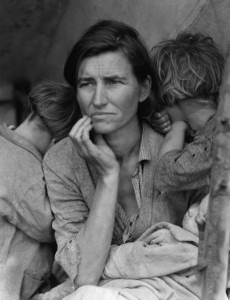
Photo Summary: Florence Owens Thompson flanked by daughter Katherine (age 4) on the left and Ruby (age 5) on the right. The Baby on Florence’s lap is Norma aged 1
Picture Taken: Early March, 1936
This image is in the public domain because it was taken by Dorothea Lange

Dorothea Lange’s famous picture of Florence Owens Thompson was taken during the Great Depression. While the book, Grapes of Wrath, became the literary representation of America’s poor during the ’30s, Lange’s ‘Migrant Mother’ picture became the visual one. Lange took the image of Florence Thompson with her family near the small town of Nipomo as part of a photo assignment for the government covering the plight of migrant farm workers. The official in charge of documenting and photographing the American poor for the federal project saw thousands of pictures as part of duties but describes the “Migrant Mother” as the “ultimate” photo of the Depression Era. The picture itself is part of a series of 6 and shows from left to right: Katherine age 4(head turned), Florence Owens (later married as Thompson) age 34, and Ruby Owens (head turned) age 5. The Baby on Florence’s lap is Norma aged 1.

Depression photographer


Colorized version of the iconic Lange image

Colorized version of the iconic Lange image


Dorothea Lange, the photographer was born in Hoboken New Jersey on May 26, 1895. At the age of seven, she developed polio which ravaged her right leg giving her a life long limp. In New York, she studied photography, and in 1918 she moved to the West coast opening a successful portrait studio in San Francisco. After the Great Depression, she became famous for her portraits of the effects of the stock market crash. Her pictures got the attention of the federal Resettlement Administration (RA), later called the Farm Security Administration (FSA), who in the mid ’30s offered her a job documenting America’s poor.

Taking the Picture

It was during March 1936 that as part of her effort to photograph migrants for the government that she took the famous shot of Florence Owens Thompson. Lange was returning to her Berkley, California home after spending a month taking pictures of migrant farmers around Los Angles. She had just passed through Santa Maria and was on the outskirts of another small Californian town, Nipomo when she saw a sprawling settlement with a sign declaring its name, Pea-Pickers Camp. Thousands had descended on the camp in hopes of getting work picking Peas in the surrounding farms. Unfortunately, an early cold snap had wiped out the crop and over 2000 people were stranded at the camp. Lange actually passed the camp as she was anxious to get home but after much internal debate decided to do a quick stop before continuing home.

Dorothea Lange took a number of pictures of the family moving closer and closer each time.


A U-turn brought her back to the camp and she quickly noticed a subject. In a 1960’s interview, she would recall that “I was following instinct, not reason, I saw and approached the hungry and desperate mother, as if drawn by a magnet.” Over 10 min and using her Graflex camera, she took 6 shots, with each exposure she moved closer to the family. The final vertical picture is what would later become the famous, “Migrant Mother”. The usually well organized Lange took detailed notes, but perhaps in her haste to get home only got the very basic of information, not even getting the subject’s name. Years later she would remember that the woman, “told me her age, that she was 32. She said that they had been living on frozen vegetables from the surrounding fields, and birds that her children killed. She had just sold the tires from her car to buy food. There she sat in that lean-to tent, with her children huddled around her and seemed to know that my pictures might help her, and so she helped me. There was a sort of equality about it”. She packed up her equipment and continued on her way, “I did not approach the tents and shelters of other stranded pea-pickers,” she remembered. “I knew I had recorded the essence of my assignment.”

When she returned home, Lange developed the pictures and immediately sent them off to the San Francisco News who used two of the 6 shots but not the now famous, “Migrant Mother”. The paper ran the images in their March 10, 1936, edition under the headline: “Ragged, Hungry, Broke, Harvest Workers Live in Squalor.” The national media quickly picked up the story and used the “Migrant Mother” picture across the country. Public outcry ensured that the federal government quickly sent the “Pickers Camp” settlement 20,000 pounds of food.

Florence Thompson Emerges

The identity of the women in the picture wasn’t discovered until the late 70’s almost 40 years after the picture was taken. It was Florence Thompson herself who got in touch with the editors of her local newspaper, the Modesto Bee to tell her story.

Florence Owens Thompson was born on September 1, 1901, in the Indian Territory of the Cherokee Nation with the name maiden name, Florence Leona Christie. Both of her parents claimed Cherokee blood rights to the land making her a full-blooded Native American of the Cherokee Nation. She lived on a small farm on the Cherokee Territory and when she was 17 married Cleo Owens, a 23-year-old farmer. They had three children before they moved with other members of the Owen family to California where they found work in the forestry and farming industries. After Wall Street crashed in 1929, millwork dried up and the family, then with 5 children moved to Oroville in northern California where the Owen clan found work on the surrounding farms.

We lived under that bridge
– Thompson

Florence’s husband Cleo, sadly died shortly after the move when he caught a fever one day while picking peaches. At the time of his death, she was pregnant and the Owen family offered to take some of the children, an offer Florence refused. She stayed with her husband’s family for two years working in the fields during the day and at a restaurant at night to support her family. In 1933 she found out that she was pregnant again and fled back to her parent’s home out of fear the father would take her child.
She lived with her family for a short time before they too moved out to California in hopes of better work. Over the next few years, the family along with thousands of migrant workers drove up and down California, camping along the way, in search of farm work so that she could feed her and her children. In 1935 she started a relationship with James R. Hill and soon she was pregnant again, eventually giving birth to a girl, Norma Lee in March of 1935. With Hill she had three more children, life was hard and they moved constantly throughout California always just making it, just getting enough food on the table. Thompson would later recall, “when Steinbeck wrote in The Grapes of Wrath about those people living under the bridge at Bakersfield—at one time we lived under that bridge. It was the same story. Didn’t even have a tent then, just a ratty old quilt.” Hill who was remembered by her daughter as not having much ambition, eventually moved out of the family’s life and after World War II she married hospital administrator George Thompson who Florence was finally able to find stability with and resources to support her family.

Not what she seems

Around the same time, the Modesto Bee article was published, author Bill Ganzel was writing a book, Dust Bowl Descent, about people photographed by the RA during the depression. During his research, he came upon Florence Thompson’s story, tracked her down in 1979. During his interviews, he was able to get Florence and her family’s version of what happened when Lange pulled into the camp and took their picture.
In March of 1936 Florence then still with Jim Hill had finished work picking beets and were off to the Pajoro Valley in their Hudson Sedan in hopes of finding work in the Pajoro Valley’s lettuce fields. On Highway 101, just outside Nipomo, the Hudson’s timing chain broke and they were able to get the car into the pea picker’s camp in hopes of making repairs. They were amazed at a number of people in the camp and the conditions they were living in. Florence would later recall that while making a meal for the family children from the surrounding camps came over to beg because they didn’t have any food. Disaster struck when the boys punctured the radiator with a screwdriver while trying to fix their car. They then had to remove the radiator and take it to town in order to do repairs.
While the boys were in town Dorothea Lange came into the camp and took her pictures. In Lange’s field notes, she described the family as, “Seven hungry children. Father is native Californian. Destitute in pea pickers’ camp … because of failure of the early pea crop. These people had just sold their tires to buy food.” Florence insists that Lange never asked her any questions. According to Florence she just took the pictures and told her that they would never be published and her family would later tell Bill Ganzel, “There’s no way we sold our tires, because we didn’t have any to sell … The only ones we had were on the Hudson and we drove off in them. I don’t believe Dorothea Lange was lying, I just think she had one story mixed up with another. Or she was borrowing to fill in what she didn’t have.”
When the story broke and the food was delivered to the Pea Pickers camp, the Owens-Hill family had already moved on and reached their destination, the outskirts of Watsonville, in Pajaro Valley.

Mama’s been shot, Mama’s been shot
Thompson’s kids

It was here while selling newspapers to make extra money that the family saw the front cover with their mother’s picture. Due to a typing error, a large ink spot appeared in the middle of Florence’s forehead and first the children thought that their mother had been shot. The boys remember running back to where their mother was camped screaming, “‘Mama’s been shot, Mama’s been shot,’ … We both ran back to camp, and, of course, she was OK. We showed her the picture, and she just looked at it. She didn’t say nothin’.” In 1979 Bill Ganzel recreated the “Migrant Mother” taking a picture of Florence Thompson and her three daughters, Norma Rydlewski, Katherine McIntosh and Ruby Sprague the same three who were present in the 1936 picture.

Florence always hated the picture and whenever she saw it would get angry because she thought Lange was getting rich off her image. However, because Lange was taking the picture for the federal government she never directly received any money. The picture did provide Lange celebrity and respect from her colleagues. Lange’s childhood polio would come to haunt her in her later years and she suffered from bleeding ulcers and post-polio syndrome. On October 11, 1965, she died at the age of seventy without ever knowing who the subject was in her famous picture.

Life moves on

Florence’s extended family grew through the ages and she passed on her legacy of hard work and loyalty to her 10 children, 39 grandchildren, 74 great-grandchildren. She always hated the picture but in 1983 it would come in useful. In early 1983 then 81 Thompson was diagnosed with cancer. Treatment of the disease triggered a stroke and she soon required round the clock care. By the summer of 1983, her bill was reaching $1400 a week. The family couldn’t afford it and turned to the public. Jack Foley of the San Jose Mercury News picked up the story and it got national attention. Soon envelopes started pouring in from all over the country eventually raising more than $35,000. Florence’s children were overwhelmed by the response and reflected that “None of us ever really understood how deeply Mama’s photo affected people … I guess we had only looked at it from our perspective. For Mama and us, the photo had always been a bit of a curse. After all those letters came in, I think it gave us a sense of pride.” The response of the nation seemed to improve Florence’s health but she never recovered from the stroke. On September 16, 1983, Florence Thompson died at her son’s home. A nurse who was helping out with her care recalls, “Right before Florence died … she opened her eyes and looked right at me. It was the most conscious she had been in a long time. I went to get the family. They were holding her, kissing her cheek, stroking her hair. Telling her how much they loved her. And then she took her last breath. It was a beautiful, very peaceful moment. It felt very complete.”

Other Famous Portraits

Related Posts:

Naked Lennon

Behind the camera: Annie Leibovitz
Where: Lennon’s New York bedroom
Photo Summary: John Lennon and Yoko Ono from cover of Rolling Stone Magazine
Picture Taken: Picture taken on December 8, 1980 for Rolling Stones magazine Cover 335, January 22, 1981

The cover of Rolling Stones Edition 335 (January 22, 1981) was the famous shot of a naked John Lennon clinging to a fully clothed Yoko Ono. It was taken just hours before John was killed by crazed fan Mark Chapman. In 2005 Yoko and Lennon’s cover of Rolling Stone was voted the best cover by a panel of magazine editors who reviewed the best covers in the past four decades.

Taking the Picture


The morning of Dec 8, 1980, Annie Leibovitz visited the New York apartment of John Lennon and Yoko Ono to do a photo shoot for Rolling Stones. Annie originally tried to just get a shot of Lennon without Yoko but Lennon insisted that she be on the cover too. Annie recalled that “nobody wanted her on the cover”. She then thought of trying to recreate the kissing scene from his album cover, Double Fantasy an image that moved Annie Leibovitz very much.

“What is interesting is she said she’d take her top off and I said, ‘Leave everything on’ — not really preconceiving the picture at all. Then he curled up next to her and it was very, very strong. You couldn’t help but feel that she was cold and he looked like he was clinging on to her. I shot some test Polaroids first,” Leibovitz wrote a month later in Rolling Stone, “and when I showed them to John and Yoko, John said, ‘You’ve captured our relationship exactly’. I looked him in the eye and we shook on it.”
Later that day Mark Chapman shot John as he was walking from his limo into his apartment.

Doctors at the hospital worked frantically to stabilize Lennon but he had lost too much blood and was pronounced dead.  Yoko Ono asked the hospital to keep it a secret so that Ono could tell their son before he saw it on the news but an ABC reporter just happened to be in the hospital for an injury and scooped the story.

When Annie Leibovitz heard that he had been shot she rushed to the hospital. She photographed the doctor announcing John’s death at the hospital.

The last photo of Lennon taken with Chapman in the background.  By Paul Goresh

The last photo of Lennon taken with Chapman in the background. By Paul Goresh

Annie Leibovitz

Leibovitz was one of six children, and was a “military brat”; her father was a lieutenant colonel in the Air Force, and family moved frequently when she was young. Leibovitz was influenced by her mother, a modern dance instructor.
In high school, she became interested in various artistic endeavours, and wrote and played music. She attended the San Francisco Art Institute. She became interested in photography after taking pictures on a trip to visit her family, who was then based in the Philippines. For several years, she continued to develop her photography skills while she worked various jobs, including a stint on a kibbutz in Israel for several months in 1969.
When Leibovitz returned to America in 1970, she became involved with Rolling Stone magazine, which had just launched a short time before. In 1973, publisher Jann Wenner named Leibovitz chief photographer of the magazine, and she remained with the magazine until 1983.
This photo is often quoted as being the last picture of John but the very, very last photograph was a snap taken by a fan, Paul Goresh, who happened to be standing outside the Dakota building at that moment when John agreed to sign an album for another fan, Mark Chapman, who turned out to be his assassin.

Other Famous Images

Related Posts:

Fairey Obama Poster

Buy on amazon

1) After an google image search Fairey picks the infamous AP image. 2)Simple is best, by making the image simpler its easier to reproduce and according to Fairey, “I want strong,” 3)Knowing that its a presidential campaign he uses a patriotic red, white and blue color scheme. 4)Asked about the socialist red Fairey says “… don’t let the Soviets steal our red. Red is a good primary color,” 5)The first 700 posters used the word “PROGRESS”. Later runs were asked by the Obama campaign to use HOPE and CHANGE 6)Instead of a flag pin Fairey uses his logo so that Fairey collectors will buy it


Behind the camera: Mannie Garcia took the photo Fairey made the poster
Where: Obama at the National Press Club in Washington
Photo Summary: Obama
Picture Taken: On April 27, 2006 Mannie Garcia took the photo on left. In early 2008 Shepard Fairey made his poster.

As the Obama presidential campaign started to build up steam one image quickly became the unofficial symbol, that of the Obama hope poster. Designed by graffiti artist Shepard Fairey the image quickly went viral and became the iconic image of the campaign. After the election, it emerged that Fairey used an AP image as the basis and since then he has become embroiled in a legal case over who owns the copyright.
History

When Obama was just starting his presidential campaign Fairey became inspired to create an image that would help the Obama’s presidential run. Mindful of the damage a “street” artist could do supporting a mainstream candidate Fairey asked advice from his associate, Yosi Sergant, a marketing/publicity guru who had ties to the Obama campaign. Yosi was able to get the go-ahead from Obama’s people and after an Internet image search found one that he thought would be perfect. He made the poster in one day and sent it to Yosi who gave it a green light. This original poster had the word PROGRESS on the bottom. Immediately he did a run of 700 posters which he split giving 350 away and selling the other 350 to make money to do another run. The first run quickly sold out paying for the second edition of 4,000 posters that were given away at Obama rallies. The second run had the word PROGRESS changed to HOPE at the behest of the Obama campaign. In an interview with blogger Ben Arnon from the Huffington Post Fairey and Sergant recall what happened next:

1) After an google image search Fairey picks the infamous AP image. 2)Simple is best, by making the image simpler its easier to reproduce and according to Fairey, "I want strong," 3)Knowing that its a presidential campaign he uses a patriotic red, white and blue color scheme. 4)Asked about the socialist red Fairey says "... don't let the Soviets steal our red. Red is a good primary color," 5)The first 700 posters used the word "PROGRESS". Later runs were asked by the Obama campaign to use HOPE and CHANGE 6)Instead of a flag pin Fairey uses his logo so that Fairey collectors will buy it

SF: As soon as I posted it on my web site a lot of people that go to my web site saw it. Yosi also blasted it out to a lot of his contacts. It became very clear quickly that the demand for an image like that had not been supplied and that the Obama supporters were very hungry for it and also very motivated to spread it…
I think a perfect pop culture example of something like that is the Rolling Stones tongue logo. The tongue was a secondary logo on the back of the Sticky Fingers album, but it was iconic and simple. Now it’s sort of undisputed as the Rolling Stones logo even though it was never created intentionally to be that. It found an audience and it manifested…
BA: Tell me more about that initial run of 350 posters.
SF: Well, the way I’m used to doing things when I print up posters is I print some to sell and I print some to put up on the street. I fund the ones I put up on the street with the ones I sell. … I actually lowered the price on the print thinking that a lot of people might be pessimistic about Obama’s chances and it might not sell well. And I included my Obey star embedded in the Obama logo, not to try to highjack Obama’s credibility as some people have said. But rather, because I know that my hard-core collectors would feel that they had to buy the poster just because it had an Obey logo. Therefore, I was more or less forcing my audience to fund further perpetuation of the image.
BA: Was the majority of your audience that bought the original print Los Angeles-based or nationwide?
SF: Definitely nationwide. I had no idea that it would happen but immediately after those prints were sold out they were selling for $2,000-$6,000 on the Internet. …
SF: I had already read rumors that I was profiting big-time off of the Obama image. Even though that wasn’t valid, I was very cautious not to do anything that would even vaguely validate that argument. So I actually ended up selling a lot of fine art commissions of the Obama image to private collectors and using that money to print more posters rather than continuing to sell the posters. We’ve sold less than 2,000 posters and have printed over 200,000 of them. And we’ve printed 500,000 stickers.

Copyright claim

Following the adage that the best defence is a good offence Fairey filed a lawsuit on February 9, 2009, against The Associated Press (AP) to declare that his Obama poster is protected from AP copyright infringement claims because the poster falls under “Fair Use Laws”. On NPR’s Fresh Air radio program Fairey had this to say:

Well, the AP was threatening to sue me, and they first contacted me and said, you know, let’s figure out how to work this out amicably, which I was [very] open to and said, you know, I’m glad to pay the original license fee for the image. For all the reasons I’ve already given you, I didn’t think that I needed to, but I’m glad to do it because, you know, I’d rather just make this easy for everyone.
And then they said no, we want damages. And then they ran a piece in the National Press basically saying I stole the photo, which as an artist that works from references frequently, you know, I feel that they’re calling into question the validity of my method of working … I felt that I needed to fight the AP not for myself only, but for a whole group of artists that would be self-censored, probably, because they can’t afford the photos and they don’t want to be in a legal entanglement over using those types of images to communicate a message.

On October 16, 2009, Fairey admitted that yes he had knowingly used the AP photo and had destroyed evidence to cloud that fact. In the ongoing lawsuit in April of 2010, a Judge ordered Fairey to say who if anyone helped destroy evidence that the AP photo was the one Fairey based the Obama poster on. U.S. District Judge Alvin K. Hellerstein ordered Fairey’s lawyers to “disclose relevant documents that were deleted or destroyed from Fairey’s files and when the deletions or destruction occurred.”

Shepard Fairey's United States Marshals Service mug shot taken in February 2012


Further complicating the issue is that Mannie Garcia claims that it’s not AP that has copyright but him. He claims that his contract with the AP gave him copyright over all his photos. However, when asked how he felt about the image he said that “so proud of the photograph and that Fairey did what he did artistically with it, and the effect it’s had,” but that he did not “condone people taking things, just because they can, off the Internet.”
In January of 2011 “The Associated Press, Shepard Fairey and Mr. Fairey’s companies Obey Giant Art, Inc., Obey Giant LLC, and Studio Number One, Inc., have agreed in principle to settle their pending copyright infringement lawsuit over rights in the Obama Hope poster and related merchandise… In settling the lawsuit, the AP and Mr. Fairey have agreed that neither side surrenders its view of the law.” Also included in the settlement was a confidential financial payment.
In February of 2012 Fairey “pleaded guilty in Manhattan Federal Court on Friday to one count of criminal contempt for destroying documents, manufacturing evidence and other misconduct.” In September of 2012, he was sentenced in a Manhattan federal court, for tampering with evidence, to two years of probation and a $25,000 fine.

Shepard Fairey

Frank Shepard Fairey is an American graphic artist whose work is similar to the Warhol pop art scene. His art, brand and logo based on the “André the Giant” emerged from the skateboarding scene and now his brand and slogan OBEY has a clothing line and print collection. He is seen as a sort of expert on graphic art and was interviewed in the Chevolution movie about the Che Guevara image. His Obama poster was included in The Smithsonian and he has also works in the Los Angeles County Museum of Art, the Museum of Modern Art in New York, and the Victoria and Albert Museum in London.
[midgoogle]

Other Famous pictures

Related Posts:

  • No Related Posts

Mao

Buy on amazon
Mao Zhang Zhenshi
Behind the camera: Zhang Zhenshi (1914 – 1992) was a famous effigy painter and outstanding fine art educator in China
Where: China
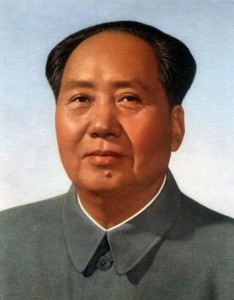
Photo Summary: A painting of Chairman Mao. The original painting stands 91cm high and 68cm wide
Picture Taken: Was created for the 1950 anniversary, the first anniversary, of the Communists take over of mainland China

The Communist Party of China after taking control of mainland China began at once building a personality cult around the Communist leader, Chairman Mao. His image appeared all over the country but it was this image created on the first anniversary, in 1949, of the Communists take over of mainland China that became the most reproduced image of Mao.

Mao

Mao Zedong (December 26, 1893 – September 9, 1976) was a Chinese communist leader who led the Communist Party of China (CPC) to victory against the nationalist Kuomintang (KMT) in the Chinese Civil War. The 20-year long civil war technically ended when Mao’s forces captured all of mainland China on which the CPC established the People’s Republic of China on October 1, 1949, in Beijing. The CPC is technically still at war with nationalist forces who retreated to and still remain on the island of Taiwan, the Republic of China (ROC). Both Taiwan and mainland China declare that they are the real China.

Mao leadership remains a controversial subject. Many see his rule as a great revolutionary leader who led China from a poor backward nation to world superpower. Critics point to the infamous, Great Leap Forward which killed anywhere from 20 to 70 million Chinese or the Cultural Revolution which greatly disrupted the country, for almost a decade. Officials now don’t know where to stand on Mao’s rule and the official line is that his policies were 70% right and 30% wrong. The book the Evil 100 list Mao as the third most evil person in history behind Hitler and Stalin.

Portrait for Power


Mao Original Zhang Zhenshi

The original painting by Zhang Zhenshi


Over 30 painters were chosen to create portraits of Chairman Mao for the 1950 anniversary of the revolution. One of the painters, Mao’s favorite, was Zhang Zhenshi. Most of the 30 paintings have since been lost or destroyed but Zhang’s image of a solemn Mao dressed in a simple grey tunic was reproduced as a poster that was put up everywhere in China. The model for the giant image of Mao that hangs in Tiananmen Square is based on this image.

The Original

On June 3, 2006, the original painting was set to go on the auction block. The Beijing Huachen Auction Company which stated there would be no location restrictions on the portrait and that the sale would have been open to both Chinese and foreign bidders were forced to cancel the auction after a huge outcry from the Chinese public. Mao is still beloved by many Chinese and they feared that a foreign bidder would take it out of the country. Eventually, a deal was reached with the private Chinese-American owner who agreed to sell the painting to China’s National Museum. The purchase was jointly financed by the museum and the State Administration of Cultural Heritage. For the auction, the painting was valued at $120,000 American dollars but the price actually paid was not disclosed.

Other Famous Images

Related Posts:

Smiling Sada Abe

Buy on amazon

Another photo with more somber police


Behind the camera: Published in the Mainichi Newspaper
Where: Leaving the Takanawa Police stn in Tokyo
Photo Summary: Sada Abe with policemen after her arrest
Picture Taken: May 20, 1936
This image is in the public domain because of its age

In 1930s Japan a Japanese woman became infatuated with and strangled her lover to death. After his death, she cut off his penis and carried it around with her while being chased by the police. When news of the crime broke that a “sexually and criminally dangerous woman was on the loose,” the nation was gripped with what was called “Abe Sada panic.” On the run for a few days, she was caught and spent six years in prison. She later became a sensation in Japanese culture for many decades. At the time of her arrest police were struck with her calm demeanor.

Sada Abe’s life

Born in 1905 Sada Abe was the youngest child of four. An independent girl at a young age she was sexually assaulted and perhaps due to this assault became difficult for her ageing parents to control. Abe was always fascinated with the Geisha lifestyle and so her father sold her to a Geisha House although there is some debate on whether she wanted to go or not. Abe found living the life of a Geisha extremely frustrating and quickly fell out with the house and turned to prostitution. She spent years working in the brothels until becoming the mistress of Kichizo Ishida.

Kichizo Ishida

The two became incredibly infatuated with each other spending days in hotels with marathon sex sessions that didn’t stop even when maids cleaned the rooms. When Ishida would return to his wife Abe became incredibly jealous and flirted with the idea of murdering him. Buying a knife she even threatened him during the next visit to the hotel but Ishida thought she was just role-playing and didn’t take her seriously. While making love she tried to strangle him with a cord but he actually enjoyed the restriction of his breath and told her to continue which threw her off. Later in the night, he passed out and Abe wrapped the cord again around his throat and strangled his sleeping body to death. Using the knife she removed his genitals with a knife, using the blood from the wound she wrote “Sada and Kitchi together” on the sheets, and carved her name on his arm with a knife. Later when the police asked about why she took Ishida’s genitalia, Abe replied, “Because I couldn’t take his head or body with me. I wanted to take the part of him that brought back to me the most vivid memories.”
[midgoogle]

“Abe Sada panic” and arrest

Another photo with more somber police


When the body was discovered the police released a media alert that sparked a public panic over a crazed woman running around Japan chopping of genitalia. Police were swamped with sightings from around the country. After the murder, she drifted around Tokyo eventually ending up in a hotel in southern Tokyo. After a massage and beers at the Inn, she fell asleep.
Police who were visiting all hotels, trying to find her, became suspicious of the alias she used to sign in. After apologetically entering her hotel room Abe Sada supposedly told the police, “Don’t be so formal, You’re looking for Sada Abe, right? Well that’s me. I am Sada Abe.” The police didn’t actually believe her but were finally convinced when she displayed Ishida’s genitalia. While interrogating Abe officers were struck by Abe’s demeanour. When they asked why she had killed Ishida. “Immediately she became excited and her eyes sparkled in a strange way [and she said] ‘I loved him so much, I wanted him all to myself. But since we were not husband and wife, as long as he lived he could be embraced by other women. I knew that if I killed him no other woman could ever touch him again, so I killed him…..’ William Johnston who wrote the book, Geisha, Harlot, Strangler, Star: A Woman, Sex, and Morality in Modern Japan suggests that what made Abe so fascinating to the Japanese public was that “she had killed not out of jealousy but out of love.”

Later life

Abe was sentenced to six years in prison which she served and was released. She tried to live her life in obscurity but the nature of her crime brought her back into the limelight. She wrote a book about her life and there were many other unofficial bios published.
The Abe craze started a little cottage industry in Japan. The hotels they stayed at saw a huge jump in business as young couples wanted to stay in the same room. Shinagawaka, the Inn where she was arrested, kept the room in the same condition as when the police caught her. In addition to the books published there are even some movies about her life, including a number of A/V films or Porn Movies.

Other Famous picturess

Related Posts:

By the Sword

Behind the camera: Yasushi Nagao
Where: Stage of Hibiya Hall, Tokyo, Japan
Photo Summary: Otoya Yamaguchi thrusting his sword into Socialist party leader, Inejiro Asanuma
Picture Taken: October 12, 1960

1960 saw great political turmoil in Japan as the ruling party, the LDP, tried to pass the Treaty of Mutual Cooperation and Security between the United States and Japan. The Japan Socialist Party tried in vain to stop the bill’s passage in the Diet even physically preventing LDP members from entering the parliament chamber before being removed by police. Failing to stop the bill the Socialists and their supporters took to the streets in sometimes violent protests that even forced President Dwight D. Eisenhower to cancel a planned trip to the country. Hoping to capitalize on the anger that the bill was passed on June 19 Socialist leader Inejiro Asanuma planned an American style televised rally for the upcoming Lower-house election. It was at this rally that an ultra-nationalist member Otoya Yamaguchi rushed the stage and twice plunged a samurai blade into Asanuma’s stomach. The picture captured by Mainichi photographer Yasushi Nagao was published around the world and eventually went on to win the Pulitzer Prize for photography the first time someone from Japan had won the award. With the award, Nagao was able to travel freely around the world, something that was difficult for Japanese citizens at the time. He died of natural causes on May 2, 2009.

Taking the photo


Yasushi Nagao was one of thirty-six photographers that worked for the daily Japanese newspaper, Mainichi. On that day he was assigned to cover the election debate at Hibiya Hall. Before he entered the Hall he slipped a twelve-exposure film pack into his 4×5 Speed Graphic camera. As Asanuma started his speech right-wing hecklers started throwing objects at the stage while shouting, “Shut up, Communist” and “Banzai the U.S.A.”
As police moved in to remove the hecklers most of the press covering the event followed them in hopes of getting some good crowd shots. Nagao chose to stay at the stage. The young Yamaguchi dressed in his high school uniform slipped past the police and ran onto the stage. Out of the corner of his eye saw Yamaguchi jump on stage and Nagao by instinct changed the focus from 10 to 15 feet. He initially thought that the boy “was carrying a brown stick to strike Asanuma.” Running full speed across the stage the young assassin slammed the blade deep in the belly of Asanuma, the impact forced the two to spin apart. Nagao had waited until this point as the impact had pushed Yamaguchi and Asanuma out from behind the podium. Nagao snapped the moment as Yamaguchi prepared to thrust his blade a second time into Asanuma’s belly. The photo was his last unexposed negative.
Realizing that he had a great image Nagao rushed his roll of film to the Mainichi building. By agreement, UPI had exclusive rights to all Mainichi news pictures and they radio-photoed Nagao’s image back to the States where it was published in numerous newspapers and magazines including the October 24, 1960 issue of LIFE magazine. The image won every photo award in America including the Pulitzer Prize for Photography in 1961.

The assassin


Colourized by Ömercolorize


17-year-old Otoya Yamaguchi was a member of an ultra-right-wing nationalist group. His father, Shimpei Yamaguchi, was a colonel in the Japanese Self-Defense force. Even though Shimpei Yamaguchi was forced to resign his commission he defended his boy saying: “A rightist is better than a leftist.”. When Otoya was arrested police records record that he expressed regret that he was only able to kill Asanuma. He had planned to kill three people: Communist member Sanzo Nosaka, Japan Teachers’ Union Chairman Takeshi Kobayashi as well as Asanuma. The sword he used is called a wakizashi which is a small blade that the samurai used to wear. It was found by Otoya in the bottom of his father’s closet a week before the assassination.

On November 2nd, while in a juvenile detention center, Otoya used toothpaste to write a message on his wall: “Seven lives for my country. Ten thousand years for His Imperial Majesty, the Emperor!”. He then tore his bedsheet into strips which he used to make a rope to hang himself in a Japanese ritual called owabi. Owabi is a samurai tradition in which one commits suicide to apologize to those inconvenienced by Asanuma killing.

Inejiro Asanuma

The 225 lbs (102 kg) politician was the left-wing leader of the Japanese Socialist Party. He often enraged the Japanese conservatives by publicly supporting communist China. In 1959 he visited Red China and even went so far to say, “the United States is the common enemy of the Japanese and Chinese peoples.” To prevent the passage of the Japanese American mutual defense pact Asanuma organized large snake-dancing demonstrations that eventually prevented President Eisenhower from visiting the country. After his assassination, the Socialist party paraded his widow in hopes of generating sympathy votes from the Japanese public. Even with the support after Asanuma’s murder during the November 20, 1960 election the LDJ won with 296 seats compared to 145 seats of Socialist party down from 166 seats they held during the 1958 election.

Other Famous picturess

Related Posts:

Reagan Assassination Attempt

Behind the camera: Assembled media members and ABC cameraman Hank Brown
Where: In front of Washington (D.C.) Hilton Hotel located at 1919 Connecticut Ave. NW, near the intersection of Connecticut and Florida Avenues, a few blocks north of Dupont Circle
Photo Summary: The aftermath of John Hinckley’s assassination attempt
Picture Taken: March 30, 1981, 69 days into the United States Presidency of Ronald Reagan

Jerry get off, I think you’ve broken one of my ribs
-Regan to his secret service agent

Reagan’s shooter was a mentally ill John Hinckley Jr who had an obsession with actress Jodie Foster after seeing the film, Taxi Driver. He stalked her for a number of years before he decided that he needed to do something grand to get her attention. Hinckley decided to try and kill the president imitating Travis Bickle the lead character (played by Robert De Niro) of the movie Taxi Driver who also tried to kill a famous politician. On March 30, 1981, Hinkley ambushed the President who was leaving the Washington Hilton Hotel after delivering a luncheon address to AFL-CIO representatives. The attempt on Reagan’s life was caught on camera and is often used as one of the most famous pieces of footage of that era.

Video Breakdown


The footage starts with Aides to the President and then the President himself walking down to the Executive Limo parked outside the hotel. It seems like any other day and in the background, you can hear reporters about to ask questions. As the limo comes into the frame you can see a bald James Brady the President’s Press Secretary walk towards the cameraman. Just as Reagan reaches the Limo you hear loud pops, screams and then a commotion as Secret Service and Police wrestle Hinkley to the ground.
As the first shots ring out you can see secret service agent Tim McCarthy wearing a light blue suit go into an almost football stance as he tries to block the bullets from Hinkley’s gun. He succeeded in taking one of the bullets in his abdomen. Surgeons at George Washington University Hospital successfully removed the round from his stomach, and he fully recovered. He received the NCAA Award of Valor in 1982 in recognition of his bravery.
As the street clears you can see wounded lying on the street. James Brady, who took the first bullet, is the closest lying face down and not moving. Shot in the forehead he would suffer brain damage and became permanently disabled. Farthest away from the camera is secret service agent Tim McCarthy and right next to the wounded Brady is District of Columbia police officer Thomas Delehanty who was shot in the back by the third of John Hinckley, Jr.’s six bullets. He would later recover from his wounds.
As the camera pans down to Brady you can see Hinkley’s gun a Rohm RG-14 .22 cal. revolver on the ground and later you hear police asking for a tissue to take the gun into evidence. Agents are screaming for a police car to take Hinkley away. Eventually, the car comes but the rear door of the squad car jams so then they have to take him to another police car further down the street. As they hustle Hinkley into the patrol car the ambulance pulls up to treat the wounded.

Mr. President, today we are all Republicans
-Head surgeon and liberal Democrat Joseph Giordano

Reagan Remembers


My speech at the Hilton Hotel was not riotously received – I think most of the audience were Democrats – but at least they gave me polite applause. After the speech, I left the hotel through a side entrance and passed a line of press photographers and TV cameras.
I was almost to the car when I heard what sounded like two or three firecrackers over to my left – just a small fluttering sound, pop, pop, pop. I turned and said, “What the hell’s that?” Just then, Jerry Parr, the head of our Secret Service unit, grabbed me by the waist and literally hurled me into the back of the limousine. I landed on my face atop the armrest across the back seat and Jerry jumped on top of me. When he landed, I felt a pain in my upper back that was unbelievable. It was the most excruciating pain I had ever felt. “Jerry,” I said, “get off, I think you’ve broken one of my ribs.”
“The White House,” Jerry told the driver, then scrambled off me and got on the jump seat and the car took off. I tried to sit up on the edge of the seat and was almost paralyzed by pain. As I was straightening up, I had to cough hard and saw that the palm of my hand was brimming with extremely red frothy blood. “You not only broke a rib, I think the rib punctured my lung,” I said.
Jerry looked at the bubbles in the frothy blood and told the driver to head for George Washington University Hospital instead of the White House. By then my handkerchief was sopped with blood and he handed me his. Suddenly, I realized I could barely breathe. No matter how hard I tried, I couldn’t get enough air. I was frightened and started to panic a little. I just was not able to inhale enough air. We pulled up in front of the hospital emergency entrance and I was first out of the limo and into the emergency room. A nurse was coming to meet me and I told her I was having trouble breathing. Then all of a sudden my knees turned rubbery. The next thing I knew I was lying face up on a gurney and my brand-new pinstriped suit was being cut off me, never to be worn again.
The pain near my ribs was still excruciating, but what worried me most was that I still could not get enough air, even after the doctors placed a breathing tube in my throat. Every time I tried to inhale, I seemed to get less air. I remember looking up from the gurney, trying to focus my eyes on the square ceiling tiles, and praying. Then I guess I passed out for a few minutes. I was lying on the gurney only half-conscious when I realized that someone was holding my hand. It was a soft, feminine hand. I felt it come up and touch mine and then hold on tight to it. It gave me a wonderful feeling. Even now I find it difficult to explain how reassuring, how wonderful, it felt. It must have been the hand of a nurse kneeling very close to the gurney, but I couldn’t see her. I started asking, “Who’s holding my hand? Who’s holding my hand?” When I didn’t hear any response, I said, “Does Nancy know about us?” — Reagan autobiography

Regan again lost conscious and when he again woke up he saw his wife, First Lady Nancy Reagan. Still keeping his wits he jokingly explained, “Honey, I forgot to duck” (borrowing Jack Dempsey’s line to his wife the night he was beaten by Gene Tunney for the heavyweight championship).
Shortly before surgery to remove the bullet, which barely missed his heart, Reagan remarked to the surgical team, “Please tell me you’re all Republicans.” The head surgeon, liberal Democrat Joseph Giordano, replied, “Mr. President, today we are all Republicans.”
Reagan had been scheduled to visit Philadelphia on the day of the shooting. He told a nurse, “All in all, I’d rather be in Philadelphia,” a reference to the W.C. Fields’s tagline (which was itself a reference to an old vaudeville joke among comedians: “I would rather be dead than play Philadelphia”).

Other Famous pictures

Related Posts:

Martin Luther King Jr Killed

Behind the camera: James Louw
Where: Balcony of the Lorraine Motel in Memphis, Tennessee, USA
Photo Summary: A mortally wounded Martin Luther King Jr surrounded by friends and aides. Marrell Mccullough appears to be holding him in his arms
Picture Taken: Minutes after the bullet struck at 6:01 p.m. April 4, 1968

By all accounts, King was in a jovial mood that April 4 day. While standing on the balcony he joked with friends and colleagues while he waited for his jacket. At 6:01 a shot rang out, hitting King in the side of the face. Friends rushed to his side and desperately tried to stop the bleeding. Police soon appeared on the scene guns drawn asking where the shot came from. Those on the balcony pointed in the direction of an old run down hotel across the street. That moment was captured by photographer, James Louw, and now lives in infamy as King’s death shot.

Dr. Martin Luther King, Jr

Dr. Martin Luther King, Jr. (January 15, 1929 – April 4, 1968) was the most famous leader of the American civil rights movement, a political activist, and a Southern Baptist minister. In 1964, King became the youngest man to be awarded the Nobel Peace Prize (for his work as a peacemaker, promoting nonviolence and equal treatment for different races). In 1977, he was posthumously awarded the Presidential Medal of Freedom by Jimmy Carter. In 1986, Martin Luther King Day was established as a United States holiday, only the fourth Federal holiday to honor an individual (the other three being in honor of Jesus of Nazareth, George Washington, and Christopher Columbus). In 2004, King was posthumously awarded the Congressional Gold Medal. Considered by many as one of the greatest public speakers in U.S. history, Dr. King often called for personal responsibility in fostering world peace. King’s most influential and well-known public address is the “I Have A Dream” speech, delivered on the steps of the Lincoln Memorial in Washington, D.C.

Garbage Strike

In late March 1968, Dr. King went to Memphis, Tennessee in support of the black garbage workers of AFSCME Local 1733, who had been on strike since March 12 for higher wages and better treatment: for example, African American workers, paid $1.70 per hour, were not paid when sent home because of inclement weather (unlike white workers). The night before on April 3, Dr. King returned to Memphis and addressed a rally at the Bishop Charles Mason Temple, delivering his famous I’ve been to the Mountaintop address. After the assassination, the city quickly, quietly, and on favorable terms settled the strike.

In High Spirits

This is Ralph, this is Ralph, don’t be afraid.
-Reverend Abernathy to King

The owner of the Lorraine Motel, Walter Bailey, where King was staying claimed that King was a frequent guest at the establishment and that Reverend Ralph Abernathy, told the United States House Select Committee on Assassinations (HSCA) under oath that he and Dr. King stayed in room 306 at the Lorraine so often that it was referred to as the “King-Abernathy suite.” Bailey also remembers that on that fateful day, April 4, 1968, King was especially happy and while he was getting ready was, “teasing and cutting up” those present. One of King’s best friends and number two man in the SCLC, Reverend Abernathy, remembers that around 1 that day he and King had fried catfish for lunch and then Abernathy had a nap waking around 4 p.m. to King on the phone asking him to come over to his Brother’s, who was travelling with them, room.
When Abernathy arrived King told him that dinner was set for 6 p.m. as they had been invited for prime rib roast and soul food such as chitterlings, greens, pig’s feet and blackeyed peas at the local Rev.
Samuel “Billy” Kyles house.

From right to left Hosea Williams, Jesse Jackson, Martin Luther King Jr., Rev. Ralph David Abernaty posing for pictures on April 3, 1968. They are on the same Lorraine Motel balcony that Dr. King would be killed on the next day.


While the two got ready back in their room 306 Rev Kyles appeared and told them to get a move on or they would be late for the dinner. Dr. King had to assure Kyles that he had telephoned the preacher’s home and that Mrs. Kyles had said dinner was not until 6. “We are not going to mess up her program,” said Dr. King.
King and Kyles went to the balcony that overlooked the motel parking lot and swimming pool. There was a crowd of people present getting ready to go for dinner. King greeted the people below and from the second floor, Rev Kyles had a short conversation with the SCLC attorney Chauncey Eskridge who had been in Federal court most of the day trying to solve some legal problems with the strike protest.
Other SCLC members were in the courtyard including advance team members Rev. James Orange and James Bevel. They had been sent ahead of time to deal with a black militant group called, The Invaders. The Invaders were pushing for violence something King deplored. In fact, Orange had just arrived with Invader member, Marrell McCullough, who was, in fact, an undercover agent working as a mole in the Invader group.
King’s chauffeur, Solomon Jones, who had been beside King’s limo all day looked up and noticed that King didn’t have a jacket and called up that King should put on a jacket as it was getting cold. Witnesses recall that Dr. King smiled back at his driver and said, “Solomon, you really know how to take good care of me.” They were about to go when Abernathy decided to slip back into the hotel for some aftershave while King waited on the balcony chatting to members of his entourage below.

At 6:01 p.m., as Dr. King stood behind the iron balcony railing in front of room 306, the report of a high-powered rifle cracked the air. A slug tore into the right side of his face, violently throwing him backward.
At the mirror in room 306, Abernathy poured some cologne into his hands. As he lifted the lotion to his face, he heard what sounded like a “firecracker.” He jumped, looked out the door to the balcony and saw that Dr. King had fallen backward. Only his feet were visible, one foot protruding through the ironwork of the balcony railing. According to Abernathy, the bullet was so powerful it twisted Dr. King’s body so that he fell diagonally backward. As Abernathy rushed out to aid his dying friend, he heard the cries and groans of people in the courtyard below.
Just below the balcony, Jones recalled that Young and Bevel shoved him to the ground just after the firecracker sound. He looked up and saw Abernathy come out of the room and then realized that the prone Dr. King had been shot. Lee, who had been talking with Young and Bevel, took cover behind a car and then noticed Dr. King’s feet protruding through the balcony railing.
Memphis undercover policeman McCullough recalled that immediately before he heard the shot, he saw Dr. King alone on the balcony outside room 306, facing a row of dilapidated buildings on Mulberry Street. As he turned away from Dr. King and began to walk toward his car, McCullough, an Army veteran, heard an explosive sound, which he assumed was a gunshot. He looked back and saw Dr. King grasp his throat and fall backward. According to McCullough’s account, he bolted up the balcony steps as others in the courtyard hit the ground. When he got to Dr. King’s prone figure, the massive face wound was bleeding profusely and a sulphurous odor like gunpowder, perhaps Dr. King’s depilatory, permeated the air. McCullough took a towel from a housekeeping tray and tried to stem the flow of blood.
Eskridge had heard a “zing” and looked up toward the balcony. He saw that Dr. King was down, and as Abernathy walked out onto the balcony, Eskridge heard him cry out “Oh my God, Martin’s been shot.” A woman screamed.
Abernathy recalled that when he walked out on the balcony, he had to step over his mortally wounded friend.
…the bullet had entered his right cheek and I patted his left cheek, consoled him, and got his attention by saying, “This is Ralph, this is Ralph, don’t be afraid.”
Kyles, who had started to walk toward his car, ran back to room 306. Young leaped up the stairs from the courtyard to Dr. King, whom he found lying face up, rapidly losing blood from the wound. Young checked Dr. King’s pulse and, as Abernathy recalled, said, “Ralph, it’s all over.”
“Don’t say that, don’t say that,” Abernathy responded.

Kyles ran back to room 306 to call an ambulance but the switchboard operator, the motel owner’s wife, wasn’t at her desk. Kyles would later find out that she had gone out to the parking lot so that she could see Dr. King. When she saw what happened, she collapsed with a heart attack and would later pass away as a result.
Having no luck with the motel phones Kyles ran onto the balcony and noticed police in the courtyard screamed for them to call an ambulance on their radios. While waiting for it to come he took a spread from one of the motel beds and covered him from his neck down. He also took a crushed cigarette from his hand. Dr. King never smoked in public as he didn’t want the kids to see him smoking.
A King biographer, Taylor Branch, claims that King was still conscious while on the balcony and that his last words were to Ben Branch (no relation to Taylor Branch) a singer that was going to play that night: “Ben, make sure you play ‘Precious Lord, Take My Hand,’ in the meeting tonight. Play it real pretty.”
Rev Abernathy kneeling over his friend tried desperately to stop the bleeding. Around 5 mins after King had been shot an ambulance arrived and took him away to St. Joseph’s Hospital where he was pronounced dead at 7:05 p.m.

Jesse Jackson is Born

People freaked out and did strange things
-Andrew Young

King’s wound produced a huge amount of blood and after the ambulance took away his body all that was left a huge pool of King’s blood. Ralph Abernathy in a state of shock grabbed a jar and started scraping up the blood, crying how it was King’s blood and precious, “This blood was shed for us.”
Jesse Jackson also still in shock had by this time made his way to the balcony from where he was hiding down by the pool. Andrew Young remembers seeing Jackson dip his hands in the huge pool of blood and after raising them to the sky wiped them on his shirt, “people freaked out and did strange things … it was_ it was_ I mean, what do you do in a moment like that”?
The main players in the SCLC quickly followed Kind to the hospital leaving Jesse Jackson behind in shock. However, it was the tragedy of King’s death that the star of Jesse Jackson was born. Media quickly swarmed the hotel where King had been shot and they quickly focused on the young SCLC member with King’s blood all over his shirt. With the rest of the SCLC off at the hospital Jesse became the media spokesman:

The black people’s leader, our Moses, the once in a 400 or 500-year leader has been taken from us by hatred and bitterness. Even as I stand at this hour, I_ I cannot even allow hate to enter my heart at this time, for it was sickness, not meanness, that killed him.
People were_ some were in pandemonium, some were in shock, some were crying, hollering, “Oh, God!” And I immediately started running upstairs to where he was and I caught his head and I tried to feel his head and I asked him, I said, “Dr. King, do you hear me? Dr. King, do you hear me?” And he didn’t say anything and I tried to hold his head. — Jesse Jackson

While the rest of SCLC was back at the motel trying to figure out the next step, Jesse Jackson quickly made his way back to Chicago where hours after King’s death he appeared on the Today show with his bloody shirt while a newly hired booking agent got him spots on other TV shows. Overnight Jesse Jackson became a nationally known figure of the civil rights movement.

Country in Mourning

The assassination led to a nationwide wave of riots in more than 60 cities. Five days later, President Lyndon B. Johnson declared a national day of mourning for the lost civil rights leader. A crowd of 300,000 attended his funeral that same day. Vice-President Hubert Humphrey attended on behalf of Lyndon B. Johnson, who was meeting with several advisers and cabinet officers on the Vietnam War in Camp David.

The Lone Gunman?

Ray was the killer but that he didn’t act alone
Conclusion of U.S. House Select Committee on Assassinations

Two months after King’s death, escaped convict James Earl Ray was captured at London Heathrow Airport while trying to leave the United Kingdom on a false Canadian passport in the name of Ramon George Sneyd. Ray was quickly extradited to Tennessee and charged with King’s murder, confessing to the assassination on March 10, 1969 (though he recanted this confession three days later). Later, Ray would be sentenced to a 99-year prison term.
On the advice of his attorney Percy Foreman, Ray took a guilty plea to avoid a trial conviction and thus the possibility of receiving the death penalty. Ray fired Foreman as his attorney (from then on derisively calling him “Percy Fourflusher”) claiming that a man he met in Montreal, Canada with the alias “Raoul” was involved, as was his brother Johnny, but not himself, further asserting that although he didn’t “personally shoot Dr. King,” hinting at a conspiracy he may have been “partially responsible without knowing it”. He spent the remainder of his life attempting (unsuccessfully) to withdraw his guilty plea and secure the trial he never had.
There was much attention devoted to the identity of Raoul and the involvement of Ray’s brother, Jerry Ray. One book by William Bradford Huie, They Slew The Dreamer, labels Raoul as George Ben Edmondson. Edmondson was a convict who learned computer programming in a Jefferson City prison and escaped eventually making his way to Canada where he worked for the West German Pavilion at Expo ’67 in Montreal. Nothing else was made of the connection and Edmondson was released and returned to Canada but the media attention by the time of his release had died out and nothing was followed up. Edmondson himself saw the allegation as ridiculous. Another theory offered by a 1977 New Times magazine article suggested that Jerry Ray (James’ brother) and “Raoul” were one and the same. State prosecutors in Memphis claimed to have investigated Raoul and did find the individual but insisted that he had nothing to do with the killing and was working on the day he was shot.
U.S. House Select Committee on Assassinations investigated the Kennedy and King assassinations released a report in 1978 that Ray was the killer but that he didn’t act alone. They concluded that a group of white supremacists in St. Louis, reportedly with a $50,000 bounty on King’s head, might have been involved, too. The house committee’s full report is sealed until the year 2029.

On June 10, 1977, shortly after Ray had testified to the House Select Committee on Assassinations that he did not shoot King, he and six other convicts escaped from Brushy Mountain State Penitentiary in Petros, Tennessee. They were recaptured on June 13 and returned to prison. More years were then added to his sentence for attempting to escape from the penitentiary. Ray died in prison on April 23, 1998, at the age of 70 from complications related to kidney disease, caused by hepatitis C probably contracted as a result of a blood transfusion given after a stabbing while at Brushy Mountain State Penitentiary. It was also confirmed in the autopsy that he died of liver failure.

Other famous picturess

Related Posts:

Face to Face the Oka Crisis

Behind the camera: Shaney Komulainen
Where: First Nation blockade near the Club de golf d’Oka
Photo Summary: Patrick Cloutier face to face with Brad ‘Freddy Krueger’ Larocque
Picture Taken: September 1, 1990

After the Mohawk First Nations had fought off the local Quebec police force (which created another iconic image) the Oka Crisis developed into a standoff. The Canadian government sent in the Royal 22e Régiment or Van Doos to create a barb wire perimeter around the Mohawks in order to contain the situation. Entrances at this blockade were often tense as shown when a young Shaney Komulainen captured this iconic moment between baby faced Van Doo member Patrick Cloutier face to face with Brad “Freddy Krueger” Larocque.

Oka Crisis

Over three hundred years ago the New France government granted land to the Catholic Sulpician seminary in 1717. Part of the land, a Mohawk burial ground was reserved for the local Mohawk First Nation. The seminary held the land in trust for the Mohawks but would over the years take full ownership. A military confrontation in 1869 between Mohawks and missionaries over the land had to be put down by local militia. The land remained in dispute even when it was sold by the seminary to private concerns. In 1961, the city had obtained ownership of the land and built a private nine-hole golf course, the Club de golf d’Oka, on a portion of the land. When they wanted to expand the golf course the Mohawks erected barricades to stop construction. A court order ruled on the side of the city and ordered the blockade to be removed. The Mohawk’s refused and on July 11, 1990, a police fast action response team tried to drive off Mohawk activists using tear gas canisters and flash-bang grenades. In the confusion, someone opened fire and a 15-minute bullet exchange ensued forcing the police to fall back, abandoning six police cruisers and a bulldozer. During the firefight, 31-year-old SQ Corporal Marcel Lemay was shot in the face and died a short while later.

Taking the picture

Shaney Komulainen didn’t get into the Mohawk enclosure before it was closed off by the military. Arriving late she had to sneak into the encampment through military lines recounting:

I snuck through backyards and past police cars with my camera tucked under my jacket, looking like one of the locals. [Her eyes were drawn to the baby face of private Cloutier ] He just looked so young under that strong helmet and gear, … In the end, it summed up the whole crisis, because there was still this tense standoff, even ‘till the end.

The siege ended on September 26 and as the people in the Mohawk enclosure left their camp Komulainen was arrested, handcuffed, strip-searched and held by the Quebec police for five hours. The next January Komulainen was involved in a near-fatal car crash that left her with a broken arm and two broken legs. While she was recovering in the hospital she learned that the police were laying charges against her including, “possession of a weapon or an imitation of a weapon, threatening and interfering with the work of a peace agent, and participating in a riot,” later in the year she was found “Not Guilty”. To make matters worse her car accident prevented her from working and she returned to school studying journalism and social work. Years later she had recovered enough to return to photography.

The men

After the image was taken private Patrick Cloutier became famous across Canada and around the world. He rose through the ranks to become Master Corporal but in 1993 was demoted after admitting to cocaine use. After a drinking and driving incident, he was kicked out of the military and as a civilian seeking to cash in on his fame he started in the 1995 pornographic, Oka spoof, Quebec Sexy Girls. For a while, he lived in Florida before moving back to Quebec and lives in the village of Saint-Maxime-du-Mont-Louis.

The masked man is often confronting Cloutier is often misquoted as being legendary and camera-friendly Mohawk warrior Ronald Cross aka Lasagna but was Brad “Freddy Krueger” Larocque a student of Economics at the University of Saskatchewan. From the Ojibway First Nation, he had joined the Mohawks in solidarity. After the siege ended he moved back to Saskatchewan.

Other Famous Pictures

Related Posts:

Mohawk Warrior

Behind the camera: Tom Hanson
Where: First Nation blockade near the Club de golf d’Oka
Photo Summary: Richard Nicholas standing on top of an overturned Sûreté du Québec police vehicle that had been turned into a barricade
Picture Taken: July 11, 1990

In 1990 the Oka golf course wanted to expand their course onto land that the local Mohawk community of Kanesatake viewed as their historical, sacred burial ground. The Mohawks in an effort to stop development set up roadblocks. The major ordered the blockades down and in the ensuing violent confrontation one police officer, 31-year-old SQ Corporal Marcel Lemay, was killed and the blockades still left standing. One of the First Nation activists, Richard Nicholas, climbed on top the newest addition to the Mohawk blockades, overturned police vehicles seized after the government forces had retreated. Below the blockade were two photographers, John Kenney of the Montreal Gazette and Tom Hanson. Hanson snapped this shot while Kenney shot a similar cropped version.

Oka Crisis

Over three hundred years ago the New France government granted land to Catholic Sulpician seminary in 1717. Part of the land, a Mohawk burial ground was reserved for the local Mohawk First Nation. The seminary held the land in trust for the Mohawks but would over the years take full ownership. A military confrontation in 1869 between Mohawks and missionaries over the land had to be put down by local militia. The land remained in dispute even when it was sold by the seminary to private concerns. In 1961, the city had obtained ownership of the land and built a private nine-hole golf course, the Club de golf d’Oka, on a portion of the land. When they wanted to expand the golf course the Mohawks erected barricades to stop construction. A court order ruled on the side of the city and ordered the blockade to be removed. The Mohawk’s refused and on July 11, 1990, a police fast action response team tried to drive off Mohawk activists using tear gas canisters and flash-bang grenades. In the confusion, someone opened fire and a 15-minute bullet exchange ensued forcing the police to fall back, abandoning six police cruisers and a bulldozer. During the firefight, 31-year-old SQ Corporal Marcel Lemay was shot in the face and died a short while later.

Taking the picture

John Kinney one of two photographers close to the blockade, the other being Hanson, remembers what happened on that day:

We were the only two people there, It was the morning of the first day of the crisis. The Mohawks had set up their blockade with the SQ vehicles they’d taken over, and this guy hopped up there on top and looked down the hill and made his defiant gesture.
It was a quick thing. Neither of us spoke to him. Through the whole summer, I always wondered who he was, but I could never identify him … He wasn’t even focused on us; most of the media were way down at the bottom of the hill and that’s where he was looking, not at us at all.

Stand off


Mohawk by John Kenney

Similar angle by John Kenney


With the police overmatched the military was called in and for the next few months, the two forces were locked in a standoff. The media attention among the Mohawks created some First Nation celebrities including a Mohawk warrior known as, Lasagna. The Oka Crisis lasted seventy-eight days before the warriors threw their guns in the fire, ceremonially burned tobacco and then walked out of the pines and tried to break out of the blockade. The federal government spent $5.3 million to purchase the section of the pines where the golf course expansion was to take place, to prevent any further development. Some of the lands were handed over to the Mohawks but the Kanesatake tribal government is still negotiating with the federal government for a larger Treaty to be signed to resolve all outstanding issues. Kanesatake First Nation leaders claim that the federal government walked away from the treaty table in 2006.

Joined again in death

In a strange twist of fate, the photographer and the Mohawk Warrior were brought together one more time in death. While playing hockey Tom Hanson collapsed and died of a heart attack on March 10, 2009. Later in the day Richard Nicholas, the man Hanson photographed, died in a three-vehicle accident near Oka on the same Highway 344 where his picture was taken. They were both 41-years-old.

Other famous pictures

Related Posts: