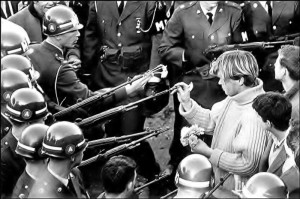
Flower Power

Buy on amazonflower power by Bernie Boston
Behind the camera: Bernie Boston
Where: One of the last big protest marches on the Pentagon
Photo Summary: 18 years old George Harris placing flowers into the rifle barrels of National Guardsman
Picture Taken: October 21, 1967

In late 1967 Bernie Boston was a reporter for the Washington Star a now-defunct newspaper. After he took this famous picture Star publishers didn’t see the value of the image and buried it the A section of their paper. Not deterred Bernie Boston sent the image out to various photo competitions which resulted in a number of awards, prizes, and international recognition.

Taking the photo

The end of the 60s saw a number of anti-Vietnam war protests. Covering one of the last big protests Bernie sat with his camera on a wall at the Mall Entrance to the Pentagon. While the protest neared the gates Bernie watched as a National Guardsman lieutenant marched a group of armed men into the sea of demonstrators. The squad formed a semi-circle, their guns pointed at the demonstrators.

In a 2006 interview, Bernie remembers thinking things could have got ugly when all of a sudden, “this young man appeared with flowers and proceeded . . . [to] put them down the rifle barrel,” Boston told National Public Radio. “And I was on the wall so I could see all this, and I just started shooting.”

While he knew he had a good picture the Star editors didn’t feel the same way and gave the picture minimal coverage. “The editor didn’t see the importance of the picture,” Boston said later. “We buried it … I entered it in contests, and it started winning everything and being recognized.”

Bernie Boston


A Washington, D.C. native Bernie Boston was born May 18, 1933, in the midst of the Great Depression. He grew up in McLean, Virginia and found his calling early when he became a photographer for his high school newspaper and yearbook. Fast forward to university when he graduated with a degree in photography from the Rochester Institute of Technology. He followed his education by in 1955 joining the army for three years. After his military service, he worked at Dayton Daily News in Ohio in 1963 and three years later joined the staff of the Washington Star, where he remained until the paper folded in 1981. When the Star went under he found work as a staff photographer in its Washington D.C. bureau. In 1994 Boston and his wife moved to Basye, Virginia where he published and she edited the Bryce Mountain Courier.

Not a photographer that is defined by the Flower Power image Bernie would over his career shoot a number of famous people of the era including every president from Harry Truman to Bill Clinton. In 1987 he was a finalist for the Pulitzer Prize, in the spot news category, for his photograph of King’s widow, Coretta Scott King, at an unveiling of a bronze bust of her assassinated husband.

Bernie Boston died at his home in Basye on Tuesday, January 22, 2008. His wife released a statement that he died from complications of amyloidosis, a rare disease in which abnormal proteins build up in organs and tissues. He was 74 years old. Boston is survived by his wife, an aunt and two nieces.

George Harris

The young protester who captured the nature of the 60s protest movement turned out to be an 18 years old actor, George Edgerly Harris III, from New York on his way to California. He would later reveal that he was gay and took the stage name, Hibiscus. He co-founded a far-out, psychedelic, gay-themed cross-dressing troupe called The Cockettes. His life would be captured in the 2002 film of the same name made by David Weissman. Hibiscus died an early victim of the AIDS epidemic that struck the West coast gay community.

Other Famous Pictures

Related Posts:

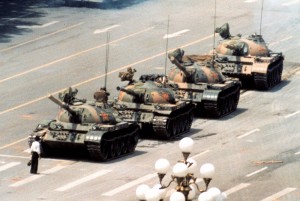
Tiananmen Square – Man vs Tank

Buy on amazon
Behind the camera: Many photographers took the same shot from different angles. The most reproduced pictures is the one shown here by Jeff Widener of the Associated Press. Other photographers who captured the scene are Charlie Cole, Stuart Franklin, and a number of TV crews
Where: The street name is Cháng Ān Dà Jiē (长安大街), or ‘Great Avenue of Chang’an’ just a minute away from Tiananmen, which leads into the Forbidden City, Beijing
Photo Summary: An unknown man blocks an advancing column of Chinese Type 59 tanks
Picture Taken: June 5, 1989

Popularly known as the Tank Man, or the Unknown Rebel, this anonymous man became famous when he pictures of him standing down a column of tanks with just his shopping bag. In April 1998, the United States magazine TIME included the “Unknown Rebel” in its 100 most influential people of the 20th century. It is easily one of the most famous pictures in the world.

Video Breakdown

As shots can be heard in the background, the clip opens with a column of Chinese Type 59 tank rolling down Cháng Ān Dà Jiē (长安大街), or “Great Avenue of Chang’an” Blvd. A man, the Tank Man, wearing what appears to be a long-sleeved white dress shirt and dark pants is standing in the middle of the road. While holding his jacket in one hand and shopping bags in another, he blocks the path of the tanks. The lead tank tries to drive around him but the Tank Man blocks the tank’s path. Eventually, he jumps up on the tank and at first tries to talk with the driver and then tries to talk through the main hatch on top of the turret. He then jumps off the tank and is bundled away by people standing on the street.

Background

PSB agents crashed through our hotel room door – Charlie Cole

Tiananmen square Jeff Widener

In 2012 Wired.com did a series of photos of photographers and their iconic pictures, this is Jeff Widener with his famous image

The protests were sparked by the death of former Secretary-General Hu Yaobang on April 15, 1989, a figure that many thought as unjustly persecuted by the Chinese government. The protests grew as different groups with a wide range of issues, some opposing views, came to Tiananmen Square. The protests were extensively covered by Western journalists who were allowed into Beijing to cover the Mikhail Gorbachev visit in May. The Chinese government was split on how to deal with the protesters but eventually, the hardliners seized control of the situation and on May 20, the government declared martial law and, on the night of June 3 and the early morning of June 4, army tanks and infantry from the 27th and 28th Armies of the People’s Liberation Army were sent to take control of the city. Local army units, the 38th Army, weren’t used as the military feared they were too sympathetic to the protesters. In fact, the commander of the 38th Army Xu Qinxian refused to carry out the martial law order and was relieved of his command.

In addition to the almost 300,000 military personnel (Twice as large as the American force that overthrew the Saddam regime in Iraq) that were deployed were also members of the Public Security Bureau (PSB). The PSB is China’s branch of government that handles policing, security and social order. By early morning on June 4, the protesters had been cleared from Tiananmen Square and over the next few days, the army and the PSB brutally suppressed the students and any media caught covering the crackdown.

One of the photographers, Charlie Cole, had spent the night running from police and the military. During the crackdown, he had witnessed an armored personal carrier (APC) that had run over some protesters. The outraged protesters then attacked the vehicle pulling out its drivers, killing them, and burnt the APC. While he was trying to get back to his hotel, he was attacked by PSB men, “One of the PSB ran up to me with an electric cattle prod and hit me in the side with it. Others punched and kicked at me. They ripped my photo vest off me and took all the film I had shot that evening.” He was eventually let go and more importantly they let him keep his cameras. While in his hotel he started shooting from the balcony of a photographer friend’s room, Stuart Franklin. Stuart had a room with a balcony on the 8th floor and while Charlie was shooting on the afternoon of June 5th he saw the Tank Man stand down the column of tanks. In a BBC interview he remembers:

It was an incredible thing to do, especially in light of what had just happened with the APC machine-gunners. I couldn’t really believe it, I kept shooting in anticipation of what I felt was his certain doom.
To my amazement, the lead tank stopped, then tried to move around him but the young man cut it off again. Finally the PSB grabbed him and ran away with him. Stuart and I looked at each other in somewhat disbelief at what we had just seen and photographed.
Later, Stuart left to go to Beijing University and I stayed behind to see what else might happen. Shortly after he left, PSB agents crashed through our hotel room door. Four agents swept in and assaulted me while a few others grabbed my cameras.

Terril Jones' street view of the Tank Man, taken by Terril Jones


They ripped the film from my cameras and confiscated my passport. They then forced me to write a statement that I was photographing during martial law, which unbeknown to me carried a hefty prison sentence. They then put a guard at the door.
I had hidden the roll with the tank pictures in its plastic film can in the holding tank of the toilet. [Cole had hidden the rolls because he saw that PSB officials on the rooftops had noticed them taking pictures of the incident] When they left, I retrieved it and later made my way to AP to develop and transmit it to Newsweek in New York.
Numerous inquiries have been made by various agencies and magazines trying to uncover the young man’s identity and find out what happened to him. I’ve seen a number of accounts that name him as Wang Wei Lin, but that isn’t a certainty.
Personally I think the government most likely executed him. It would have been in the government’s interest to produce him to silence the outcry from most of the world. But, they never could. People were executed at that time for far less than what he did.
I think his action captured people’s hearts everywhere, and when the moment came his character defined the moment rather than the moment defining him. He made the image, I just took the picture. I felt honored to be there.

Charlie Cole would later die of sepsis on September 5, 2019, aged 64. He had been living in Bali, Indonesia.

In 2013 Stuart Franklin did an interview with VICE where he talked about taking his famous image:

It was all very uncertain [Stuart would get the photos out of China]. The police and security people were going from room to room in my hotel, searching for journalists and confiscating films. That atmosphere was very worrying. I remember packing my film into a box of tea that was supplied in the hotel room and asking someone who was going back to Paris to take it for me. I was left in China without my film. I wasn’t worried about it once the film was out, and I didn’t mind if I lost a couple of cameras. It wasn’t easy—we were shot at, at times—but I was lucky.

When I got back from China, I went into Michael Rand’s office at the Sunday Times Magazine. He was laying out one of my photos on the cover of the magazine, but it was another of the photos from my trip —a topless guy with his arms raised. That became equally well known for a while. The “Tank Man” picture grew in importance over time, but it didn’t actually stand out far from the body of work immediately after the event.


Who is the Tank Man?


Little is publicly known of the man’s identity and or his fate. It would have been in China’s best interest that he be brought forward as proof that he wasn’t executed but the Chinese have not been able to. This could mean any number of things including, that in the confusion following the crackdown he was either killed on the streets or arrested and executed, or perhaps the PSB never identified who he was. So basically you have two schools of thought. One that he was arrested and the other that he managed to slip away.

Arrested

But I think never never killed
-Chinese General Secretary Jiang Zemin

Tiananmen Square full picture Stuart Franklin

Tank Man wasn't just standing up to a few tanks, he was staring down dozens of tanks. Photo by Stuart Franklin


The arrested side believes that the people who hustled the Tankman away were PBS agents and even if they weren’t they don’t believe that the Tankman could have slipped past security.

  • Reporter Charles Cole thought quite strongly that he was executed. While shooting the pictures from the hotel he noticed many Chinese agents on the rooftops who appeared to be coordinating snatch teams on the ground. Plus he witnessed a lot of public executions put on Chinese TV for people that had done far fewer offenses.
  • Three weeks after the protest Alfred Lee of the British tabloid, Sunday Express, broke a story where he named the Tank Man, Wang Weilin (王维林), a 19-year-old student and son of a Beijing factory worker. In Alfred’s report, he wrote that Wang Weilin’s friends had seen him on with a shaved head and paraded on state television. Recalling his story, Alfred Lee remembers getting the new from his sources in China, “These contacts were very close to what was happening at Tiananmen Square at the time. I knew that once his name had come into the public domain, the Chinese authorities wouldn’t be able to do anything to him. They couldn’t execute him. It would have brought outrage from the world.” Five days after Alfred’s story the, London Evening Standard, reported their Beijing correspondent John Passmore had come across intelligence reports that Weilin had been executed. Alfred Lee’s story has never been fully excepted by journalists or government agencies. Reporters note that Alfred wasn’t working in China at the time and that other journalists who had excellent contacts, fully fluent in Chinese were never able to confirm the story. Even John Passmore denies that he reported Wang Weilin’s execution saying that it was a mistake by the Standard that his name was used.
  • Slipped Away


    The slipped away side, view the people that ran out to get him as being just ordinary people who then slipped away into the crowds.

  • Jan Wong journalist for the Canadian paper the Globe and Mail pointed to the footage of the Tank Man being pulled away from the tanks as proof the men weren’t security agents, “If you’ve ever seen security people manhandle a Chinese citizen, they’re really brutal. They twist your arm. They make you bend over. They punch you a few times. They kick you. So to me, I think he was helped to the side of the road. He wasn’t being arrested.” Jan Wong claims that the man is alive and well hiding in communist China.
  • One account has him making it to Taiwan, where he worked for the National Palace Museum but other media have never been able to track him down and the Museum denies that he works there.
  • China follows a policy of total silence when talking about the Tiananmen Square protest and the Tank Man’s fate. Officials have only spoken about it once, in a 1990 interview with Barbara Walters. Then-CCP General Secretary Jiang Zemin was asked what became of the man:

    BARBARA WALTERS, ABC News: What happened to the young man?
    JIANG ZEMIN: I think this young man maybe not killed by the tank.
    BARBARA WALTERS: No, but did you arrest him? We heard he was arrested and executed.
    JIANG ZEMIN: [through interpreter] Well, I can’t confirm whether this young man you mentioned was arrested or not.
    BARBARA WALTERS: You do not know what happened to him?
    JIANG ZEMIN: But I think never never killed.
    BARBARA WALTERS: You think he was never killed.
    JIANG ZEMIN: I think never killed.
    BARBARA WALTERS: Never killed.

    Aftermath

    No one knows for certain how many people died during the Tiananmen Square massacre. The Chinese Red Cross at first reported 2,600 killed but then under intense government pressure retracted the total. The official government body count is 241 dead, including 23 officers and soldiers, and 7,000 wounded. After the crackdown, China moved on with its economic reforms and since the protest is taboo to discuss, most young Chinese don’t even know it happened.

    Copyright info


    Copyright to this photo is managed by Magnum Tiananmen Square – Man vs Tank by W. Eugene Smith

    Tank Man by Jeff Widener was another photo managed by AP Images

    More Famous photos

    Related Posts:

    I Have a Dream

    Buy on amazon
    Behind the camera: AP Images
    Where: Steps of the Lincoln Memorial during the March on Washington for Jobs and Freedom
    Photo Summary: Dr. Martin Luther King, Jr.
    Picture Taken: August 28, 1963

    I have a dream!
    Dr. Martin Luther King, Jr.

    “I Have a Dream” is the name given to the August 28, 1963, historic public speech by Dr. Martin Luther King, Jr., when he spoke of his desire for a future where blacks and whites would coexist harmoniously as equals (I Have a Dream). The speech is seen as his crowning moment and one of the most Iconic moments of that time. The speech is often ranked as one of the greatest 20th-century speeches in America. Footage and pictures of the speech are still famous and the clip is used in movies and on TV to represent the civil rights movement in the ’60s.

    Taking the photo


    G.Marshall Wilson started the day with 6:00 AM walking through the crowds with four 35mm cameras. The cameras, film and other equipment weighed 38 lbs but that didn’t slow down Wilson. Around noon he had wandered over to the speaker’s platform in front of the Lincoln Memorial and climbed to the top of the elevated cameramen’s stand. Seeing the crowd spread out he had an idea for a photo. Walking back down he talked with King and his entourage and King always on the lookout for iconic photos jumped at the chance for a front page photo. Climbing to the top of the cameramen’s stand Wilson took a number of shots of King waving to the crowd. Space was limited so Wilson used a 24mm wide-angle lens on his 35mm camera.

    March on Washington for Jobs and Freedom

    The federal government had for years tried half-heartedly to pass some kind of civil rights bill that would grant equality to all Americans. It wasn’t until President John F. Kennedy tried to pass his bill on June 11, 1963, that a real attempt to give Blacks civil rights was undertaken. The bill was quickly blocked by southern representatives in Congress.
    It was under this atmosphere that leaders from the civil rights movement planned a march to Washington to build political momentum behind the measure. Proposed by A. Philip Randolph and organized by him, Bayard Rustin and Martin Luther King Jr. the march saw a joining of multiple parties who often were in disagreement. At first, the Kennedy Whitehouse was against the march as it might turn violent and hurt the passage of the bill. The organizers agreed to tone down the rhetoric and keep the more militant organizations in check but refused to cancel the march. Once he saw that he couldn’t stop it Kennedy supported the march but because of the concessions organizers gave Kennedy many prominent Black leaders were against it. Malcolm X called it the “Farce on Washington” and the Nation of Islam punished any members who attended.

    Stay home. This will not be safe
    Southern congressmen

    Before the march there was an atmosphere and fear of potential violence, on one side Southern congressmen told their white female employees, “Stay home. This will not be safe.” and on the other, there was a fear that not enough people would show to show how much the public supported the goals of the march. These fears proved unfounded as almost a quarter of million people came to hear the speeches given that day, the largest demonstration in America at that point in time. Amongst the speakers were Martin Luther King Jr and many others who each got 15min to speak or perform. The speakers included SNCC leader John Lewis, civil rights figures such as Gordon Parks and Roy Wilkins, labor leaders such as Walter Reuther, clergy including Patrick Cardinal O’Boyle (the Archbishop of Washington, who made the invocation), Rabbi Uri Miller (President of the Synagogue Council of America) who gave the prayer, remarks by Rabbi Joachim Prinz (President of the American Jewish Congress), Archbishop Iakovos primate of the Greek Orthodox Archdiocese of North and South America, author James Baldwin, film stars such as Charlton Heston, Sidney Poitier, Harry Belafonte, and Marlon Brando, nightclub stars Josephine Baker and Eartha Kitt, and singers such as Mahalia Jackson, Marian Anderson, Joan Baez, Peter, Paul and Mary and Bob Dylan (who performed after King’s “I Have a Dream” speech, as seen in the film No Direction Home)

    Prepared Speech

    Legend holds that King departed from his prepared text and began preaching on the fly, but he had delivered a similar speech incorporating some of the same sections in Detroit in June 1963, when he marched on Woodward Avenue with Walter Reuther and the Rev. C.L. Franklin. He had rehearsed other parts before the march.

    Liscening

  • Text and Audio of Speech Accessed Dec, 2006
  • AP IMAGES handles the copyright for the several images that day: AP “I Have a Dream” picture from behind and the AP “I Have a Dream” picture from the front

    Copyright of the Speech

    Because King distributed copies of the speech at its performance, there was controversy regarding the speech’s copyright status for some time. This led to a lawsuit, Estate of Martin Luther King, Jr., Inc. v. CBS, Inc., which established that the King estate does hold copyright over the speech and had the standing to sue; the parties then settled. Unlicensed use of the speech or a part of it can still be lawful in some circumstances under the doctrine of fair use.

    While the recording King gave that day is considered a national treasure it is still copyrighted, like a song would be. This is why you can’t find a full copy on YouTube or even a government site. This is due to the British music publishing EMI Publishing house (In 2011 Sony Corp bought out EMI) and the King estate own the rights to the recording. If movies, documentaries want to use the speech they have pay. If you want a copy for yourself you have to buy the Martin Luther King Jr. – I Have a Dream DVD.

    Other Famous pictures

    Related Posts:

  • Iraqi Mobile Production Facilities

    Behind the camera: A computer graphic based on sketches created from the description of mobile bio labs from Iraqi informant, Curveball
    Where: Federal Government
    Photo Summary: Iraq’s supposed mobile weapons of mass destruction vehicles
    Picture Taken: First shown February 5, 2003
    This image is in the public domain because it was taken by a federal employee

    After the 911 attacks, the hawks in the Bush Whitehouse pushed for the invasion and overthrow of the Saddam regime. In order to build international support to mount an invasion of Iraq the Secretary of State in the Bush administration, General Colin Luther Powell, gave a presentation on the status of Iraq’s Weapons of Mass Destruction (WMDs). The speech given at a plenary session of the United Nations Security Council on February 5, 2003, was presented with Images of Iraq’s supposed WMD program including this image of Iraqi Mobile Production Facilities for biological weapons. The image was used by media around the world making it a household image.

    The Intelligence

    The reports of mobile biological weapons facilities emerged from supposed defectors of the Iraqi Weapons of Mass Destruction program. The Whitehouse cited four sources that claimed the mobile units existed.
    The first reports came from an Iraqi defector, given the codename “curveball”, who came to Germany claiming asylum because he was accused by the Iraqi government of stealing money. In Nov 1999 Curveball changed his story claiming, to German intelligence agents, that he designed laboratory equipment to convert trucks into biological weapons laboratories. This intelligence was passed to the US who at that time were looking for evidence of mobile facilities.

    Even though British intelligence and other Iraqi defectors found much of Curveball’s testimony to be false, divisions of the CIA saw his accounts of the facilities supporting descriptions of mobile labs they found on the internet and even though foreign intelligence agencies and even other divisions of the CIA particularly the European division maintained that Curveball’s testimony was false, the account of the mobile weapon labs was still used in Powell’s speech.

    In February of 2002, the Iraqi National Congress (INC) provides Mohammad Harith who claims that on behalf of the Iraqi government he had purchased seven Renault refrigerated trucks so that they could be converted into mobile biological weapons laboratories. By May 2002 a “fabricator notice” is issued to the intelligence community concerning Harith’s testimony after the Defense Intelligence Agency (DIA) determined that the intelligence he provided was false and he been “coached by [the] Iraqi National Congress.” Even though the “fabricator notice” was sent out Mohammad Harith’s and Curveball’s discredited accounts of mobile labs were used in Powell’s speech.
    The third source that was quoted by Powell as credible testified in June 2001 that Iraq had mobile weapons labs. However, this source later recanted in October of 2003 directly contradicting his earlier testimony. The fourth source cited by Powell remains classified.
    US Intelligence was never able to photograph a mobile lab but through the eye witness accounts they pieced together determined that Iraq had, “perhaps 18 trucks that we know of.”

    Actual Text of the February 5, 2003 UN presentation

    One of the most worrisome things that emerges from the thick intelligence file we have on Iraq’s biological weapons is the existence of mobile production facilities used to make biological agents.
    Let me take you inside that intelligence file and share with you what we know from eyewitness accounts. We have first-hand descriptions of biological weapons factories on wheels and on rails.

    Some of the other slides used to show the Iraqi mobile production facilities used to make biological agents.
    The trucks and train cars are easily moved and are designed to evade detection by inspectors. In a matter of months, they can produce a quantity of biological poison equal to the entire amount that Iraq claimed to have produced in the years prior to the Gulf War.
    Although Iraq’s mobile production program began in the mid-1990s, UN inspectors at the time only had vague hints of such programs. Confirmation came later, in the year 2000. The source was an eyewitness, an Iraqi chemical engineer who supervised one of these facilities. He actually was present during biological agent production runs. He was also at the site when an accident occurred in 1998. 12 technicians died from exposure to biological agents.
    He reported that when UNSCOM was in country and inspecting, the biological weapons agent production always began on Thursdays at midnight, because Iraq thought UNSCOM would not inspect on the Muslim holy day, Thursday night through Friday.
    He added that this was important because the units could not be broken down in the middle of a production run, which had to be completed by Friday evening before the inspectors might arrive again.
    This defector is currently hiding in another country with the certain knowledge that Saddam Hussein will kill him if he finds him. His eyewitness account of these mobile production facilities has been corroborated by other sources.
    A second source. An Iraqi civil engineer in a position to know the details of the program confirmed the existence of transportable facilities moving on trailers.
    A third source, also in a position to know, reported in summer, 2002, that Iraq had manufactured mobile production systems mounted on road-trailer units and on rail cars.
    Finally, a fourth source. An Iraqi major who defected confirmed that Iraq has mobile biological research laboratories in addition to the production facilities I mentioned earlier.
    We have diagrammed what our sources reported about these mobile facilities. Here you see both truck and rail-car mounted mobile factories. The description our sources gave us of the technical features required by such facilities is highly detailed and extremely accurate.
    As these drawings, based on their description show, we know what the fermenters look like. We know what the tanks, pumps, compressors and other parts look like. We know how they fit together, we know how they work, and we know a great deal about the platforms on which they are mounted.
    As shown in this diagram, these factories can be concealed easily — either by moving ordinary looking trucks and rail-cars along Iraq’s thousands of miles of highway or track or by parking them in a garage or a warehouse or somewhere in Iraq’s extensive system of underground tunnels and bunkers.
    We know that Iraq has at least seven of these mobile, biological agent factories. The truck-mounted ones have at least two or three trucks each. That means that the mobile production facilities are very few — perhaps 18 trucks that we know of. There may be more. But perhaps 18 that we know of. Just imagine trying to find 18 trucks among the thousands and thousands of trucks that travel the roads of Iraq every single day.
    It took the inspectors four years to find out that Iraq was making biological agents. How long do you think it will take the inspectors to find even one of these 18 trucks without Iraq coming forward as they are supposed to with the information about these kinds of capabilities.
    Ladies and gentlemen, these are sophisticated facilities. For example, they can produce anthrax and botulism toxin. In fact, they can produce enough dry, biological agent in a single month to kill thousands upon thousands of people. A dry agent of this type is the most lethal form for human beings.

    Aftermath

    One of the trucks the US initially claimed was a mobile bio weapons lab facility

    Shortly after the war, US forces did find some trucks that appeared to be mobile bio-weapons facilities. A press release was quickly sent out backing this point
    up and numerous Whitehouse officials, including Bush, claimed these were the mobile bio labs that Colin Powell was talking about in his UN speech:

    We found the weapons of mass destruction. We found biological laboratories. You remember when Colin Powell stood up in front of the world, and he said, Iraq has got laboratories, mobile labs to build biological weapons. They’re illegal. They’re against the United Nations resolutions, and we’ve so far discovered two.– President Bush

    It soon emerged that the two trailers discovered were in fact not mobile weapons labs and an official report was released that gave the reasons why the discovered trucks could not be the bio lab trailers:

  • There was a critical absence of instrumentation for process monitoring and control of the process.
  • The positioning of the inlets and outlets on the reactor would make even the most basic functions (such as filling completely, emptying completely, and purging completely the vessel) either impractical or impossible to perform.
  • The lack of the ports required to introduce reagents would exacerbate this problem. These aspects of the design alone would render fermentation almost impossible to control.
  • The low-pressure air storage system capacity would be inadequate to provide the volume of compressed air required to operate the fermentation process over a complete aerobic production cycle. In addition, it would not be practical to charge and use the existing compressed gas storage with nitrogen or carbon dioxide for anaerobic fermentation. Similarly, the collection system for effluent gas would be wholly inadequate to deal with the volume of effluent gas produced during a complete production cycle.
  • Harvesting any product would be difficult and dangerous.
  • Back View


    The trucks were in fact what the Iraqi’s claimed them to be for, the production of hydrogen to fill balloons to determine target adjustments for long-range artillery targets. The original technology had been in fact sold to Saddam by a British company, Marconi Command & Control which sold the Iraqi army the Artillery Meteorological System, in 1987.

    After the Speech

    Even the day before the speech Powell and his longtime deputy Larry Wilkerson had doubts on the mobile bio labs. Larry Wilkerson remembers that “Powell and I were both suspicious because there were no pictures of the mobile labs [but the CIA] said: ‘This is it, Mr. Secretary. You can’t doubt this one,'” Powell was later asked to resign and did, announcing his resignation as Secretary of State on Monday, November 15, 2004. In 2005 he told Barbara Walters that he feels, “terrible” about giving the speech and when asked if it tarnished his reputation, Powell said, “Of course it will. It’s a blot. I’m the one who presented it on behalf of the United States to the world, and [it] will always be a part of my record. It was painful. It’s painful now.” On Sept 13, 2004, he told the Senate Governmental Affairs Committee that the intelligence that made up the speech he gave to the UN in 2003 was flawed and that it was, “unlikely that we will find any stockpiles” of WMDs in Iraq.

    Other Famous Images

    Related Posts:

    Donald Rumsfeld Shakes Hands With Saddam Hussein

    Behind the camera: Iraqi State TV
    Where: Baghdad, Iraq
    Photo Summary: Donald Rumsfeld shaking hands with Saddam Hussein surrounded by aides from both parties.
    Picture Taken: Dec 20, 1983
    This image is in the public domain because it was taken by a federal employee

    America has had a love-hate relationship with Iraq. After the Iranian revolution, Iraq became America’s best friend in the Persian Gulf. That all changed after Saddam’s invasion of Kuwait in 1991. When this video was first released, in 1983, it quietly slid into oblivion. As government “Hawks” used Weapons of Mass destruction (WMDs) as reasons to overthrow his government the footage saw a resurgence in popularity. Critics like to use the video to illustrate how Donald Rumsfeld was shaking hands with Saddam in 1983, even though government intelligence knew he was using WMDs against Iran and his own people. The argument being: why is America taking the moral stance now when as shown by this video the American government had no problems with him using WMDs and selling him the means to make more.

    America Backs Iraq


    When the Iraq-Iran War broke out in September 1980 it was American policy to let the two nations fight it out. America had turned anti-Iran since the Iranian revolution and its hostage crisis. America had no love for Saddam in Iraq either, at the time he was part of the Soviet sphere of influence and backed terrorist attacks against the US’s close ally, Israel.
    This all changed when Iran started to make significant gains in the war. President Ronald Reagan saw disaster if Iran’s revolutionary government overran Iraq and so Reagan created the National Security Decision Directive 114 on Nov. 26, 1983. This directive changed US policy from neutral observer to active supplier of military supplies, battlefield intelligence, and most controversially, the dual-use technology that allowed Saddam to create WMDs. Howard Teicher, who served on Reagan’s National Security Council described in sworn statements how, “CIA Director Casey personally spearheaded the effort to ensure that Iraq had sufficient military weapons, ammunition, and vehicles to avoid losing the Iran-Iraq war,”

    Special Envoy Rumsfeld

    During his period as Reagan’s Special Envoy to the Middle East (November 1983 – May 1984), Rumsfeld was the main conduit for crucial American military intelligence, hardware and strategic advice to Saddam Hussein, while Iraq was fighting Iran in the Iran-Iraq war. His first visit was when this footage was taken, from December 19 – December 20, 1983. He and Saddam Hussein had a 90-minute discussion that covered Syria’s occupation of Lebanon, preventing Syrian and Iranian expansion, preventing arms sales to Iran by foreign countries, and increasing Iraqi oil production via a possible new oil pipeline across Jordan (Syria had shut down a Syrian-Iraqi pipeline).
    Later Rumsfeld would try and claim that in his “head to head” meeting with Saddam he brought up Saddam’s use of Chemical weapons on the battlefield. However, it was later revealed that Rumsfeld didn’t discuss the issue with Saddam but instead brought it up at a later meeting with Tariq Aziz (Iraqi Deputy Prime Minister and Foreign Minister) in passing as part of a list of issues that “inhibited” US assistance.

    Republican Presidential nomination

    In 1988 when Rumsfeld made a short-lived run for President the campaign was quoted as saying that one of his great achievements while in office was to “reopen U.S. relations with Iraq.” Even though by 1988 Iraq had been actively using chemical weapons against Iran and even his own people for years.
    Golden Spurs

    Rumsfeld didn’t come empty-handed on his trips to Iraq bringing a wide range of gifts from the Reagan administration including pistols, medieval spiked hammers even a pair of golden cowboy spurs. These were all displayed in at Saddam’s Victory Museum in Baghdad, which held all the gifts bestowed on Saddam by world leaders.

    Other famous images

    Related Posts:

    Nixons V sign

    Behind the camera: AP Photographer
    Where: White House lawn Washington D.C. America
    Photo Summary: Nixon giving his famous V sign before he boards the Presidential helicopter, Army One (Until 1976 Marine Corps shared the responsibility of helicopter transport with the Army).
    Picture Taken: August 9, 1974

    Well, when the President does it, that means that it’s not illegal
    -Nixon

    Say Nixon to anyone and ask what word comes to mind, most likely they will say “Watergate”. One of the biggest scandals in America’s history, Watergate forced the 37th President of the United States, President Richard Milhous Nixon, to resign from the president’s office on August 9, 1974 (The only president ever to resign). Every other scandal since then has had the suffix “gate” added to it. The image of Nixon entering the Marine-One Helicopter door, smiling and giving his patented two-handed V-sign was for many
    the last image of Nixon.

    Nixon

    Photo by Bob Daughtery/AP File Photo

    Photo by Bob Daughtery/AP File Photo

    Nixon was born Jan 9, 1913, to Francis Nixon and Hannah Milhouse Nixon in Yorba Linda, California. Raised a Quaker he lived a modest life yet still managed to excel in school earning a full-tuition scholarship from Harvard. The Harvard scholarship didn’t include living expenses, so Nixon couldn’t go and instead studied at the local Quaker school, Whittier College. He graduated in 1934 second in his class and managed to secure a full scholarship at Duke University School of Law.
    He returned to California after graduation where he practiced law and met his future wife Pat, a high school teacher. The two married on June 21, 1940. When war broke out the next year he served as an officer in the Navy eventually working in the supply corps of the South Pacific. As a poker shark he built up a large fund which when the war ended, he used to fund his election campaign to get into Congress.
    Nixon quickly rose through the political ranks becoming Vice President on Dwight D. Eisenhower’s 1952 ticket. In 1960, he first tried to become President running against and losing to John F Kennedy. In 1962 he again lost an election this time for California Governor. He moved to New York where he worked as a high profile lawyer until 1968 when he made a political come back to not only win the Republican nomination for President but also the election itself. Beating Hubert H. Humphrey and George Wallace, Nixon became the 37th President of the United States.

    Nixon Achievements

    He took America off the gold standard, created many of the acronyms that we are familiar with today including the: Environmental Protection Agency (EPA), the Drug Enforcement Administration (DEA), even the Strategic Arms Limitation Talks Treaty with Russia (SALT Treaty). The Nixon presidency normalized diplomatic relations with Communist China, talked to Neil Armstrong and Buzz Aldrin while they walked on the moon, and among other things created the Legal Services Corporation. However, the Nixon White House will always be marred by some of the Bloodiest years of the Vietnam War, secret bombings of neutral Cambodia and of course Watergate.

    Watergate

    Ollie Atkins takes a different angle


    On June 17, 1972, Frank Wills, a security guard working at the Watergate Hotel in Washington, D.C. called the police when he noticed suspicious activity. The police arrived and arrested five men who were discovered breaking into the headquarters of the Democratic National Committee. The five men, Bernard Barker, Virgilio González, Eugenio Martínez, James W. McCord, Jr., and Frank Sturgis were discovered to have links to the CIA and the Committee to Re-elect the President (CRP also known as CREEP). The men had been part of a plot to sabotage the Democratic election bid the burglary was later revealed as an attempt to repair listening devices planted in an earlier break-in. The White House at the time was able to deny any links to the men but over the course of two years two reporters, Bob Woodward and Carl Bernstein, were able to uncover a series of embarrassing and incriminating disclosures about Nixon’s abuse of presidential executive powers. The final straw that forced Nixon from office was a tape between the Vice President and Nixon, the recording would later be known as the “smoking gun”.

    His own undoing

    Secretive and often paranoid Nixon had taken to tape recording all activities in the White House. These tapes would later be used against Nixon when a transcript of a recording made in the Oval Office, the so-called “smoking gun” tape was released on August 5, 1974. It showed that on June 17, 1972, six days after the Watergate break-in, Nixon had discussed using the CIA to block the FBI’s investigation of the burglary. This recorded conversation directly linked “Tricky Dick” to the burglary something he always denied. Seeing the writing on the wall and seeking to avoid a long drawn out impeachment trial, three days later Nixon gave a televised resignation speech and on August 9, 1974, boarded the Army One Helicopter. Just before entering he turned back to the White House and Press and gave his famous smile and V-sign.

    Hunter S. Thompson on the scene

    In with the Press Club was reporter Hunter S. Thompson who gave this account:

    I walked outside to the Rose Garden, where a big olive-drab helicopter was perched on the lawn, about 100 feet out from the stairs. The rain had stopped and a long, red carpet was laid out on the wet grass from the White House door to the helicopter. I eased through the crowd of photographers and walked out, looking back at the White House, where Nixon was giving his final address to a shocked crowd of White House staffers. I examined the aircraft very closely, and I was just about to climb into it when I heard a loud rumbling behind me; I turned around just in time to see Richard and Pat coming toward me, trailing their daughters and followed Closely by Gerald Ford and Betty. Their faces were grim and they were walking very slowly; Nixon had a glazed smile on his face, not looking at anybody around him, and walked like a wooden Indian full of Thorazine.

    …I lit a cigarette and watched him climb the steps to the door of the helicopter. . . Then he spun around very suddenly and threw his arms straight up in the famous twin-victory signal; his eyes were still glazed, but he seemed to be looking over the heads of the crowd at the White House. Nobody was talking. A swarm of photographers rushed the plane as Nixon raised his arms– but his body had spun around too fast for his feet, and as his arms went up I saw him losing his balance. The grimace on his face went slack, then he bounced off the door and stumbled into the cockpit. … The helicopter went straight up and hovered for a moment, then swooped down toward the Washington Monument and then angled up into the fog.
    Richard Nixon was gone.

    Retirement

    After leaving by helicopter Nixon fly flew from the South Grounds of the White House to Andrews Air Force Base, Maryland. He later recounted, “As the helicopter moved on to Andrews I found myself thinking not of the past but of the future. What could I do now?…” At Andrews, Nixon boarded the Air Force One Jet that flew him to El Toro Marine Corps Air Station, California and then to his new home, San Clemente, California. While flying to California to start his self-imposed exile back in the East Room of the White House, Chief Justice Burger swore in Ford as the 38th President of the United States. When news reached the pilot of Air Force One, he radioed in to change the plane’s call sign from “Air Force One” to “SAM 26000” as the plane no longer carried the president.
    In his home state of California Nixon over the years with carefully timed releases of interviews and books slowly worked his way back into the Washington political scene, even visiting the White House. By his death on April 22, 1994, he was seen as a respected elder statesman and gave counsel to both Republican and Democratic governments.

    Copyright Info

    AP Images handles the copyright info for the Bob Daugherty image

    Other Famous pictures

    Related Posts:

    Fetus hand reaches out

    Behind the camera: Michael Clancy
    Where: Vanderbilt, Hospital Nashville
    Photo Summary: Samuel Armas touching the surgeon’s hand while still being in his mother’s womb
    Picture Taken: August 19, 1999

    In late 1999, the closing days of the millennium, a story broke about a popular picture that was being emailed around the world. Matt Drudge a right-wing radio commentator who at the time had a show on FOX was actually prevented from airing the photo. The shot was of an operation with what appeared to by a baby’s arm reaching out of its mother’s womb and grabbing the surgeon’s finger. The picture was immediately seized upon by the anti-abortion establishment, which ensured that it would become an iconic picture.

    Background

    Spina bifida is a disease were a baby developing inside its mother’s womb has a small lesion on its back exposing the spinal column. While the baby swims around the womb it hits the uterus walls and if the exposed spinal column hits the uterus walls the spinal nerves can be damaged. By the time the baby is brought to term irreversible damage is done. The results differ depending on the extent of the harm with some children being able to control their bowels and walk using crutches but others are forced to use wheelchairs, suffer from learning problems and endure endless operations to fix chronic life-threatening issues.

    Enter the doctors


    In 1992 two doctors, Dr. Joseph Bruner and Dr. Noel Tulipan met for lunch at Vanderbilt hospital. Tulipan treated many spina bifida patients but felt that the damage could be lessened if the lesion or opening that allowed the spinal damage could be closed as soon as it was detected. At the time, technology forced surgeons to wait until the baby was delivered before they could close the spinal column. Burner seeing the potential of a pre-birth operation suggested the two work together to perfect a surgical operation where they would operate on the fetus in the womb, “The idea,” Tulipan recalls, “was that we could prevent enough of the secondary injuries so that more spina bifida children would have a chance to walk.”

    The two spent years practicing and perfecting the operation before settling on a procedure where they would remove the uterus, place it on the mother’s stomach, drain the amniotic fluid, operate on the fetus, refill the uterus, place it back in the mother and then allow the baby to continue full term. The operation soon had some success and word began to spread. Letters and emails starting pouring in. Some letters were from grown spina bifida patients who felt that the operation was playing god, risking the life of the fetus in order to create a “perfect” baby. However, most of the communication was from desperate parents willing to risk the surgery.

    Not one but two

    The pictures circling the Internet are actually of two babies undergoing the new Vanderbilt procedure. One picture is of Trish and Mike Switzer’s baby, Sarah Marie and the other popular shot is of the Armas’ baby, Samuel Armas. Both are being operated on by the two Vanderbilt surgeons Dr. Bruner and Dr. Tulipan.

    Sarah Marie Switzer

    The Switzer baby shot was taken by photographer Max Aguilera-Hellweg for LIFE magazine. During July 1, 1999, operation he captured the moment Dr. Bruner gently placed Sarah Marie’s hand back into the uterus. “She’s going to be beautiful,” he recalled saying.
    Her parents would agree when on August 22, 1999, almost two months after having the surgery Sarah Marie Switzer was born. Born nine weeks premature, doctors were amazed at the health of the baby and allowed Sarah Marie to go home with her parents in early Sept. Sarah Marie showed none of the signs of extreme spina bifida and even kicked her legs as an infant rare in most spina bifida patients.

    Sarah Marie Switzer in the womb

    Sarah Marie Switzer's arm

    Samuel Armas
    Samuel Armas’ parents, Alex and Julie, discovered that Samuel had spina bifida during an ultrasound at 14 weeks. Doctors offered to terminate the pregnancy as the risks of delivering a healthy baby are rare. Julie refused to accept this solution and with her family scoured the net for information about the disease. It was then she came across the Vanderbilt procedure being performed by Bruner and Tulipan. She quickly raised the money, as an experimental procedure American insurance companies refuse to pay for the operation, and performed the surgery during the 21st week of surgery.

    The Armas’s family also allowed the operation to be photographed and let Nashville free-lance photographer Michael Clancy take pictures of the Aug. 19, 1999 operation, the 54th mother to undergo the procedure. Clancy’s picture eventually was published as part of a September 7, 1999, article in USA TODAY. From there other media picked it up and it quickly spread around the world.

    This photo has become an icon … Depending on your political point of view, this is either Samuel Armas reaching out of the uterus and touching the finger of a fellow human, or it’s me pulling his hand out of the uterus … which is what I did. … The baby did not reach out the baby was anesthetized. The baby was not aware of what was going on.
    Both mother and fetus were drugged and would not have been able to move on their own and according to Dr. Tulipan, who closed the hole in Samuel’s spine, at 21 weeks Samuel, “would have no ability to reach out and grab anything,”

    Clancy the photographer offers a different version where he claims that little Samuel “thrust” his arm out of the uterus incision and Clancy took a picture when the surgeon, “reached over and lifted the hand, which reacted and squeezed the doctor’s finger. As if testing for strength, the doctor shook the tiny fist. Samuel held firm.” The medical journal write up of the operation offers this version of events:

    [J]ust as surgeon Dr. Joseph Bruner was closing the incision in Julie Armas’ uterus, Samuel’s thumbnail-sized hand flopped out. Bruner lifted it gently and tucked it back in.
    Whatever happened, a healthy Samuel was born on December 2, 1999, and almost four years later, on September 25, 2003, Alex and Julie Armas testified before the U.S. Senate Subcommittee on Science, Technology, and Space about the photo and their experience with the surgery. Samuel was also present and his father said, “Today, Samuel is nearly four years old and has not had to endure the surgeries that are common for most children with spina bifida. He’s walking with leg braces, is cognitively normal, and loves looking for bugs.”

    The Drudge Connection

    In Nov 1999 the right-wing news gossip guru, Matt Drudge, had a Saturday night television show called Drudge on the Fox News Channel. Drudge wanted to show Samuel’s image on his Nov 13 show but Fox news directors refused to allow Matt to display the image. He refused to go back on air crying censorship and the two parties supposedly, “amicably”, went their separate ways with the November 6, 1999 episode of Drudge being the last.

    Fox News directors refused to allow the airing of the picture because they feared that Drudge, a staunch anti-abortionist, would use the picture to further his argument against late-term abortions. The news directors felt that this use would miss-represent a picture that they felt represented a breakthrough medical procedure for spina bifida NOT a picture to be used for or against abortion.

    Buy it to Kill it

    When Michael Clancy took the picture of little Samuel he had no idea that he was going to get in a life-altering experience and at the same time battle LIFE. In fact, when he initially took the picture he didn’t even know if the shot was in focus. To prevent digital manipulation of images USA Today requires that all film be submitted unprocessed. So he had to wait until 10 days after he submitted the film before he finally heard that the photos turned out alright. USA Today loved the shots and the photo editor called saying, “It’s the most incredible picture I’ve ever seen.” They were published on September 7th, 1999 in USA Today and The Tennessean Newspaper with Clancy’s caption, that Samuel reached out on his own.

    When Clancy’s picture was released he didn’t realize it but he was scoping, at the time, one of the biggest magazines in the world, LIFE magazine. They had Max Aguilera-Hellweg take the Switzer baby shot and were planning to do a big story called “Born Twice” in their December 1999 issue. Their photo was posed and as Clancy asserted his picture wasn’t, the baby reached out on its own. Also, the Switzer baby operation was taken at 24 weeks into the pregnancy, while the shot of Samuel was taken at the 21-week mark.

    Clancy offered to sell the picture to LIFE and initially, they agreed. Clancy’s agent told him over the phone, “They do want to buy your picture. They want to buy it to kill it.” The photojournalist quickly told him no way and that if LIFE didn’t buy it to print then he would spread the shots through multiple media outlets and thus kill the LIFE magazine big breaking news item as by then the story would be old news. After negotiations that went on over four days LIFE eventually decided to pass on the photo and true to his word Clancy aggressively published his photo so by the time December rolled around LIFE had buried their story and picture in the back of their Dec issue.

    Mike Clancy thought he had won his little battle but then a bomb dropped. Dr. Bruner, whose hands which are present in both shots, released a statement where he stated, “The baby did not reach out, The baby was anesthetized. The baby was not aware of what was going on.” This directly contradicted what Mike Clancy stated and published in his caption where he claimed that Samuel reached out on his own. The doctor’s statement in Clancy’s opinion “stripped any credibility” that he had as a journalist. His Editors and co-workers were soon asking why he lied about the picture but Clancy stuck to his guns always claiming that Samuel reached out and grasped Dr. Bruner’s hand. Even though the photographer was eventually forced to leave his profession as a result of the caption discrepancy he doesn’t blame Bruner stating, “He’s an incredible surgeon but [he] simply could not admit the unborn child came out from under the anesthesia too soon.”

    Results

    Dr. Bruner, while acknowledging that his experimental surgery is still in the early development stages and poses significant risks, he looks to a future where this surgery will be performed across the world, offering incredible promises to parents of unborn children with birth defects.

    Other Famous pictures

    Related Posts:

    • No Related Posts

    Ear Mouse

    Behind the camera:
    Where: Vacanti’s Boston Lab
    Photo Summary: The Vacanti mouse
    Picture Taken: August 1997

    In August 1997, Joseph Vacanti (now the Director of the Tissue Engineering and Organ Fabrication Laboratory at Massachusetts General Hospital in Boston and a group of scientists published a ground-breaking paper in the journal, Plastic and Reconstructive Surgery. In the journal, they showed a picture of a mouse with what appeared to be a human ear growing out of its back. This surreal image soon spread like wildfire as people emailed it to everyone they knew.

    Controversy

    The picture often emailed without any caption on context didn’t take long to cause protest. Animal rights and right-wing religious groups were soon up in arms as they assumed that somehow someone had genetically altered a mouse’s DNA to grow ears. In October 11, 1999, the anti-genetics group, Turning Point Project, placed a full-page ad in the New York Times showing the photo of the mouse with the human ear, with a misleading caption that read, “This is an actual photo of a genetically engineered mouse with a human ear on its back”. However, this was totally untrue as the ear was merely “grafted” on the mouse with no involvement of genetics at all. In fact, the Pope and Catholic Church who have a strict anti-genetic stance have given its blessing to Vacanti procedure.

    British misinformation

    In April 1998 the British media was abuzz over a story that Jade Harris, from Middlesbrough, Britain would be the first girl to use the technology developed to grow the ear on the back of the mouse:

    Girl may be first to grow artificial ear

    A six-year-old girl could become the first person to grow an artificial ear using a controversial technique developed by American scientists…. Full Story

    This gave false hope to many patients with similar problems much to the chagrin of the University of Massachusetts who were forced to send an email like this:

    Thank you for your email of inquiry about the Massachusetts Eye and Ear Infirmary. While physicians at the Infirmary are working on a research project that deals with tissue engineering, we are nowhere near the point where we may be able to grow ears for people. We are not even in the human studies stage of this process. Unfortunately, there is quite a bit of misinformation in the British press, especially regarding Jade Harris. If Jade does come to the Infirmary for treatment, it will be for regular surgery that would use some of her rib-bone to reconstruct her. We will not be growing Jade an ear in a test tube because we are not able to do that at this time. Please ask your local physician about treatments available to reconstruct ears. Best regards, Mary Leach, Director of Public Affairs”[BBC News]

    Procedure

    The technique that Joseph Vacanti had spent years developing was growing cartilage over biodegradable moulds so that they could custom shape cartilaginous body parts, like ears. They used cartilage from a cows knee (There was no human tissue used at all in the procedure) placed it into a biodegradable mould shaped like a three-year-olds ear. To allow the cow cartilage to grow they needed a host which is the where the mouse came in.

    As the immune system of most animals will reject foreign tissue the Vacanti team used a special nude mouse, a special type of mouse that through a rare mutation has a very weak immune system. These types of mice are very useful for tissue research as their bodies will not reject foreign tissues.

    The cartilaginous ear was implanted under the skin of the nude mouse. Over time, the mouse grew extra blood vessels that supplied nourishment to the cow cartilage cells, that then grew into the biodegradable ear-shaped mould. The “ear” was never transplanted onto a human because it was grown from cow cells and would have been rejected by a person’s immune system.

    In Practice

    Sean G. McCormack was born with a rare disease called Poland’s Syndrome which blocked the development of bone on the left-hand side of his chest. This left major organs like his lungs and heart unprotected by the rib cage. Dr. Joseph P. Vacanti and his brother, Dr. Charles A. Vacanti worked together using the same technology as was used with the ear on the mouse to “grow” a cartilage rib cage that within a year had developed into a normal-looking chest that was able to grow along with him.

    Charles Vacanti predicts that within 20 to 30 years the same procedure could allow scientists to grow any organ, for example, a kidney or a liver, from a tissue sample.

    Other Famous pictures

    Related Posts:
    • No Related Posts

    Omayra Sanchez

    Omaira Sanchez by Frank FournierBehind the camera: Frank Fournier
    Where: Armero, Colombia
    Photo Summary: 13-year-old Omayra Sanchez trapped in debris caused by a mudslide following the eruption of a volcano in Colombia
    Picture Taken: November 16, 1985

    On November 13, 1985 there was the Volcanic Disaster at Galeras and Nevado Del Ruiz. Ash blanketed the surrounding areas including the town of Armero. The volcano also sent huge mudslides of volcanic ash that swept the countryside around the volcano burying towns and villages under meters of mud. One victim trapped in the carnage was Omayra Sanchez. She was photographed by Frank Fournier hours before her death. The photo won on to win the World Press Photo of The Year award, in 1986.

    Before the photo


    In the Sahtander district of Armero, Colombia Omayra Sanchez sat with her parents, her brother and an aunt, Maria Adela Garzón in their house wondering about the ash raining down. With a loud crash tons of volcanic ash and water, that had mixed together to create a thick mud, slammed into the town. When the mudslide hit the home of 13-year-old Omayra Sanchez it buried her up to her waist in concrete debris from her own home and submerged her up to her neck in freezing water. Due to lack of supplies, rescuers were unable to free her and for three days she sat in the water waiting for help. Reporters arrived and photographed her throughout her ordeal bravely giving interviews while people vainly tried to help her.

    Taking the photo

    Frank Fournier was sent to cover the eruption and he set out to report on the disaster travelling by car for five hours and then walking for two and a half hours before arriving on the scene. He remembers that

    I reached the town of Ameroyo at dawn about three days after the explosion. I met a farmer who told me of this young girl who needed help. He took me to her, she was almost on her own at the time, just a few people around and some rescuers helping someone else a bit further away…
    I could hear people screaming for help and then silence – an eerie silence. It was very haunting. There were a few helicopters, some that had been loaned by an oil company, trying to rescue people.
    Then there was this little girl and people were powerless to help her. The rescuers kept coming back to her, local farmers and some people who had some medical aid. They tried to comfort her.
    When I took the pictures I felt totally powerless in front of this little girl, who was facing death with courage and dignity. She could sense that her life was going.
    By this stage, Omayra was drifting in and out of consciousness. She even asked me if I could take her to school because she was worried that she would be late.
    I gave my film to some photographers who were going back to the airport and had them shipped back to my agent in Paris. Omayra died about three hours after I got there.

    Controversy

    When Fournier’s Paris Match magazine published the photo a few days later it caused outrage when it was learned that Fournier didn’t or couldn’t help the girl. Called a vulture he welcomed the controversy as it drew attention to the disaster, and was quoted as saying:

    I felt the story was important for me to report and I was happier that there was some reaction; it would have been worse if people had not cared about it…
    I believe the photo helped raise money from around the world in aid and helped highlight the irresponsibility and lack of courage of the country’s leaders. There was an obvious lack of leadership.

    Frank Fournier

    Born in 1948 at Saint-Sever France Frank Fournier was the son of a surgeon and actually studied medicine for four years before becoming a photographer. He moved to America and in New York worked in the office of Contact Press Images for a few years before becoming a staff photographer in 1982. He won the 1986 World Press Photo award for his picture of Sanchez
    Sanchez family

    Her father was killed under the rubble of the house but her mother and brother were able to escape. Omayra’s mother commented, “I will live for my son, who only lost a finger.” She expressed her feelings about Omayra’s death. “It is horrible, but we have to think about the living.” The eruption killed around 25,000 people.

    Other Famous pictures

    Related Posts:

    Starving Sudanese girl

    Behind the camera: Kevin Carter
    Where: Ayod, Sudan (Now South Sudan)
    Photo Summary: Young Sudanese girl crawling to the food station
    Picture Taken: March 1993

    In March of 1993 the combination of civil war, drought had created famine conditions throughout Southern Sudan. Reporting on the starving people Kevin Carter and other journalists flew into Ayod, Sudan (Now in the newly created country of South Sudan) where he took this famous picture of a young Sudanese girl crawling to the food station. For the image he won the 1994 Pulitzer Prize Winner for Feature Photography.

    Taking the image

    In 1983 the East African Famine had struck the whole region leaving millions starving in Africa. Carter was anxious to cover the event and took a leave of absence from his newspaper job and borrowed money to pay for the flight. At Ayod, Sudan a small village that became a food aid station, starving people from hundreds of kilometers away staggered into the camp to get food but were still dying at an incredible rate of twenty an hour. Seeing such horror Carter went out into the open bush outside the camp where he heard a whimper and walking towards the sound found the young girl resting on the ground. A vulture settled down nearby and Carter waited twenty minutes hoping it would spread its wings allowing him to snap a better picture. When the bird didn’t comply he snapped the now infamous shot and then shooed away the vulture. Distraught at not being able to help any of the people at Ayod he sat under a tree and cried in despair.
    [midgoogle]

    Controversy

    Returning from Ayod Carter was able to sell the image to the New York Times who published it on March 26, 1993. Almost immediately people phoned and wrote to the newspaper asking about the fate of the small girl. When it was learned that the journalist didn’t help the girl and that her fate was unknown people accused him of exploiting the desperate scene even though at the briefing in Sudan the journalists were warned that touching any of the famine victims was strictly forbidden. American papers like the St. Petersburg (The Florida city) Times slammed Carter saying “The man adjusting his lens to take just the right frame of her suffering, might just as well be a predator, another vulture on the scene.” Carter took the criticism harshly and spiralled into depression and drug use.

    Kevin Carter

    Carter was born in 1960 in South Africa during the height of apartheid. As a child, he saw how the injustice at how the state dealt with blacks and became outraged. He got a job as a photographer and quickly made a name for himself when he took a number of pictures of the anti-apartheid demonstrations and violent incidents in South Africa. He quickly fell into a group of like-minded individuals and “They put themselves in face of danger, were arrested numerous times, but never quit. They literally were willing to sacrifice themselves for what they believed in,” says American photojournalist James Nachtwey, who often worked with Carter and his group of friends.
    Travelling in groups for safety Carter and his three friends Ken Oosterbroek, Greg Marinovich and Joao Silva covered the intense violence of the country as groups vied for power and fought the apartheid state. They became infamous for getting in the thick of things and were known as the The Bang-Bang Club
    .
    Carter had a number of pictures published but what he was seeing in the violence of the townships was affecting his mental stability. He resorted to drugs to dull the pain and to forget the horrors he saw. He found a brief respite after winning the 1994 Pulitzer Prize Winner for Feature Photography and was headhunted by the prestigious photo agencies but after a number of bungled assignments, the death of Bang Bang member Ken Oosterbroek and mounting debts he became even more depressed and despondent. On Wednesday, July 27, 1994, Carter drove his vehicle to his childhood neighborhood ran a hose from the exhaust to the cab and killed himself via carbon monoxide poisoning. His suicide note wrote that he was “depressed . . . without phone . . . money for rent . . . money for child support . . . money for debts . . . money!!! . . . I am haunted by the vivid memories of killings & corpses & anger & pain . . . of starving or wounded children, of trigger-happy madmen, often police, of killer executioners . . . ” And then this: “I have gone to join Ken if I am that lucky.”

    Other Famous Images

    Related Posts: